
WriteFest 2023
Out for Six
WriteFest 2023
17th Annual WriteFest
Progress Company at Progress Theatre, Reading until 30th September
Review by Nick Swyft
The 17th WriteFest event at Progress comprises six plays by Reading writers. Local writing groups are welcome to contribute, but if you see yourself as a playwright there is nothing to stop you either.
The first play was War Games by Liz Carroll, who features regularly at WriteFest. This featured two child evacuees who, for different reasons, find themselves back in the care of their parents and grandparents. Only two parts are credited, but there should have been at least four. Tom (Laurence McNaughton), and Emily (Pixie Nash) are seen pretending to be fighter planes shooting each other down around a park bench covered in props for future use. This all works fine but when other characters come in, there is a rather lumpy on-stage costume change and the audience has to get to grips with the fact that they are now looking at different characters. Tom doesn’t realise at first that Emily is a girl and is horrified by this. We assume that this is boyish sexism, but he has been told by his Nan that girls are full of sin and that he mustn’t play with them for fear of damnation. Nevertheless Emily charms him into playing with her. Her mother doesn’t think like Tom’s Nan, and in turn Nan thinks of Emily’s Mum as the ‘devil’s spawn’ for her progressive attitudes towards women. The actors did their best with what they had, but in the end I think the point was lost.

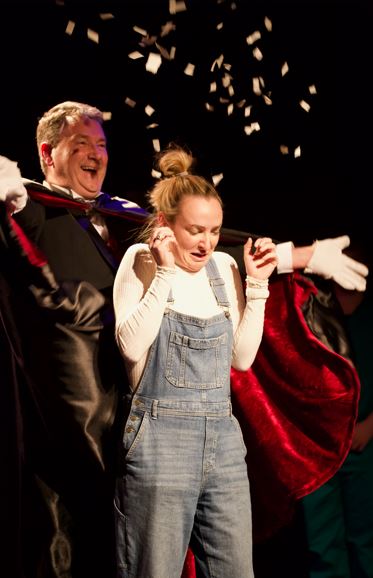
The second play was The Execution Chamber by Arthur Burke. This was a fun concept consisting of a play within a play … within a play. The initial concept appears to be some kind of game show in which a man (Neil Padigan) is condemned to die by the priest (Paul Gallantry). He is strapped to an electric chair, which is then switched on by an alluring but sinister masked executioner (Flora Paulo). The doctor (Emma Kellow) then certifies that he is dead and the ‘show’ is deemed a success. It turns out that he really is dead, and they have to work out what to do about it. It feels as if some of the background and reasoning wasn’t really thought through, but that didn’t detract from the fun, darkly surreal idea.

Again written by Liz Carroll, the third play was The Debt. This featured Brenda Sharpe (Ali Carroll) dismembering a body. I was expecting her opening monologue to explain a little about who she was chopping up and why, but I didn’t really get that. It’s hard to know whether this was a senior moment on my part or if anyone else felt that too, but it wasn’t helped by the fact that neither Ali Carroll, nor Pixie Nash who played the Police Sergeant managed to bring much life into the characters. I know they can do better.

After the interval we were treated to three more plays. The first of these was Lump by Melanie Roan, which explored the impact of the discovery of a breast lump by a woman (Emily Browne) on her life and attitude. Interestingly the ‘lump’ had its own character in the form of Paul Gittus. The woman had lead an ‘exemplary’ life, eating the right things, taking exercise and avoiding any drugs, and so she reacts against the ultimately inevitable chemotherapy. It was good to see the arrogant ‘lump’ getting weaker, in the same way we enjoy the bad guy’s impending demise, although the woman’s attitude to the ‘lump’ wasn’t as hostile as you might expect. This was a reaction to the writer’s real life discovery of a lump, and her awareness of her own mortality, and as such brought authenticity to the play, especially the emotional reaction superimposed on sometimes witty pragmatism. All the actors did justice to this, including Juliet England and Declan Gray, who played both the medical staff and acquaintances of the woman.

Then came Scotty by Phillip Mannion as our fifth play. This featured Kit (Paul Gallantry) and Fancy (Freddie Meader) in a bar, discussing a character called Scotty (whom we never see) and who may not even exist. The language was Shakespearian, but the setting seemed modern. Kit expresses his desire for Fancy, which was not quite what you’d expect of Shakespeare. There were no props apart from a table and chair. The waitress (Donna Collins) had to mime cleaning the table and presenting Kit with a bottle of wine for example, and that didn’t really add to the play. Still, it was said of the director Ali Carroll that she ‘wasn’t afraid of a challenge’, and it was certainly a challenging play.
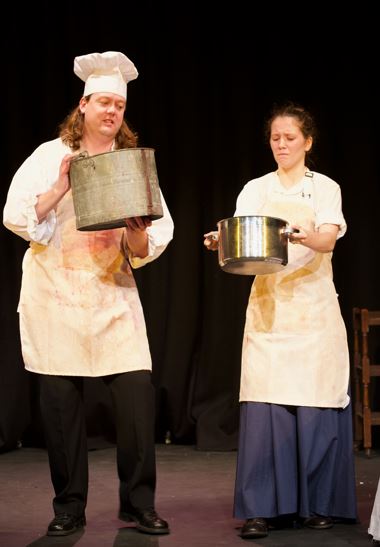
The final play was Pie by Adam Wells. Imagine a Michelin-starred chef, presenting a carefully prepared menu to visiting dignitaries, having his plans disrupted by their demand to present a pie with a couple of human heads in it. There you have it. The chef (Damien Passmore) and the put-upon steward (Imogen Haley) clearly had a lot of fun with this idea and that was infectious. One of the best lines was ‘what wine do you pair it with?!’ A large part of the offstage reaction of the Sommelier (Juliet England) is comically bleeped out, ending with the sound of smashing glass. This was easily the most enjoyable play of the series, and particular credit has to go to Imogen Haley for bringing her role to life.
Nick Swyft, September 2023
Photography by Aidan Moran


 Mark Aspen