
Farm Hall
Moral Dilemmas Exploded
Farm Hall
by Katherine Moar
Theatre Royal Bath and Jermyn Street Theatre Productions at Richmond Theatre until 28th October
Review by Mark Aspen

Theatre has many functions. Comedy makes us laugh; tragedy makes us cry. It can entertain (and the panto season is just around the corner) … or it can make us think.
Farm Hall has a contemplative depth that probably no other live performance art could provide. This is theatre at its best. It is not easy theatre though, and requires an investment by the audience, but an investment that pays handsomely.
Operation Epsilon was a military action towards the end of World War II. The British government detained some of Germany’s most gifted nuclear scientists, who were believed to have worked on Nazi Germany’s atomic weapons development. The scientists, who included three Nobel Prize winners, were captured in southwestern Germany during the late spring of 1945, as part of a larger intelligence mission. They were all interned together at Farm Hall, a former stately home near Godmanchester, then in in Huntingdonshire, from July that year until early in 1946.
Farm Hall, which had previous been used for MI6 operations, was comprehensively bugged and used the then state of the art surveillance methods. The idea was that by listening to their conversations between them, more information could be obtained than by interrogation. The main aim of this subtle approach was to discover how close Nazi Germany was to constructing an atomic bomb.
Equally subtle is the writing, which remarkably is historian Katherine Moar’s first play, and the sharply incisive and shrewdly perceptive focus of the acclaimed director Stephen Unwin.
Designer Ceci Calf’s set is a single large room, in which dilapidated St James meets faded William Morris. The stately home’s frayed grandeur is perhaps part of the deception. The costumes are spot-on to period, but comment on each character. The lighting and sound design (by Ben Ormerod and John Leonard) is largely understated, a foil to provide big impact at the punctuation points of the action.
The play gathers momentum between these punctuation points, which occur when events change the direction of their conversations and interactions. The action advances in three merging developments. At first, light banter relieves the bored brainpower, but it becomes more pointed as personal animosities surface, and old scores are uprooted, but with gentlemanly restraint. Then comes the shattering news of the dropping of the first atom bomb on Hiroshima and the atmosphere changes, firstly to disbelief that Americans were capable of building the bomb and wondering if the news is false to trick them and then blame-game. Which of them, or of the Nazi authorities caused the delay. Finally, they are given a radio so that they can hear the BBC news announcing the bombing, after which, making of excuses, abject shame or crippling guilt takes over.
Authenticity of these conversations is clear since Moar has taken much of the dialogue verbatim from the translations of the scientists’ actual words.

Unwin’s punctuations are moments of theatrical brilliance. The news of Hiroshima bomb, brought from their British custodian, is greeted with horror. As we hear the sound of the devastation, the protagonists are all frozen in a tableau, petrified in the overpowering bright white light of the atomic flash. This tableau is for the interval, and it picks up from that frozen point in the second half. More so, however, is the few minutes leading up to the BBC Home Service later confirming their fears about Hiroshima, which masterfully creates an atmosphere of palpable tension. Silence is pierced by Diebner, one of the scientists, counting down the minutes to the nine o’clock news, with Teutonic efficiency, as the others, stiff with anticipation add the occasional word. It is nail-biting.
The acting is unimpeachable, and all the actors achieve a concentrated intensity, yet worn lightly. Each of the six scientists has a quite distinctive character. They could be considered as pairs on the basis of their age, Von Laue and Hahn are 66, Heisenberg and Diebner are in their forties, and Weizsäcker and Bagge are both 33 years old. Yet each of the pair are very deferent in outlook, views and temperament.

Prof. Max von Laue received the 1914 Nobel Prize in Physics for his work on X-ray diffraction in crystals. He was a vociferous and courageous opponent of Nazism, but studied special relativity in Berlin during the war. William Chubb gives a nuanced performance as von Laue, as a principled and thoughtful man and respected colleague. Otto Hahn is known as the father of nuclear chemistry, for which he awarded the 1944 Nobel Prize in Chemistry, whilst interned at Farm Hall, for his discovery of the fission of heavy nuclei. Von Laue and Hahn were friends and both hated Nazism, but loved Germany, and both had been instrumental in protecting Jewish colleagues, including Teller, Fermi and Einstein, at considerable personal risk. Forbes Masson plays Hahn as a friendly easy-going man, one who takes practical steps the whole time to make the lives of his fellow internees as comfortable as he can. Masson depicts the rapid emotion journey of Hahn from cheerful and optimistic to guilt-racked as he learns of the fate of Hiroshima. He believes that his discovery of nuclear fission has led to these terrible consequences. So abject becomes his guilt, that he contemplates suicide.
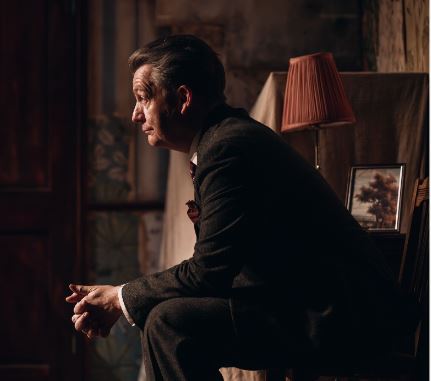
Most famous of the group today is Werner Heisenberg, largely for his Uncertainty Principle, which he published in 1927. He too was awarded the Nobel Prize in Physics, in 1932 for the creation of quantum mechanics. Heisenberg was regarded with some suspicion as he was well-connected. He had figuratively crossed swords with Himmler, but his mother and Himmler’s mother knew each other well, and he was exonerated. He had become the principal scientist in the Uranvereinprojekt, the nuclear weapons programme during the war, and was ipso facto the leader of the group in Farm Hall. Alan Cox plays Heisenberg as urbane, erudite and refined, a man who could just as easily play Schubert on the piano (Hahn had wheedled a decrepit one, which he had repaired for their use) as undertake complex calculations ab initio on quantum mechanics in hour or so.
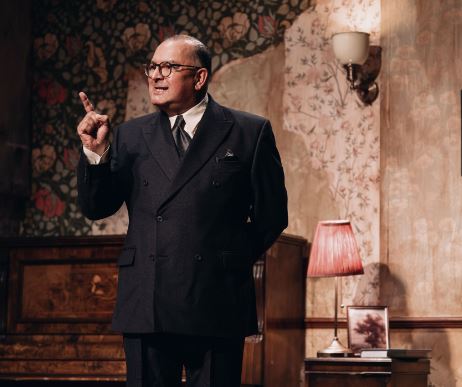
Kurt Diebner is the outsider of the group. He was a nuclear physicist who became the administrative and planning director of the Uranverein, when the nuclear research was put under military control. The marked barely disguised acrimony to Heisenberg, at a professional, personal and academic level is clear in the play. Diebner was a member of the Nazi party, but whether he believed in it or was coerced is not obvious. Julius D’Silva, in this role, plays Diebner as a stiff, humourless stickler. His body language speaks volumes; he almost always stands and then almost to attention; his suit is never unbuttoned.
Mutual animosity also extends to the relationship between Diebner and von Weizsäcker.
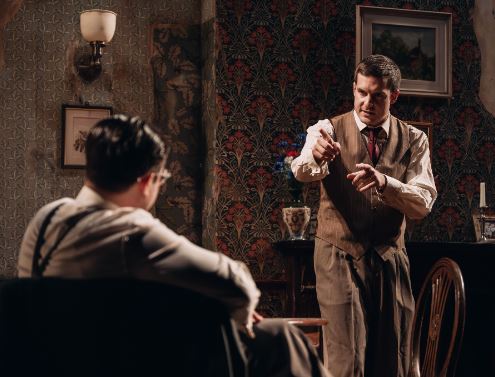
Carl von Weizsäcker was also well-connected, a scion of a prominent aristocratic family. (His younger brother later became the President of Germany.) He was an astrophysicist and his discoveries regarding nuclear processes in the sun, and was academically a protégé of Heisenberg’s. Weizsäcker realised the possibility of producing vast amounts of energy from refined uranium by nuclear processes, and he was ambitious to discover experimentally if nuclear chain reactions were sustainable. Daniel Boyd portrays Weizsäcker as bright and intelligent young man, but a man of integrity, who acts as mediator in their more heated discussions. Weizsäcker argues that they could claim that they had never wanted to develop a nuclear weapon. As others pointed out though, they were never allocated the necessary resources (in contrast, as they hear on the radio, to the American project) because the German war economy had other priorities. Weizsäcker talks of a “uranium engine”, a peaceful use of nuclear power.

The sixth scientist, Dr Erich Bagge had been a student under Heisenberg. Bagge’s expertise was in developing processes to enrich uranium using gas centrifuges. He admits to joining the Nazi party, as if he didn’t his academic career would be in jeopardy, for he was in his early twenties when the Nazis came to power. George Jones plays Bagge as light-hearted and somewhat vain. He puts over a sense of relief that he is no longer in Germany under a tyrannous yoke. Jones has a heart-rending scene when he discovers that his wife is in the Soviet zone, anticipating they will be separated, she under the yoke of an even worse regime, and he as an ex-Nazi party member unable to join her. All the members of the group are concerned about their wives and families, but the others’ are in the British or American zones.
All wonder whether they will be allowed to return to Germany and discuss the alternatives. The options rise to the surface in some of the lighter moments. When they are first interned, they are bored and restless. You see, in spite of the heavy discussions on physics, politics and ethics, moments of humour shine thorough. They find a copy of Noël Coward’s Blithe Spirit and begin to act it out. Bagge wonders if he could play Elvira and they rag Diebner, but all are incredulous that this play premièred in wartime. Weizsäcker, prefers the American approach of the Westerns and acts out the Ringo Kid in Stagecoach. When they self-censor their letters home to prevent them being redacted later, there are plenty of quips about the English way of life.
As the play progresses, though, the tone becomes increasingly serious as the enormity of what their work has led to, becomes an horrific reality. When the news of the atom bomb is released to them, they cannot believe that this is not a trick to trap them. The Americans, even with British help, could not have the expertise. Then begins the what-ifs. Their opposition to, or collusion with the Nazis could weigh seriously against them. All have been compromised by the pragmatic necessity to go along with the party line, and they are painfully conscious of this. Bagge in particular is ashamed, but it meant his job, his family, his career, his reputation. Suddenly, the relevance to today comes into sharp focus when academics can be “cancelled” for not believing what they know to be patently untrue. Toe the line, no dissent from the newspeak, or profession, reputation, career, a life’s work, can be summarily destroyed.
Then comes the confirmation, via the BBC news broadcast, that many thousands of lives have been destroyed at Hiroshima. These men have the knowledge to work out the effect of the atom bomb explosion and tell each other, but Hahn cannot take the sheer horror of all this and rushes away to vomit. The discussion of the morality of what has happened weighs heavily on them all. Their quest for knowledge has had such evil consequences, and although they are not directly responsible, guilt overwhelms them. Again the relevance to today comes into sharp focus, with events in the Ukraine and the Middle East causing so much suffering to all.
Farm Hall is essentially an examination of moral dilemmas. But there is much more than that. The six scientists are three-dimensional characters, with strengths and weaknesses. Stephen Unwin and his six outstanding actors give so much insight into the complexities of coming to terms with those moral dilemmas. The recent film, Oppenheimer, looks at the people who made the bomb, but solely from the American point of view, and Frayn’s 1998 play Copenhagen, examines Heisenberg’s wartime meeting with Niels Bohr; but both seem superficial in comparison.
Here is play, relevant to today’s ethically inverted world, with moral profundity and intellectual sinew. Farm Hall is totally engaging, and demands that engagement. If there is one play to see this year, this is it.
Mark Aspen, October 2023
Photography by Alex Brenner


 Mark Aspen
Trackbacks & Pingbacks