
The Creation
Perfect World
The Creation
by Joseph Haydn, libretto by Gottfried van Swieten
Glyndebourne Productions at Glyndebourne Festival Theatre until 15th December
Review by Mark Aspen

One of the joys of visiting any of our national art collections is to stand in a gallery and immerse oneself in vast Old Master canvasses depicting the Garden of Eden, the world of the earliest part of the Book of Genesis, by say by one of the Brueghels, probably Jan, or Rubens, or Cranach. The more you look, the more you see; and the more you see the more you feel.
(Of course nowadays, your pleasure may be interrupted by a destructive and pitifully ill-informed protester; a fate that even, ironically, environmental aware Glyndebourne has suffered.)
Haydn’s oratorio, The Creation is the musical equivalent of these canvasses, a work of art that bears listening to again and again; for the more you listen, the more you hear; and the more you hear the more you feel. Regretfully, there are just two opportunities to hear Glyndebourne’s wonder-filled presentation of Haydn’s 1799 masterpiece this year, while it runs in parallel with another pre-eminent oratorio, Handel’s Messiah, as part of its Autumn Season.
Orchestra, chorus and solo voices paint in music just as vivid and detailed a picture as the old master’s oils, in as rich and even more powerful description of the first six days of God’s creation of the World, and then of the creation of mankind, as related in first two chapters of Genesis. It is all there in Haydn’s The Creation, the account of the primordial formation of all there is, beautifully illustrated in the music.
Moreover, it is all remarkably upbeat, for The Creation finishes its narrative before Satan, via the serpent and the apple, mars the world’s perfection. We are in a perfect prelapsarian realm of peerless innocence.
One gets the impression that Haydn was an upbeat sort of chap, and that’s why he left the story here on such a positive note. Not long after The Creation’s London premiere at Covent Garden in 1800, Haydn wrote that he hoped his audiences: “… will for a while derive peace and refreshment” from the work. It was a sentiment very much aligned with the zeitgeist of the Age of Enlightenment.

The libretto is derived from the King James Version of Genesis and the Psalms, with inspiration from John Milton’s Paradise Lost. The Austrian diplomat and music patron Baron Gottfried van Swieten developed the libretto, batting is back and forth in translations between English and German according to its production venue at the time. The robust directness of the Bible and of Milton are however retained, and this give the libretto much of its charm. The only material used is that prior to the Fall of Adam, hence its optimistic ambience and general feel-good nature.
The feel-good factor clearly permeates the performers in their animated delivery. With the orchestra in full view, one can see the how much leader, Richard Milone and the musicians are enjoying the work, in their dynamic body language and the music’s spirited attack. Conductor James Henshaw brings out all the brightness, lightness and fleetness of the work from the Glyndebourne Sinfonia and all the singers.
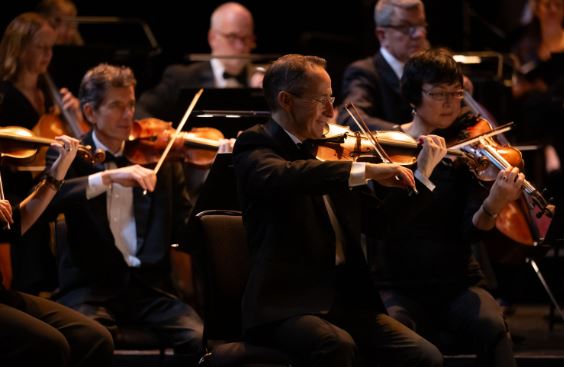
Up behind the orchestra, the chorus are seen in front of the cyclorama, which is lit in colour washes that hint at the themes of the oratorio. This is in three major Parts; firstly, light overcoming chaos, the creation of the universe and the heavenly bodies, and of the earth, its waters and its land with plant life. The second Part tells of the coming of animal life, culminating in man and woman. The final Part describes the bliss of Adam and Eve in the sublimity of the Garden of Eden. The cyclorama colours change from reds and yellows, to blues and greens, and to white and gold.

During the first two Parts, three archangels Gabriel, Uriel and Raphael tell of the sequential days of God’s creation in the voices of the soprano, tenor and bass soloists respectively. The chorus represents the heavenly host, angels who triumphantly punctuate the oratorio in epic songs of praise, many based on the Psalms, celebrating each of the six days of creation. The Glyndebourne Chorus, directed by Aidan Oliver, is magnificent and majestic in its own right and forms a rich foil to the soloists.
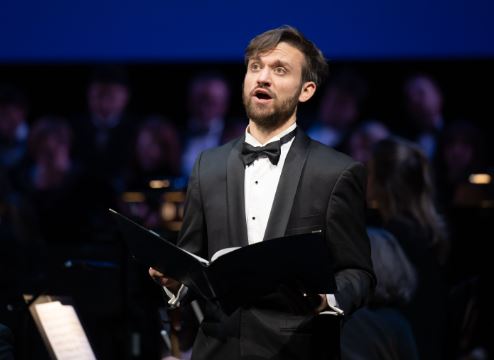
Against the continuo of harpsichord and cello (Matthew Fletcher and Jonathan Tunnell) the instruments set the scene and depict the action in descriptive tone painting. The opening Representation of Chaos before the beginning of time has a sense of unease almost anticipating a style that was to come two centuries after Haydn’s composition. With the sudden sensational fortissimo C major chord, as God creates light, this is surely amongst the most spectacular soundscapes in music. Does this chord depict what we now know as the Big Bang?
The orchestral pictures of other forms of light are further described by Uriel and acclaimed recitalist Hugo Hymas’s precise ringing tenor makes the most of the wonderful words; the moonrise, “steps on the silver moon through silent night”; and the brittle aventurine starlight with its “numerous hosts of radiant orbs”.
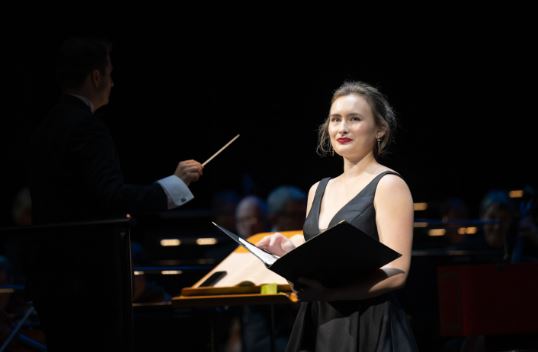
The appearance of life comes first as verdurous grasses and then the full range of flora. Gabriel tells that “here fragrant herbs their odours shed, here shoots the healing plant”. Australian soprano Cleo Lee-McGowan beautifully decorates the descriptions with thrilling athletic coloratura. This is consummately effective in the later descriptions of the creation of the birds, the eagle that “cleaves the air”, the “merry lark”, the “tender dove”, pictures accurately painted by deft instrumental playing and lifting soprano voice. “The nightingale’s delightful notes” echo between a trio of flutes and Lee-McGowan’s coloratura. The libretto remarks of the nightingale that “no grief affected yet her breast”, so definitely no hint of the “plaintive anthem” that famously Keats point out.
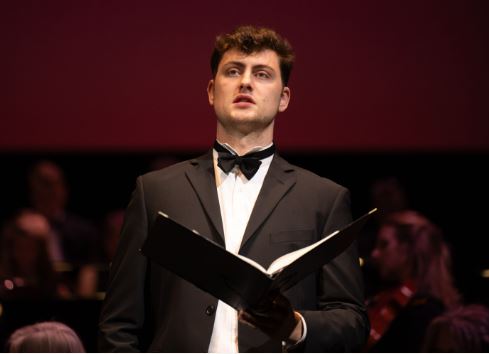
The bigger creatures, ultimately such as whales, are described by woodwind and percussion, including the contrabassoon for “the heavy beasts”, and the rich resonant voice of the prize-winning bass William Thomas as Raphael. However, Raphael also gets the other end of the scale, the “unnumbered … hosts of insects”. The buzzing swarms infest the string section and it is fascinating to see all those hyper-busy bows working away. Thomas picks up the moment with a laconic flick of the eyebrow, and then immediately has the lugubrious description, “in long dimension creeps, with sinuous trace, the worm”. One can almost see the worm dropping off the bottom of the staves in the score, as this vermian depiction takes Thomas right to the bottom of the register into basso profundo territory. It is a feat that Thomas accomplishes with aplomb.
These animal portraits are illustrative of Haydn’s keen sense of musical humour, infamous in his time. Best known are in his London symphonies, in the Surprise Symphony (No. 94) and the Clock Symphony (No. 101), where he again uses a startlingly sudden fortissimo chord, in later case just as he has lulled his audience with a tick-tock pendulum swing like a hypnotist’s pocket watch.
Haydn’s menagerie grows with stags and exotic beasts, lions and tigers, and the shoals of fish, described with shimmering chords. But it’s back to Hymas’ triumphant tenor as Uriel recounts God’s magnum opus. “With beauty, courage, strength, adorn’d, erect, with front serene, he stands … a man”. Wow, we do have something to live up to! Woman, “fair and graceful spouse”, doesn’t get quite such a puff. She is “softly smiling”.
The third Part is entirely given over to a paean of the delights of the Garden of Eden. It is parenthesised by Uriel, but the body of the Part is told by Adam and Eve, and Thomas and
Lee-McGowan pick up these roles. Uriel sets the scene of a spring dawn, “in rosy mantle appears, by music sweet awak’d, the morning, young and fair”. Adam and Eve, blissfully together, send a prayer to God, that is lyrical both in its poetry and song. With the sentiments echoed and expanded by the chorus, this is a wonderfully swelling and uplifting section.
It seems a pity that the production is an oratorio and not a staged work, as Thomas and Lee-McGowan show us the chemistry between Adam and Eve, and a straining to act it out. This is more so in the ensuing passages, which are effectively a love duet between Adam and Eve. Here we have the perfect marriage, literally one made in heaven. (It probably however would not chime with some 21st Century views on marriage. Eve pledges, “thy will is law to me”. This Paulian emphasis would not sit well with modern notions of equality.)
Adam and Eve, though, are in a state of rapturous contentment. Together they sing, “with thee is life incessant bliss”. It is a beautiful, exciting and uplifting passage.
The realist in in one thins there must be a big “BUT” coming up, but there isn’t. Uriel does hint though at the coming Fall, urging them to not “more desire to know than know ye should”. It is the only intimation that the perfect new world they find themselves in could be fragile. The final ensemble piece with all the singers and the full chorus, is a stately, broad, and magnificent crescendo of praises to God.
Glyndebourne’s The Creation is a wonderfully positive piece, an antidote to today’s ills, when the news suggests that mankind is nothing but a scourge on the Earth. Here, we can count our blessings, reflect on the good in the world, and muse that, but for that serpent, it could all be better.
Just the thing for a dank November, The Creation brightens the spirit and lifts the soul.
Mark Aspen, November 2023
Photography ©Glyndebourne Productions Ltd. Photography by ASH

 Mark Aspen
Trackbacks & Pingbacks