
The Signalman
Cutting Drama
The Signalman
by Charles Dickens, dramatised by Jennie-Mae James
Mudlark Creativeat Drayton Arms Theatre, South Kensington until 2ndJanuary 2026
Review by Harry Zimmerman
We are in the middle of peak season for two forms of theatre, both very different but hugely popular. The first, of course, is pantomime. The second feeds in to our love of a creepy ghost story to while away the long winter nights and inject a frisson of fear into our festive gatherings.

Mudlark Creative have chosen as their seasonal offering Charles Dickens’s The Signalman, a well-known eerie tale which has been featured regularly in film, radio and on stage as a contribution to the Christmas supernatural canon. One of the most famous adaptations was in 1976 as part of the much-loved BBC series A Ghost Story for Christmas, with Denholm Elliott in the eponymous role. A wider UK national tour of the piece is also currently taking place. The appeal of the ghost story remains undiminished.
Written in 1866, following the trauma of a railway crash which Dickens personally experienced, this is a short, unsettling tale of a lonely railway signalman haunted by visions of impending disaster on his isolated stretch of line. Can a well-meaning traveller, who chances upon the lonely signal box while out walking, calm the man’s fears before he spirals into mental self-destruction?
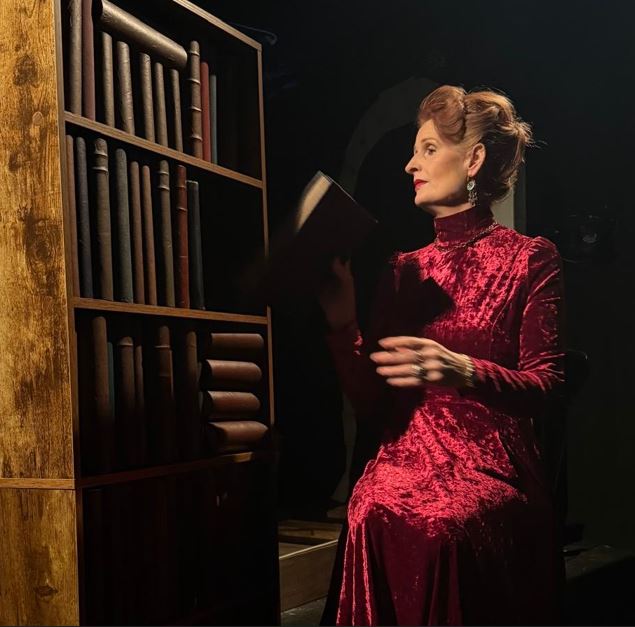
The intensity of this story lies essentially in its ambiguity, as many questions are open to interpretation.
As the relationship between the curious, unnamed traveller, (who serves as the eyes and ears of the audience), and the increasingly disturbed signalman develops, the question of whether something physically or psychologically supernatural is playing out hangs in the air until the shocking and startling denouement at the very end.
As an audience, we are privy to all of these unsettling occurrences, leaving a feeling of unease and disquiet throughout. Do we believe what we are seeing and hearing? Are these weird, unearthly incidents actually happening? What does it all mean?
Through a combination of monologue and memory, the play transforms into not merely a ghost story, but an exploration of the nature of fear, guilt, and isolation. Spectres all too real to the tormented custodian of this isolated stretch of railway. The suggestion throughout is that rational and scientific explanations may not, in this case, be sufficient to explain what the troubled signalman is experiencing.
This adaption plunges audiences into the Clayton Signal Box, a forgotten railway cutting where isolation and a palpable sense of foreboding hangs thick in the air and, perhaps, something is watching from the shadows….
“For God’s Sake, Clear the Way!”
Clearly, a lot of work has gone into the staging of this production. Karen Holley’s set is exquisitely designed, with a stretch of railway track, complete with crunchy gravel and, at one side of the stage, a dark tunnel entrance being marked with a forbidding red stop light.
The set has a three-dimensional aspect, with the back of the performing space transformed into the cosy sitting room with armchair, gramophone and railway clock where the Visitor and Signalman talk. On the side is a recreation of the signal box itself, all bells, levers, telephones and fire buckets.
Steve Ramondt’s soundscape is similarly impressive. Birdsong and wind mingle with a “sound surround” recreation of passing trains thundering down the track. A rockfall punctuates one stage of the narrative. These impressive effects are held together by appropriately brooding musical bursts. The whole of the intimate space within the theatre is used, especially where The Visitor climbs to the top level of the auditorium seating to create the sense of a vertiginous railway embankment from which she descends to greet the Signalman.
In an interview, director-producer Jennie-Mae James describes her wish to fully immerse the audience in the action: “I want people to feel like they’re actually sitting in the railway cutting as the events unfold around them…”
In this respect, the production succeeds admirably. Transitions are seamless and help the narrative move along, whether that be switching a bookcase around to recreate a hotel lounge, or the adroit use of the stage manager, (alternately played by Natalie Romero and Nyah Felix) to become part of the action at appropriate times.
The use of a dramatic stage trope taken from The Woman in Black is chillingly effective.
The attention to detail underpinning the play extends to the well-researched and amusingly informative programme.
The Signalman, essentially, is a two-hander, with everything resting upon the believability of the relationship and burgeoning affinity between The Visitor and The Signalman
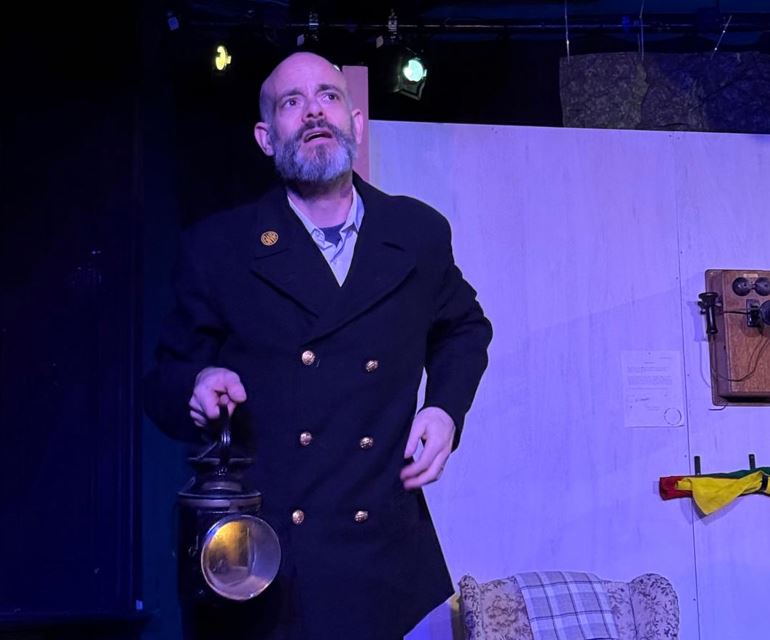
Peter Rae gives us a thoughtful, nuanced portrayal of The Signalman; a cautious, watchful man bowed down by fear. Rae skilfully tracks his descent into an escalating uneasy discomfiture, apprehension and dread. His initial mild, almost endearing, reserve gradually gives way to something far more chilling, an inner unravelling portrayed with an honesty that draws the audience into his increasingly suspicious and anxiety ridden discomposure.
There is the occasional lapse into overloud declamations of fear at key moments of the narrative which could be toned down, but otherwise this is a powerful creation of a man on the edge of mental disintegration as the narrative progresses.
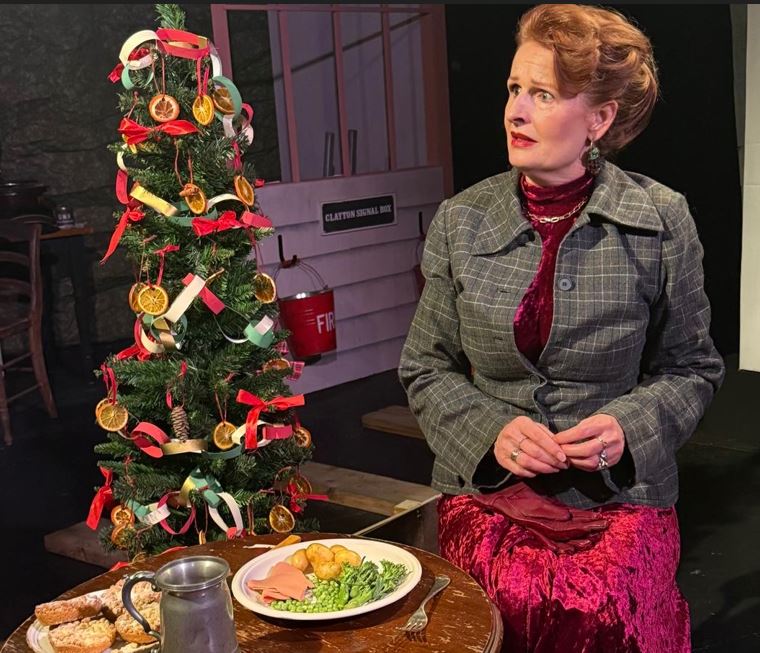
Helen Bang is the steady-handed, sensible ballast in the relationship between the two protagonists. She moves from studied politeness to a genuine interest in the trials and tribulations of her new friend as they converse, and this helps drive the plot. However, there is a curious lack of warmth on her part as the story progresses, which inhibits the evolution of their connection, meaning that her reaction to the final climatic horror is somewhat muted. The stiff upper lip is maintained assiduously throughout, possibly too much.
There is a lot to admire in this production, but it does struggle to overcome one self-inflicted structural defect, namely the existence of an interval.
The play is around 65 minutes long, and the insertion of a break after half an hour serves only to dilute the dramatic thrust of the narrative, providing significant challenges for the actors to recreate the growing sense of fear, doubt and unease which they had assiduously sought to build over the first half of the tale.
Running the play over a 70 minute duration without an interval would have given the actors the time needed to relax into the piece and create a continuous narrative structure that would have helped them build up the tension and disquiet in a more measured way, enhancing the disturbing foreboding which is fundamental to the power and effectiveness of the piece. This is a production that needs no break. Let it brew and let it stew, so that the shattering horror of the denouement is given full exposure.
Nevertheless, Mudlark’s production of The Signalman goes a long way to capture the icy chill of this quintessentially classic ghost story with a fresh inventiveness that is perfect for a dark, winter’s evening.
Harry Zimmerman, December 2025
Photography by Victoria Lari


