
The Sweet Science of Bruising
Hitting Home
The Sweet Science of Bruising
by Joy Davidson
The Questors Theatre at the Questors Studio, Ealing until 2nd May
Review by Alex Tustin
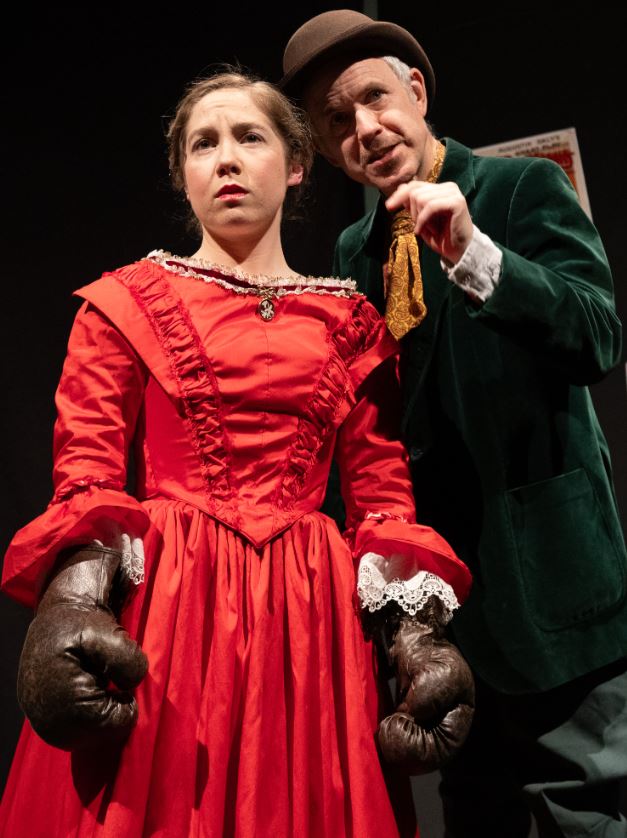
I was somewhat surprised to learn that women’s boxing was not included in the Olympic Games until London 2012. It must have been one of the last sports to reach gender parity. It had taken a long time to be accepted. The Sweet Science of Bruising takes us right back to its earliest days and is set in 1876 in Victorian London. And although the play professes to be about female competitive boxing it is actually about so much more than that.
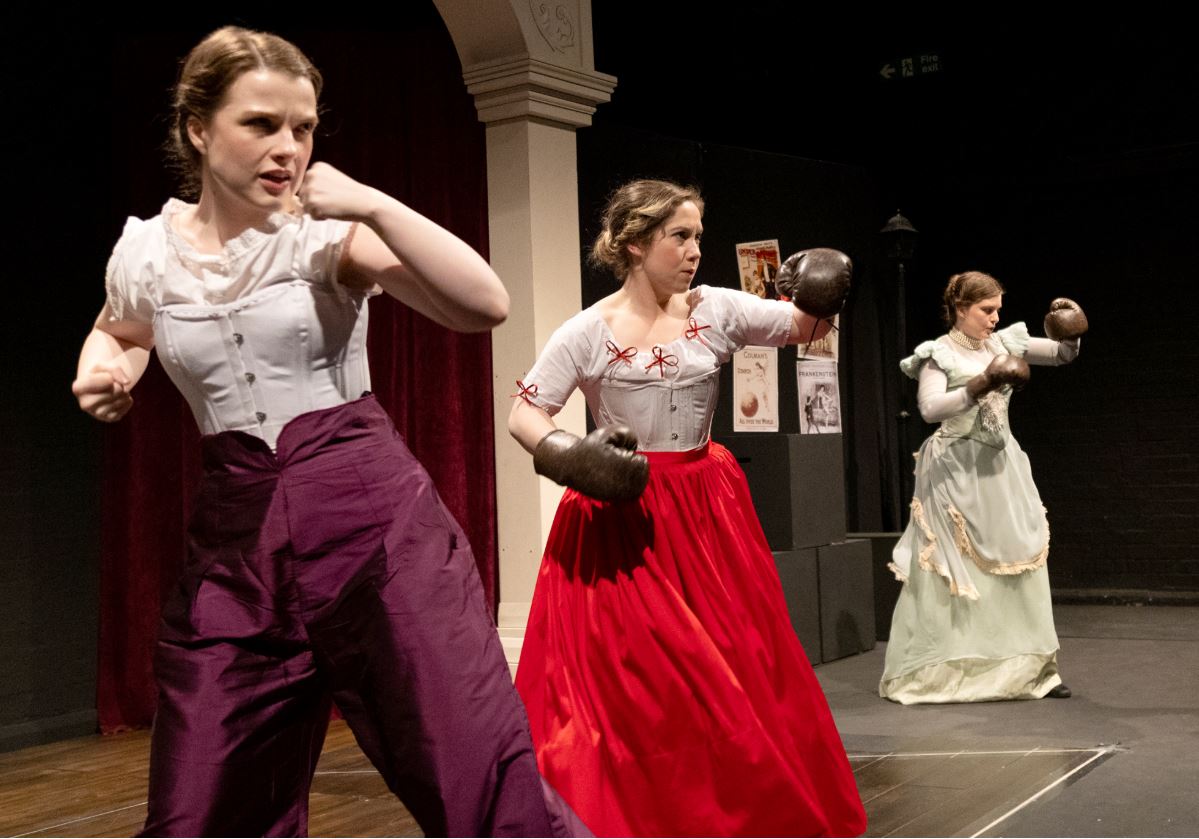
It centres around four women who take up boxing for very different reasons and, initially, with different levels of enthusiasm: Matilda Blackwell (a well judged performance by Leah Serens) sees it as a way of escaping from the drudgery of prostitution and an uncertain income; Violet Hunter (brightly played by Hannah Rosamund) perhaps as a way of funding herself through medical school (another profession forbidden to women at the time); Anna Lamb (a sympathetic performance by Isabella Cottrell Kirby), if only she could learn to fight back she could see her way out of a life of control and domestic abuse; and finally the talented if wild Polly Stokes (assuredly played by Fionna Gough) the real fighter, born to box as an end in itself but also as a way of proving herself to the man she has grown up with and whom she counts as her brother. They are all protegees of self styled promoter, Charlie Sharp (Lawrence McGrandles Jr), an ex boxer himself, who also has an interest in the ‘science’ of boxing and a curiosity in seeing women take part.
But despite this platform for the play, Sweet Science of Bruising digs much deeper. It reminds us how little choice women had over their lives 150 years ago, and about control, disempowerment and a search, amidst this, for identity. Indeed there are references to early women’s suffrage and I wonder if Joy Davidson, the playwright, bases her character, Emily (Emily Sanctury), who chooses a more political direction to find a collective female identity, is loosely based on Emily Davidson. (This actually can’t be a real character as Emily Davidson was barely a toddler at the time but it’s a nice reference.)
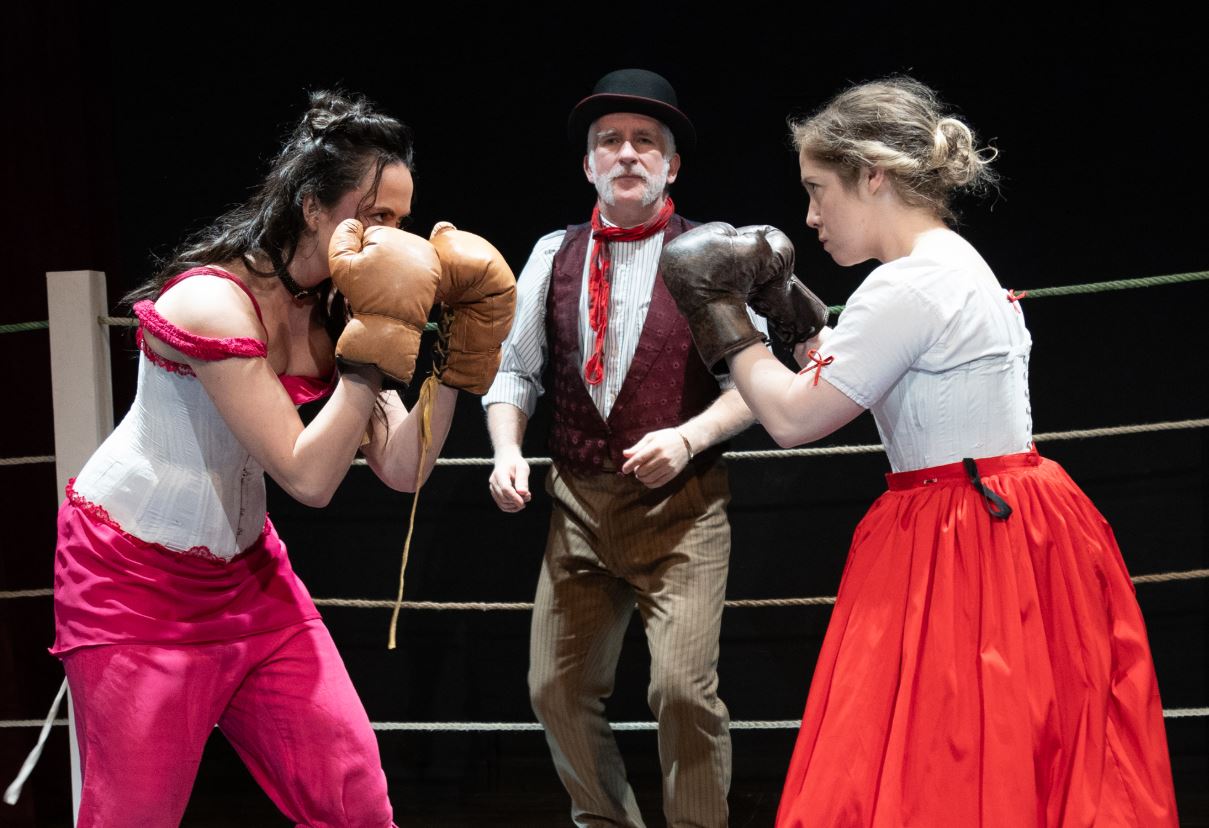
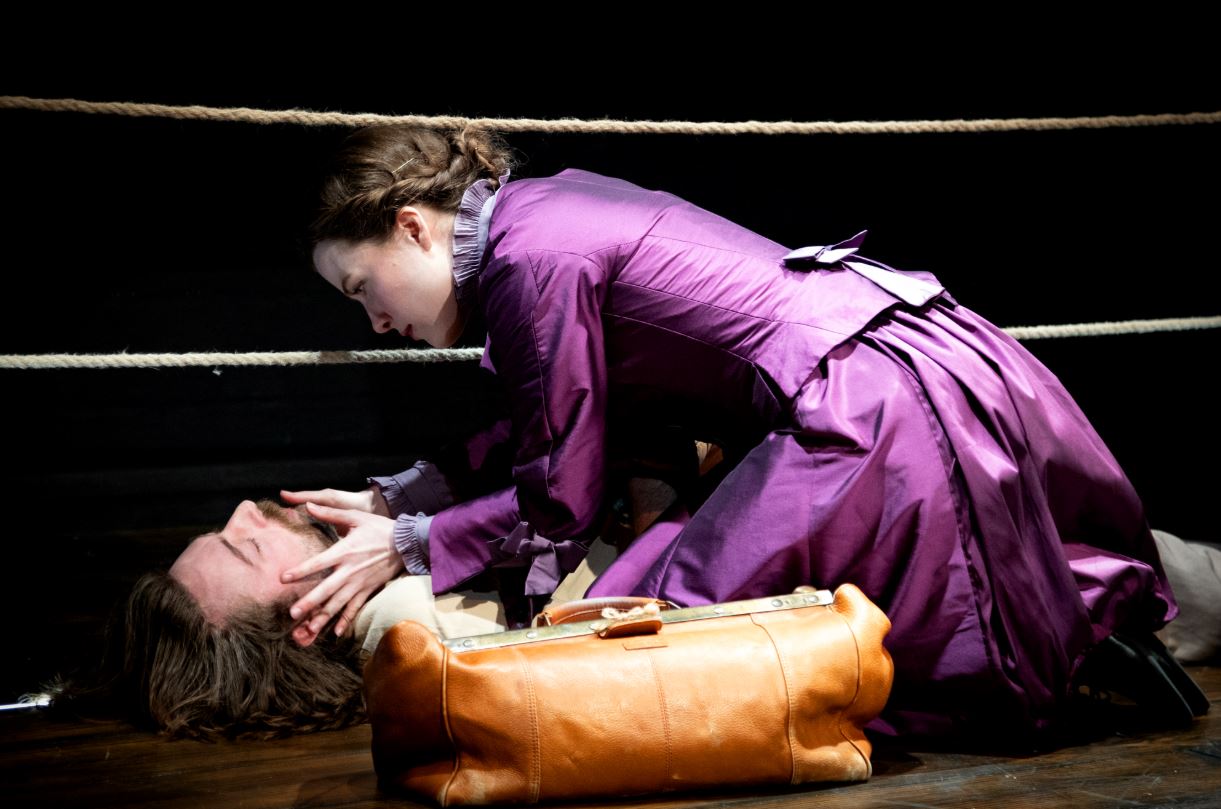
The first half of The Sweet Science of Bruising introduces us to the main protagonists and the attitudes of the time from various perspectives. The boxing doesn’t really come into its own until the second half; and when it does the script suggests it isn’t always successful. It is certainly seen more as a spectacle rather than necessarily requiring any degree of sporting prowess. Injuries, to both men and women are inevitable and the ‘fitness’ (or lack) of women to box is questioned from many sides. Judgement is rife and I was chilled by the oft repeated line ‘see what happens if you don’t keep the little ladies in check’. Indeed the women’s wish to fight is frequently seen as a mental disorder and the most shocking scene is the performance of a clitoridectomy as a way of ‘curing’ this. This difficult scene was well staged, though I wanted a scream of despair and pain.
In fact I think one of the challenges of the play is the need to maintain momentum through the many episodic scenes of all of these women’s stories as they gradually unravel. And, a fault of the play, not the production I would add, is there doesn’t seem to be enough jeopardy or tension. We care about all the women’s stories and when they are pitted against each other in the ring somehow or another the tension isn’t quite there.
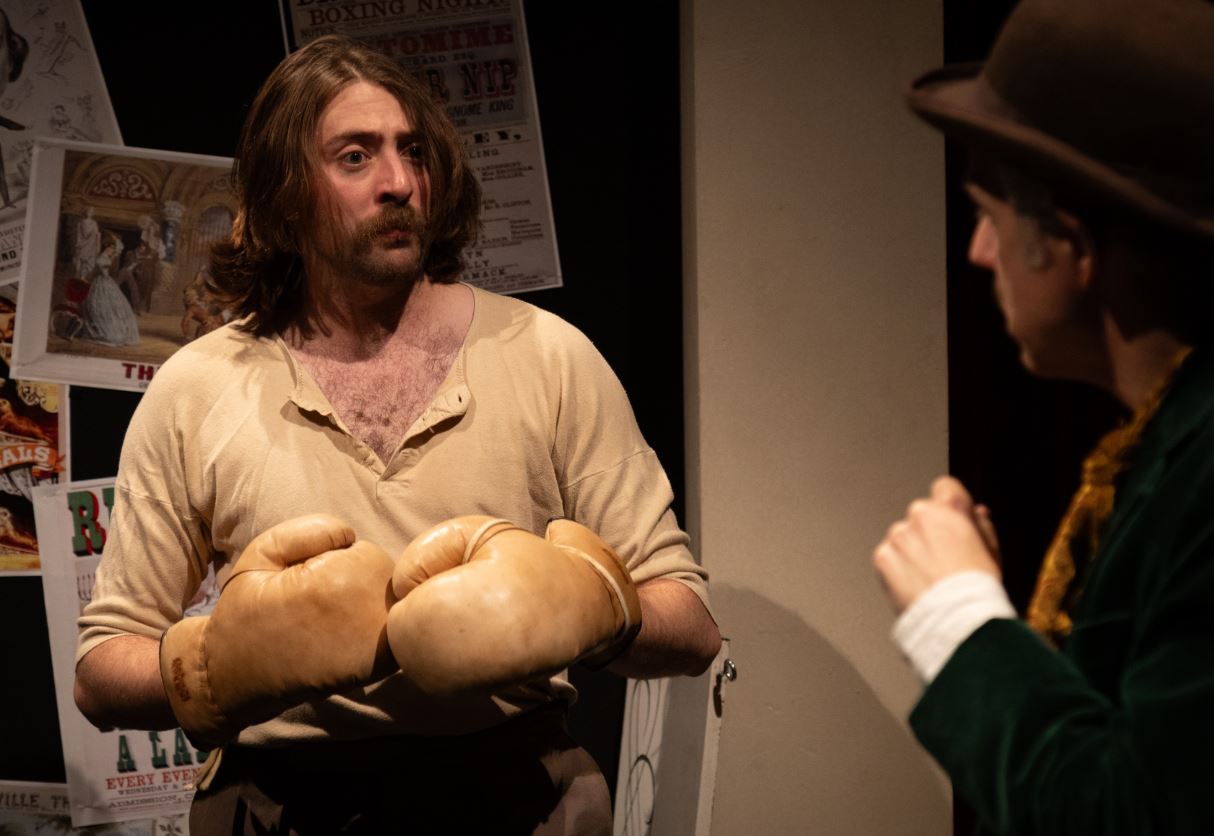
That said it needs to be well judged with a genuine honesty and I think Questors’ production, under the original and creative eye of director Becky Hartnup, did everything it could do overcome this and offered a visual and pacey show. There was an immersive feel and the ringside seats added to this, although they weren’t always that popular among the audience!! A truly ensemble cast bought the story together and there was sympathetic characterisation throughout. Fionna Gough, as Polly Stokes, led the boxers with a spirited and energetic performance, and an understated mischievous humour, whose genuine love of the fight for its own sake was always clear. Lawrence McGrandles Jr had a nice mix of authority and vulnerability as Charlie Sharp, promoter and mentor to all the women.
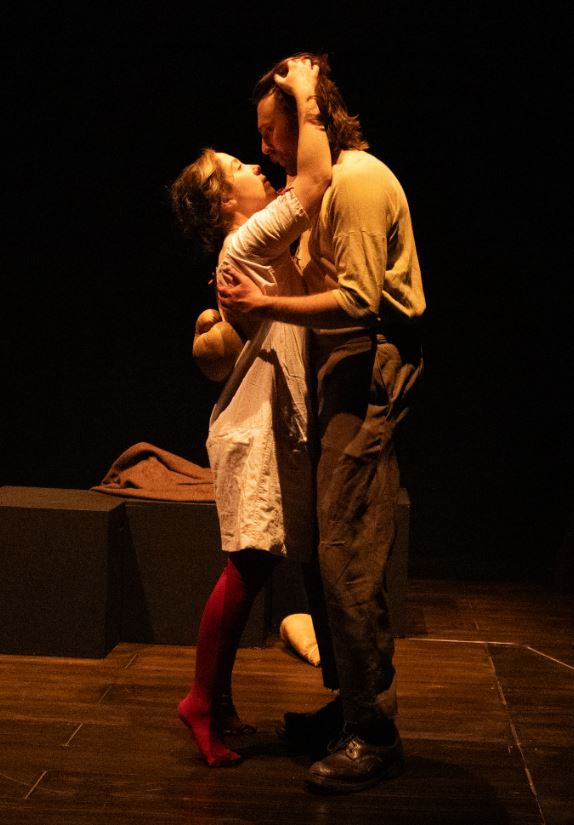
In an episodic play of this nature you cannot do too much with a realistic set, so several wooden blocks were deftly moved around to act as chairs, tables and provide different levels on stage. Indeed I think this was used to good effect to provide depth to essentially a long narrow playing area. It gave a real extra dimension to have the women use this as an aspiration towards power and independence. Questors always seems to excel with period costumes and, led by Nel Wilson, this production was no exception, with a colourful and authentic Victorian array. I could really see the poor women stepping into the ring with a mixture of corsets, bodices and hooped skirts! A largely original score by James Connor built up the atmosphere of the tense calm before the fight. Almost too unobtrusive at times; there could at points have been a little more volume. And last but not least, Catherine Luff, as fight director, led some realistic and gritty boxing. Despite the small space and the proximity to the audience it always felt spontaneous and (importantly) safe.
So my congratulations to Becky Hartnup and her cast and crew for recreating this dark underworld of Victorian London in a visual and thought provoking production.
Alex Tustin, April 2026
Photography by Carla Marker


