
Krapp’s Last Tape
Reel-to-Real
Krapp’s Last Tape
by Samuel Beckett
Godot’s To-do List
by Leo Simpe-Asante
The English Stage Company at The Royal Court Theatre, Chelsea until 30th May
Review by Patrick Shorrock
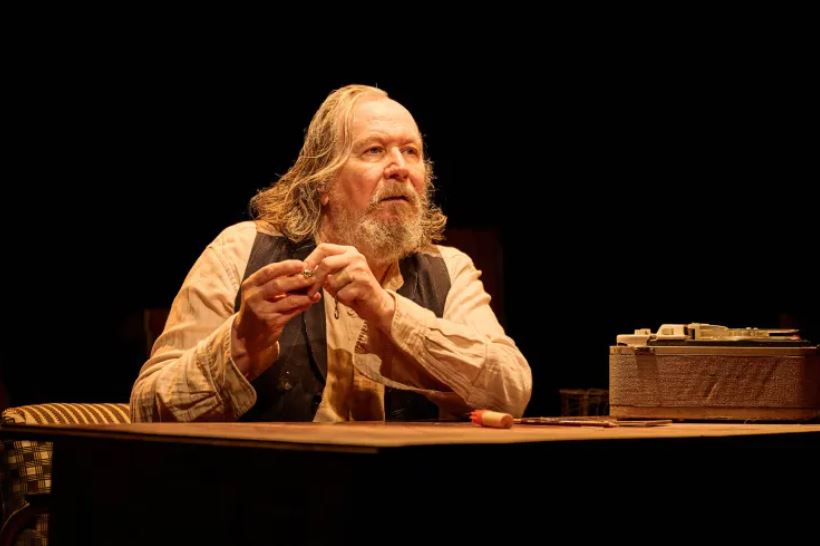
It’s quite a shock to realise that the plays of someone as implacably avant garde as Samuel Beckett are old enough to have been subject to the censorship of the Lord Chamberlain. It’s worth remembering that the Lord Chamberlain, an official of the monarch, used to have power to demand cuts in any publicly performed play until 1968.
For all that Krapp’s Last Tape had its premiere in 1958, it has not lost its modernist edge. Nevertheless, it does give away its age, from time to time, not least in its use of spools of reel-to-reel tape rather than cassettes, let alone something entirely digital. Whilst the Lord Chamberlain expressed concern about the sexual language in the 1950’s, the only trigger warning deemed necessary today is about sudden loud noise.
The long silent opening, during which Krapp very slowly eats three bananas, remains provocative, while generating uneasy laughter of a suitably Beckettian kind, but doesn’t seem to join well with the later angst.
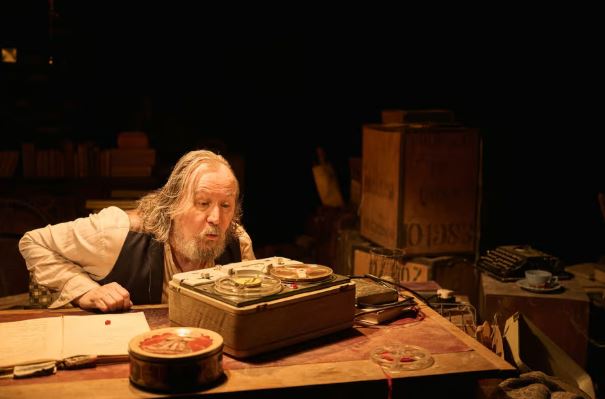
The play is less of a monologue and more of a duet between a man and his past selves, as preserved on tape, and the way that time gives a new, not necessarily welcome or encouraging, perspective. There are suggestions that loneliness and isolation have left Krapp with nothing better to do with his time. The play perhaps privileges the interpreting and assessing of experience over the experience itself. But this is not entirely unexpected with Beckett, who can seem to lend himself better to being analysed and written about than experienced live in the theatre.
The image of a man listening to his earlier self is certainly a very resonant one and an interesting anticipation, in some ways, of the experience of looking at Facebook memories. But Facebook is more about curating memories to generate a reaction from others, whereas Krapp is analysing his tapes entirely for his own purposes and is in danger of disappearing into his own solipsistic black-hole.
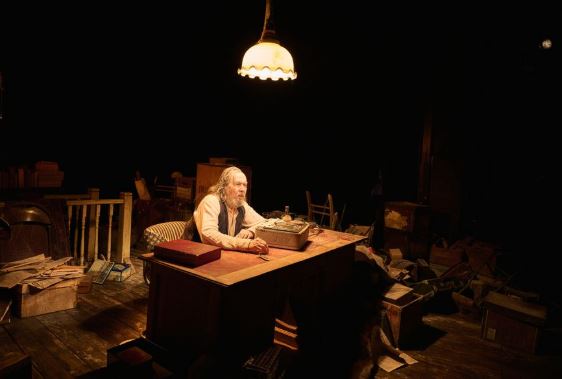
Gary Oldman directs, designs, and plays the piece with great subtlety, in a way that injects as much dramatic charge into it as it can take, without ever overloading it. He is much aided by both Malcolm Rippeth’s sensitive lighting and a sense of isolation produced by his own set: a vast amount of clutter — books, tea chests, boxes — accumulated over a long life. Similarities with Oldman’s most famous character, Jackson Lamb in Slow Horses, include a smoker’s cough and a tendency to drink whisky straight from the bottle. But more remarkable are the differences: this is the body language of another person altogether, physically more robust, but emotionally more distraught, and overcome with self-hatred. It’s a masterclass in creating a distinct character through gesture, movement, as well as speech. Oldman, with apparent effortlessness, manages the paradoxical achievement of communicating isolation and loneliness to an audience that the character is always entirely unaware of.
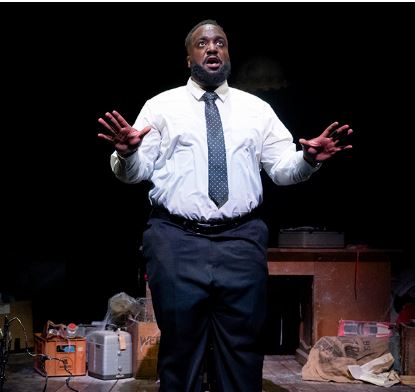
The teenage Leo Simpe-Asante’s Godot’s To-do List provides an entertaining curtain-raiser that doesn’t outstay its welcome. It plays with Beckettian tropes very much in the spirit of Stoppard’s Rosencrantz and Guildenstern Are Dead. Godot (Shakeel Haakim) knows that Estragon and Vladimir are waiting for him but is unable to get away. This is because he is detained by an off-stage voice (Flora Ashton hilariously sounding like the world’s most irritating chatbot) that keeps giving him random tasks, ranging from having an existential crisis to doing the splits, from taking a breath to learning something new about himself. It’s possibly a little too much fun to be authentically Beckettian, but provides a welcome chink of comic light before we are engulfed in bleak existential gloom.
Patrick Shorrock, May 2026
Photography by Jack English and Camillia Greenwell

 Mark Aspen