
I’m Sorry, Prime Minister
No Country For Old Ministers
I’m Sorry, Prime Minister
byJonathan Lynn
Barn Theatre Productions at Richmond Theatre, until 30th May, then on tour until 1st August
Review by Andrew Lawston
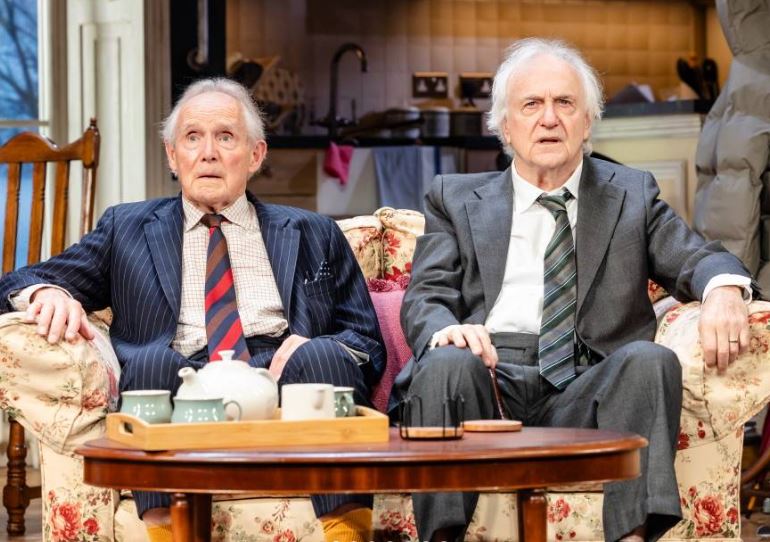
As London swelters in record-breaking May temperatures, it is something of a relief to enter the wintry world of I’m Sorry, Prime Minister, not to mention the air-conditioned auditorium of Richmond Theatre.
Classic sitcoms have proved to be a rich vein for theatre in recent years, with stage versions of The Good Life, Only Fools and Horses, and Fawlty Towers all finding a ready and enthusiastic audience. By comparison, Yes, Minister and Yes, Prime Minister feel like a much more obvious candidate for stage adaptation. The original television version was particularly studio-bound, with lengthy character scenes and a small central cast.
Unlike other recent theatrical sitcoms, Yes, Prime Minister’s original co-creator Jonathan Lynn, writing and directing, has chosen to set his play in the 21st century rather than recreating the characters’ 1980s heyday. In his 80s, Jim Hacker is now a cross-bench member of the House of Lords and the Master of Hacker College, Oxford. The play is set in his spacious but untidy rooms. The shelves full of pristine political volumes contrast sharply with the faintly shabby kitchenette. Hacker keeps having to insist that he’s not dead, but signs of his decline are plainly visible, with piles of archive boxes dotted around the stage, and the telling appearance of a stairlift to stage left.
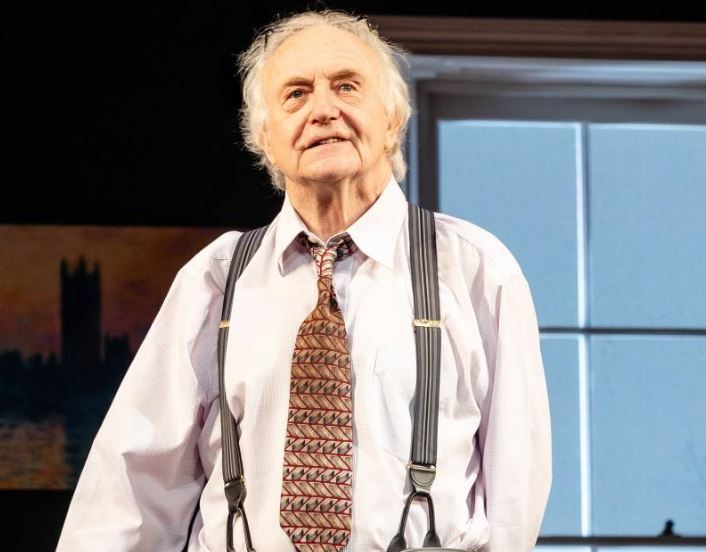
Simon Rouse gives a wonderful performance as the decidedly rumpled Hacker. With wayward wispy white hair and dishevelled clothes, we first see him barefoot as he interviews his new care worker Sophie. His pompous attitude and careless comments to Sophie contrast with the fact he can no longer put on his own socks.
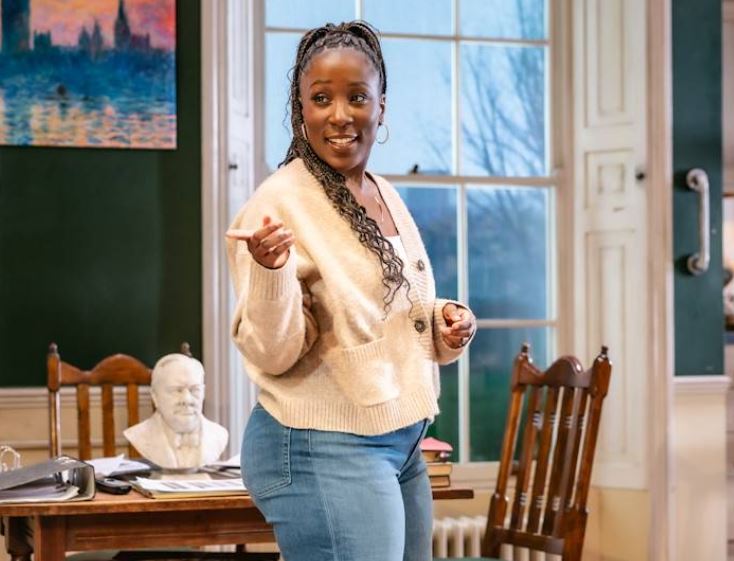
Sophie, played by Princess Donnough, represents the voice of youth in a play dominated by ageing members of the establishment. A young, black, gay woman, she “ticks all the boxes” as Hacker inelegantly puts it as he considers trying to find her a teaching post at Hacker College. Donnough spends much of the play reacting to the conversations around her, and is superb at drawing the audience’s attention even when she’s not speaking. When Sophie does interject, she is often exasperated, frustrated, angry with Hacker, but mostly she seems amused by his bluster and entrenched attitudes. She patiently tries to teach a man who she knows will never really change.
Hacker is under pressure to resign as Master of Hacker College and, on learning that his former Private Secretary Bernard Woolley died three years previously (a surprise, even though we learned Hacker attended the funeral, in one of a number of suggestions that he might not be quite so firmly in control of his faculties as he protests), he calls upon another old colleague: Sir Humphrey Appleby.
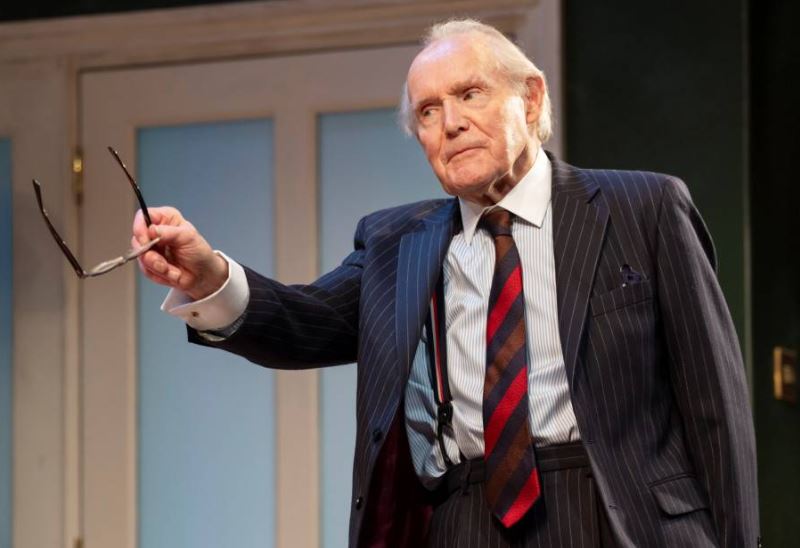
Clive Francis puts in a commanding performance as the unctuous civil servant, and appears to be having a huge amount of fun in the role. While Rouse in places is almost uncannily reminiscent of Paul Eddington’s original depiction of Jim Hacker, there is no serious attempt to impersonate Nigel Hawthorne’s Humphrey Appleby.
Like Hacker, Appleby is clearly a man whom the world has left behind. We quickly learn that he has lost all his money to his son and daughter-in-law, who had him briefly committed to St Dymphna’s Hospital for the Elderly Deranged. When Hacker and Sophie leave the stage for a moment, his polished facade crumbles and he begins desperately to stuff his pockets with biscuits. Later he confesses that he agreed to see Hacker because he’s hoping he can get a lecturing job.
Sir Humphrey seems to have weathered the changing world better than Lord Hacker in some respects, however, despite his reduced circumstances. His relentless charm makes much more headway with Sir David than Hacker’s bluster, and he and Sophie swap literary quips and appreciate each other’s jokes.
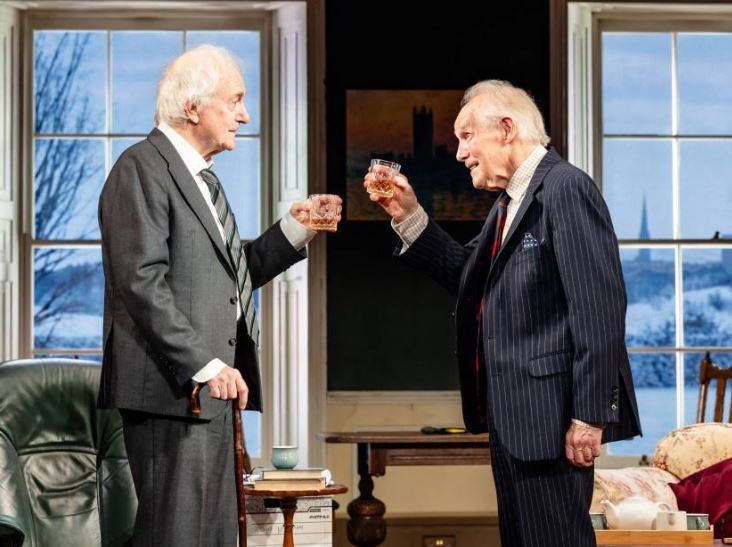
Hacker and Appleby fall swiftly back into the companionable jousting that’s delightfully familiar to fans, and there are clearly many of them in the audience. Hacker blusters and boasts about his success in politics, while Appleby smiles and delivers quiet little barbs: “I’m so glad you think so.” The old conflicts between civil service and government is repeated in Hacker’s slightly shabby rooms, and there’s a bittersweet air of futility about the whole business, even as the two of them spar gamely.
The catalyst for the play’s events is an attempt by the Fellows, graduates, and undergraduates of Hacker College to force Jim Hacker’s resignation. This threat is personified by William Chubb, who appears unforgettably as the Grim Reaper before introducing himself as Sir David. Chubb has less time on stage to shine than the other three cast members, but he makes a true mark with his modern day Sir Humphrey persona: polished, smooth, and quietly amused by all the bluster and nonsense that surrounds him. The point is underlined heavily when Sir David and Sir Humphrey simultaneously clamp their hands over their ears as Lord Hacker suggests a thoroughly inappropriate course of action.
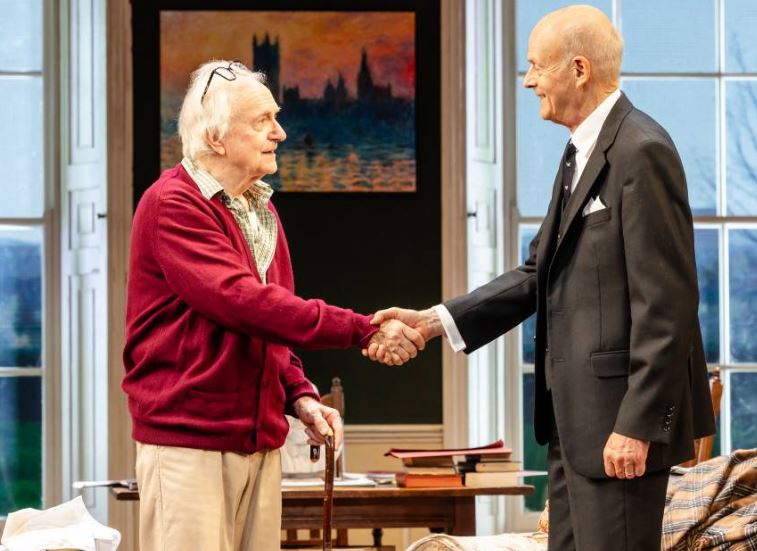
It gradually emerges that there are many reasons why everyone is seeking Lord Hacker’s resignation, and this brings the play firmly into the 2020s as the characters discuss Brexit (which Hacker is credited with indirectly causing, with his Great British sausage speech), Covid, the Black Lives Matter movement, trigger warnings, and safe spaces. Jonathan Lynn’s script is as sophisticated as the rest of the play at this point and avoids any glib answers or firm viewpoints, but the discussion does occasionally feel contrived and the play’s substantial running length starts to make itself felt. The mere fact that it takes so long for Hacker to reveal what he said to prompt calls for his resignation demonstrates that he’s well aware his comments were inappropriate, which fundamentally undermines his defence of them.
On the whole, however, Jonathan Lynn’s script contains much that is as sharp as Yes, Minister at its peak, and his direction, along with co-director Michael Glyngell, keeps the play moving at a brisk pace. A very wordy script is balanced with occasional visual gags including a bit with a stairlift, some business with a pair of underpants, and some extended business with characters snatching a newspaper from each other which is so much fun that Francis repeats one part after he and Rouse fluff their lines. The characters roam across Lee Newby’s magnificent set, and a play which could very well have lapsed into three people chatting from armchairs constantly feels animated and dynamic.
I’m Sorry Prime Minister is an undeniably odd beast, and it sometimes creaks under the pressure of its conflicting priorities. It walks a tightrope between telling a new story, and indulging fans of the original, who will clearly be a large part of the audience. Bereft of their power and influence, the generally pragmatic rivalry between Hacker and Appleby becomes pugnacious and personal. A story about the world passing to a fresh generation ends with an inevitable tribute to a television programme from forty years ago.
But this is also a complete play in its own right, told with warmth and pathos, about two old colleagues struggling in a world that’s left them behind, and it would remain compelling even without the wider context of these characters. If you remember Yes, Minister with fondness, or appreciate a spot of political comedy, I’m Sorry, Prime Minister is a fun evening’s entertainment with a sharp script and some great performances.
Andrew Lawston, May 2026
Photography by Johan Persson


