
Giulio Cesare
I Came, I Saw, I Concurred
Giulio Cesare
by George Frideric Handel, libretto by Nicola Francesco Haym
The Grange Festival at The Grange, Northington, Alresford until 25th June
Review by Mark Aspen
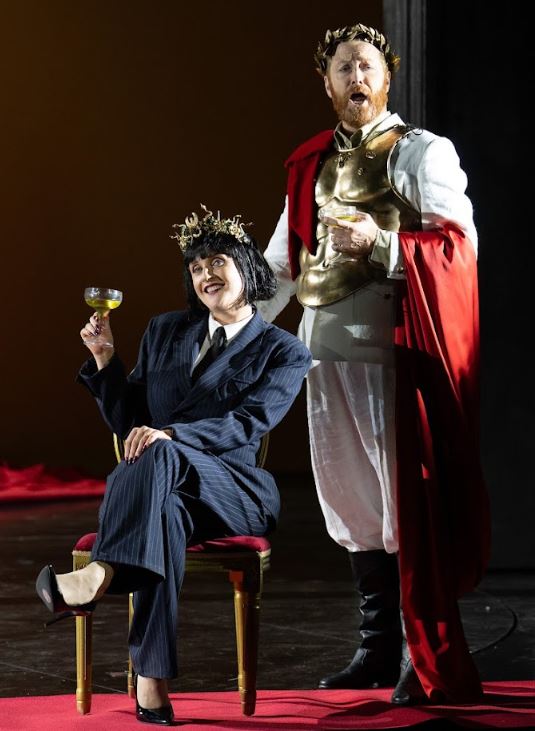
Wow! Now here is a remarkable production, and one that the term mixed-media could have been made for. It is eclectic, violent, colourful, sexy and edgy, but is melodic, incisive, expansive, creative and beautiful. Post-modernist director David Alden’s new take on Handel’s Giulio Cesare has his trademark bold and innovative approach that made his English National Opera productions so controversial. The gravity of Handel’s historical account is heavily overlaid with broad comedy, often steering perilously close to spoof, yet never losing the magical magnificence of his music, both vocal and instrumental.
And, with a world-class cast and musicians, the music is indeed remarkable. It features four countertenors, a rare thing in modern opera productions, although Glyndebourne’s 2014 production of Handel’s Rinaldo also had four (and in 2022 Bayreuth Baroque Opera Festival had five countertenors for Vinci’s Alessandro nell’Indie !). Handel was generous in roles for contraltos, and Giulio Cesare has a major well-served contralto role. All along the bubbly baroque music keeps all fresh and on its toes.
Designer Jon Morrell is clearly on Alden’s wavelength, and its eclecticism embraces both costume and set.
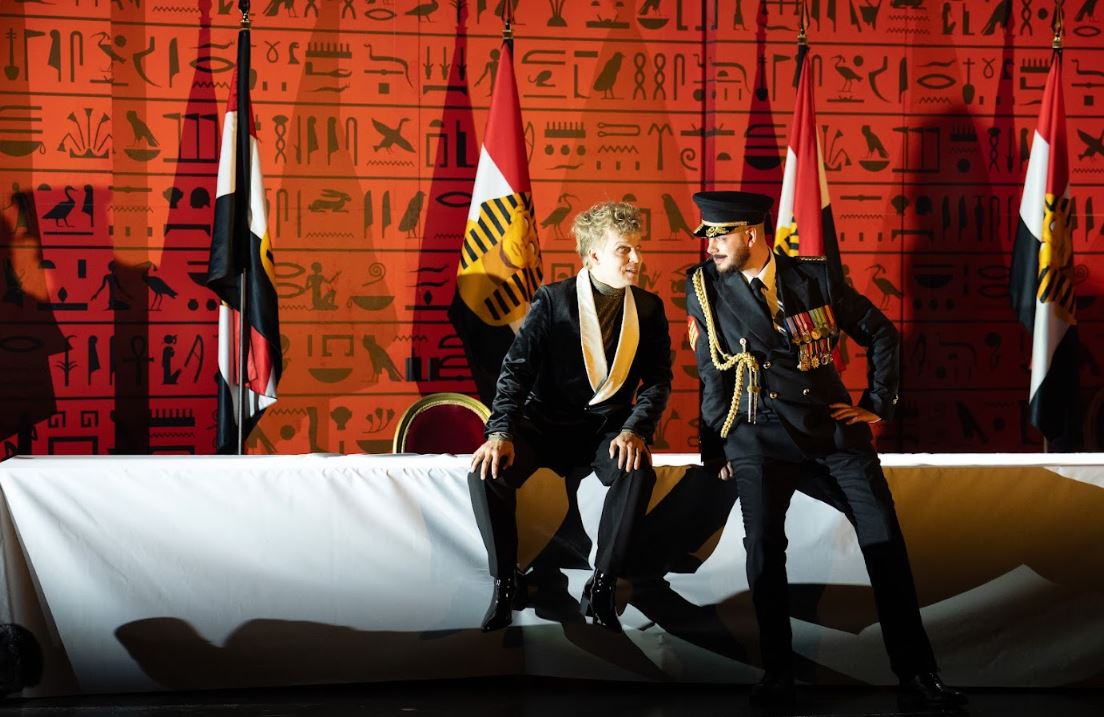
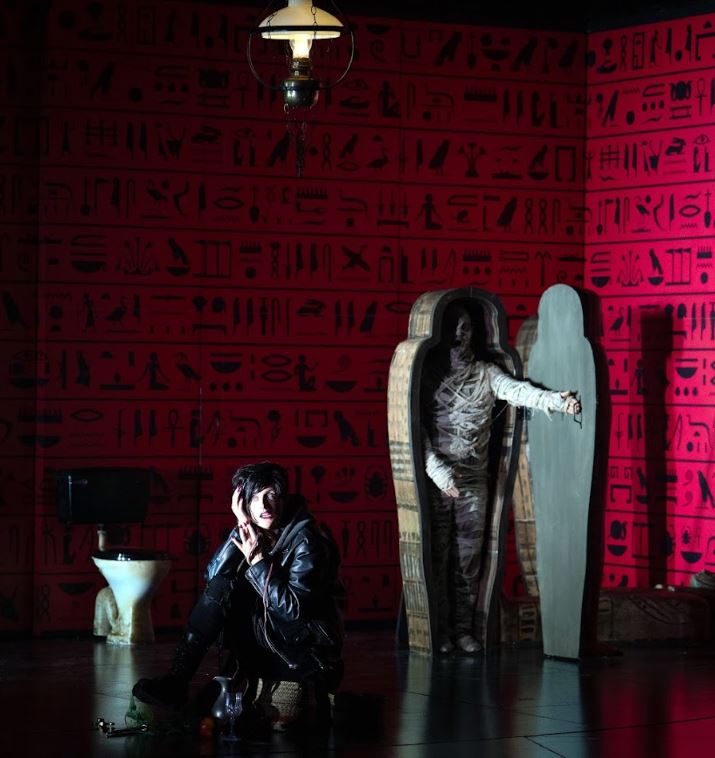
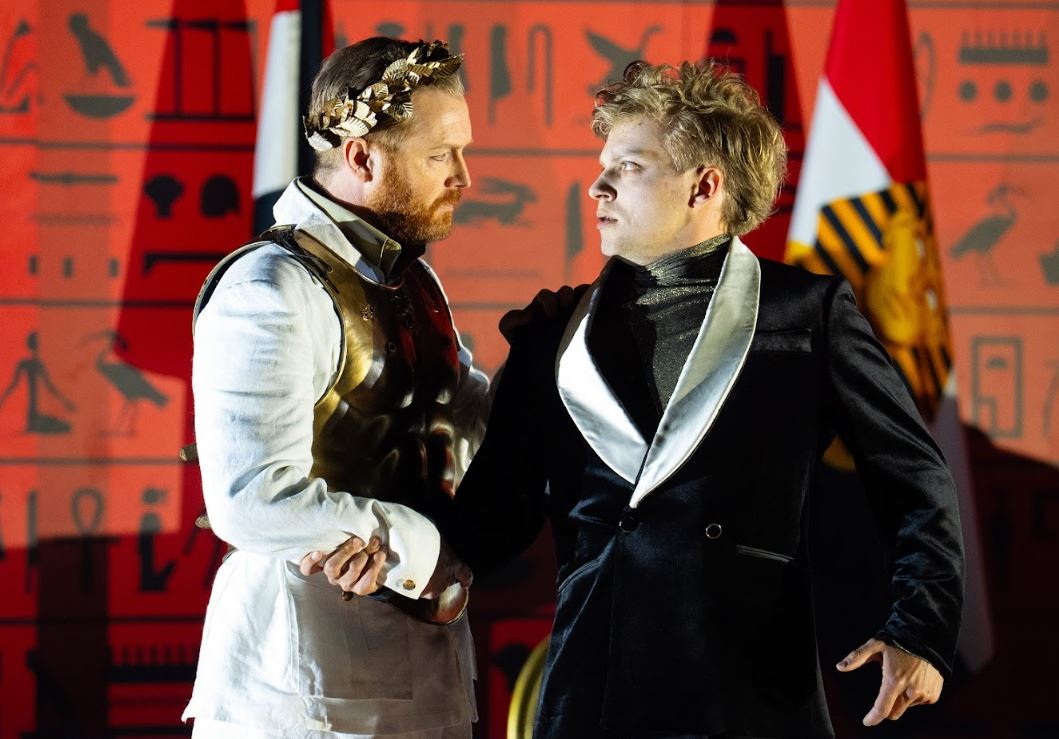
While Caesar’s general, the praetor Curio is dressed as a Roman centurion, his counterpart, the Egyptian pharaoh Ptolemy’s general Achilla wears a modern military uniform, looking vaguely like a cross between President Assad and General Gadaffi. Alden is known for his satirical political undercurrents, and perhaps this says that all this could happen now. When Cornelia, the recent window of the Roman statesman and general, Pompey the Great, and her stepson Sesto (Sextus) arrive, it could be from post-war London. He is the archetypical schoolboy, blazer, cap and shorts. But maybe, when later as his father’s avenger, he dons the OTT shoulder protectors of the American footballer, rather than his cricket togs, Alden is referencing Operation Epic Fury ? Nireno, the butler to both Tolomeo (Ptolemy) and to Cleopatra, is a mummy swathed in bandages, a (very) old retainer, it would seem.
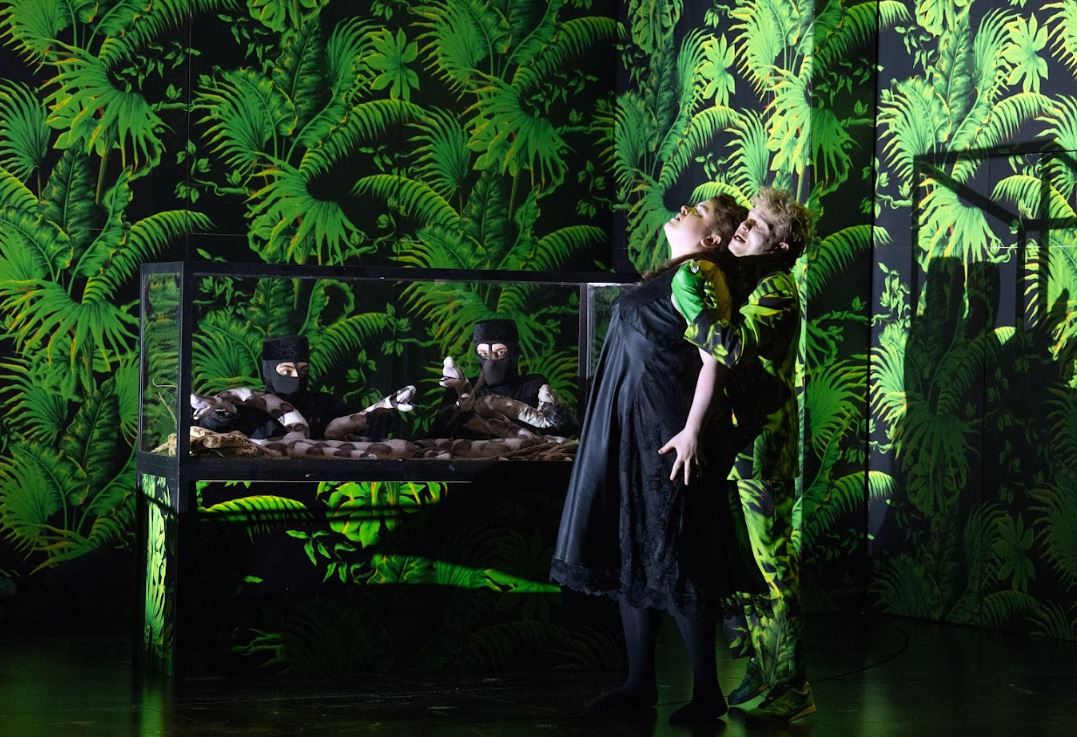
The set also relishes in anachronisms, although the setting is in 48BC in Tolomeo’s palace in Alexandria. A stage revolve allows quick (albeit sometimes noisy) changes from the imposing stone triumphant gateway arch, to Tolomeo’s apartments and staterooms, right down to his elaborate dungeon-like chamber in his harem, with tanks of serpents and walls covered in tropical foliage, hiding Tolomeo himself (a technique also used to great effect in Glyndebourne’s Rigoletto). There are memorable mise-en-scène where Morrell’s designs and Matthew Richardson’s lighting create a heightened atmosphere.
At a very long dining table, think Putin’s safety desk, Tolomeo invites Cesare to discuss diplomacy, with their respective generals. In Cesare’s aria va tacito e nascosto, a metaphor of huntsman and prey, and appropriately accompanied by a horn obbligato (by Ursula Paludan Monberg) the four progress warily around the table. Cesare’s guard are pressed in to act as tasters for the wine and food proffered by Tolomeo, and a what ensues is a cross between musical chairs and Russian roulette as the hapless soldiers expire all around.
In the eponymous role of Cesare, Tim Mead’s countertenor is clear-cut, but warm and expressive. His Cesare may be Shakespeare’s “noblest man that ever lived in the tide of time” in his honourable treatment of his late rival, Pompey and his family, and in complete contrast to that of Tolomeo, but he has very human weaknesses. Tolomeo’s sister Cleopatra easily seduces him with her obvious charms, and Mead’s Cesare is soon so enthralled that he seems quite literally in a spin.
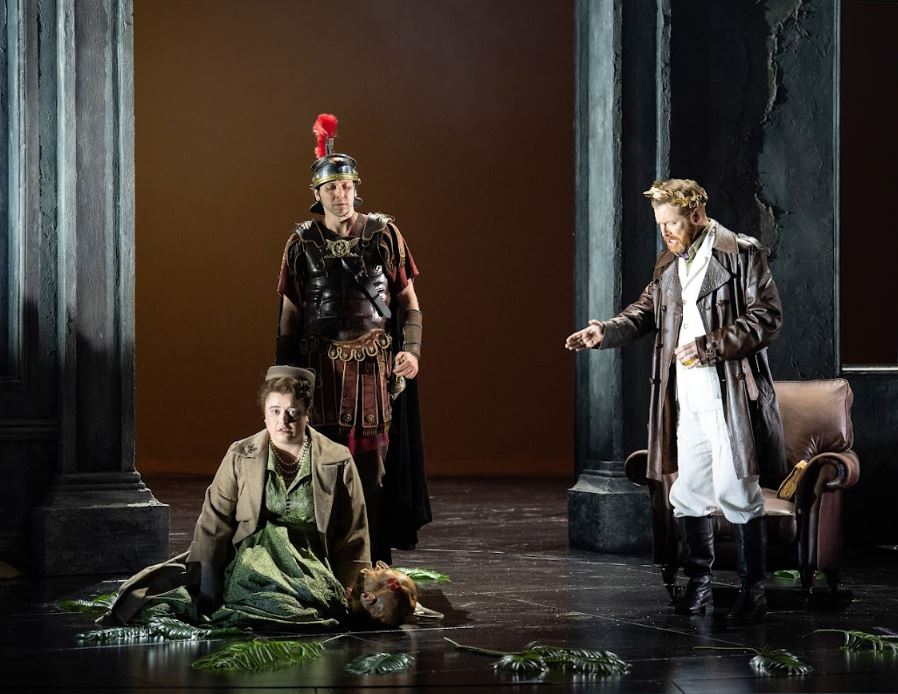
Tolomeo is far from honourable. He is a sybaritic psychopath. His first act on meeting Cesare is to present him with the head of Pompey, in a bucket. Cesare is appalled and is immediately wary. As the mercurial Tolomeo, Hugh Cutting’s countertenor makes use of coloratura flourishes to give a silvery sinister edge to his voice. His attempted rape of Cornelia, and her threatened execution by dismembering are truly repulsive.
Cornelia is a remarkably resilient woman. Witnessing, with Pompey’s young son, the presentation by Tolomeo of her defeated husband’s severed head, is shocking. She becomes the target of the lust of both Tolomeo and his general Achilla, and is subject to all sorts of atrocities. Yet Cornella has strength in her pride and her plucky nature to remain steadfast. Jess Dandy is outstanding as a dignified and brave Cornelia. And, my what an amazing voice she has, a creamy rich contralto of wide range with beautiful colour. Moreover, she is a very convincing actress, consummately expressing the rawness of her shredded emotions. When she is promised to Achilla by Tolomeo as a “prize” if he assassinates Cesare, Cornelia’s anguish, in the duet son nata a lagrimar with Sesto, is profoundly affecting.
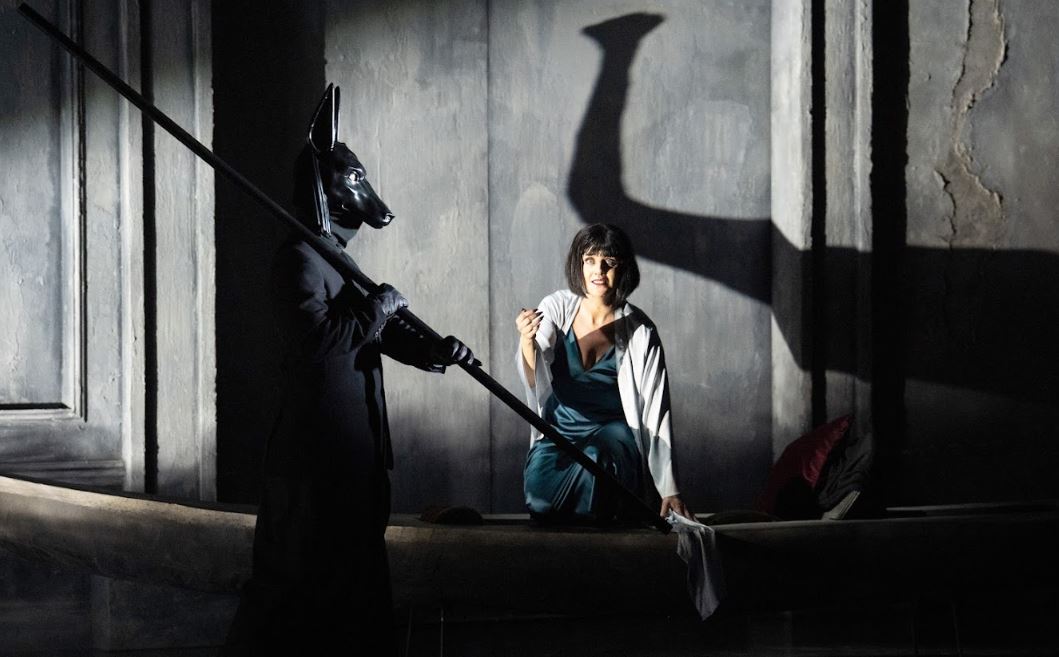
Sarah Brady’s Cleopatra is as sinuous and slippery as the asps she enjoys as pets. Her Cleopatra is first seen as a smoky-eyed Goth tantalising her brother Tolomeo. Then later, when Cesare appears on the scene, she is capable of flipping from flapper to femme fatale to suit the persona she wishes to use, from her disguise as Lidia, the maidservant with the roaring twenties bob-cut, observing Cesare while entrapping him with her wiles; to the Queen, as his burgeoning lover manipulating him as a potential military ally to usurp Tolomeo. It is however, a nuanced trajectory of Cleopatra’s character coloured in by Brady’s emotive soprano, who uses coloratura to dramatic effect. Her v’adoro pupille aria is captivating, and is the love-song that sends Cesare in a spin. In a sequinned dress she delivers her seductive song amongst a ballet of spheres floating in the air, reflective gazeballs in a cool blue light. Another impressive visual image is having Brady singing Cleopatra’s se pietà aria whilst being ferried in Cheops’ solar barque by Anubis.
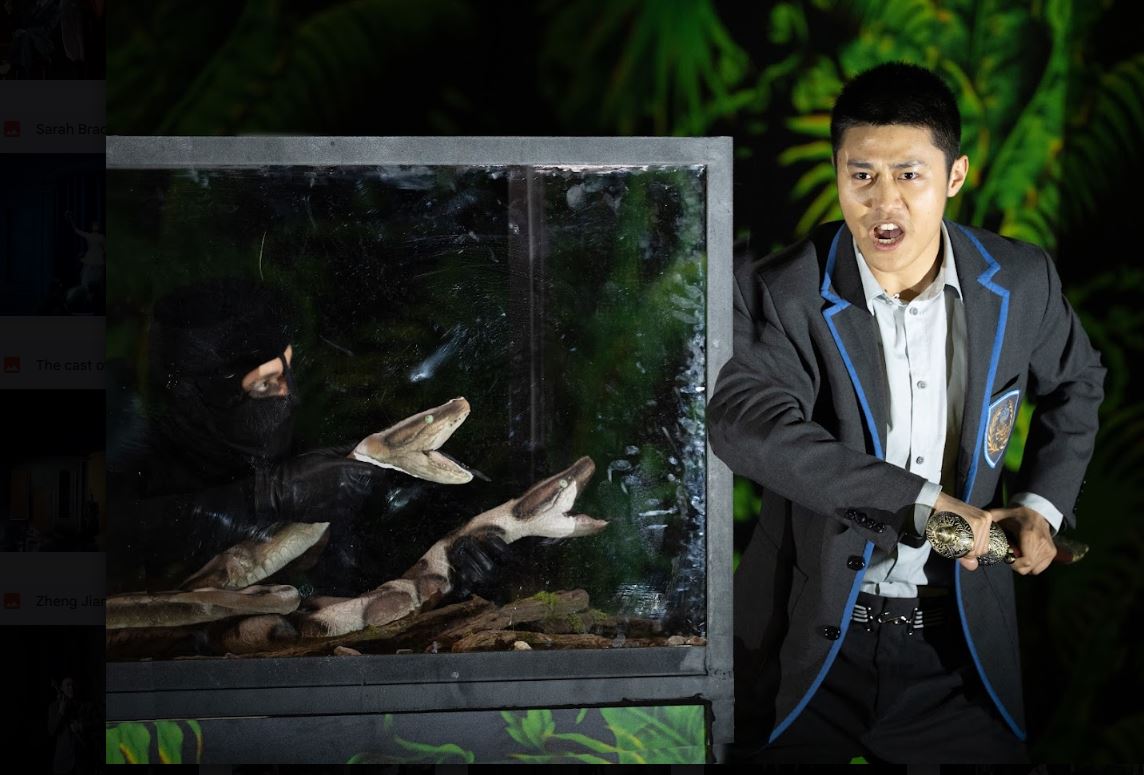
Completing the role-call of countertenors are Zheng Jiang, as Sesto, and Owen Willetts, as Nirerno. Zheng Jiang’s Sesto is an earnest youth, firing on all cylinders as he strains to protect his stepmother and to avenge his father’s death. Jiang’s nimble countertenor has a soft fluidity that elicits empathy yet is underlaid with bubbling anger. This prizewinning Chinese newcomer is clearly on his way up. Already well on his way up, Owen Willetts does sterling work as Nireno, whilst weighed down by his mummy swaddling. Although much in evidence, his strong ringing countertenor seems underutilised, which is a pity as it is splendid.
In view of the plethora of top-notch countertenors, it is highly appropriate that this production of Giulio Cesare is dedicated to the Grange Festival’s retiring Artistic Director, Michael Chance, himself an acclaimed countertenor. Michael Chance has taken the Grange Festival from strength to strength since its inception with Monteverdi’s Il Ritorno d’Ulisse in Patria in 2017.
In rich contrast, the other male roles are performed by baritone James Atkinson, and bass-baritone Tristan Hambleton. Atkinson makes a chilling Achilla, full of menace and barely concealed violence. His voice has real sinew that speaks of Achilla’s ruthlessness.
Tristan Hambelton’s Curio has a swaggering self-assuredness and he sings with an authoritarian richness. Both are clear relishing their strong-man roles, Atkinson as the baddie, Achilla, and Hambelton as Curio, the goody (sort-of).
Nireno has subordinate mummies in the form of the ubiquitous group of five lithe dancers, all men, choreographed by movement director Tim Claydon, who animate the stage ,variously as black clad ninjas, or sometimes alluring (?) sirens, sometimes Roman soldiers, sometimes androgynous niqab wearers. Alternatively, they may be vaguely animal, as caterpillar-like crawling creatures, or colourful serpents. Indeed with the help of some puppetry, there are snakes, tanks full of them. It is all very cleverly and athletically done, and might make an intriguing stand-alone ballet, but here does often pull the focus.
Baroque maestro Christian Curnyn conducts the Early Opera Company to bring out the vigour of Handel’s magnificent musical energy. The orchestral performance is sumptuous and stimulating. Curnyn integrates instrumental with vocal music empathetically, absorbing the changing emotions of each character within the presentation of the music. The music often enters directly into the drama, as in on-stage violin solo is a dramatical part of Cesare’s wooing of Lidia-Cleopatra in his aria se in fiorito ameno prato, as well as solos from the pit.
This tongue in cheek Giulio Cesare certainly has the wow-factor, in its superb music, inventive staging, and outstanding singers, but there is so much going on a once, that one needs to see it three times, to absorb the drama and music, to disentangle the visual gags, and to heard the world-class singing.
Mark Aspen, June 2026
Photography by Richard Hubert Smith


 Mark Aspen