
Cluedo
In the Park, With the Lead . . .
Cluedo, The Play
by Jonathan Lynn and Sandy Rustin
Questors Theatre at Walpole Park, Ealing, until 27th June
Review by Harry Zimmerman
There can be very few people who have not, at some time, played the board game Cluedo. Together with Monopoly and Scrabble, Cluedo, launched in the UK in 1949, has always been a staple of rainy afternoon entertainment, and has sold more than 150 million copies worldwide.
The popularity of the game and the concept spawned the cult classic 1985 film Clue, (adopting the American name for the game), which starred Tim Curry. The screenplay for the film was written by comedy writer Jonathan Lynn and subsequently adapted for the stage by Sandy Rustin. This is what Questors have developed for their summer production in Walpole Park.
They are not afraid of subverting traditional whodunnit concepts. Instead of a dark and stormy night, think beautiful summer evening.
The premise of the play is simplistic and instantly recognisable. Six people are invited to the house of one ‘Mr Body,’ who apparently has news to their advantage. Each of the six is hiding a guilty secret or indiscretion which plays out over the course of the evening. Each guest adopts a pseudonym, conveniently adopting the recognisable personas of the board game, masking who they truly are, until it becomes clear they are connected by the fact that they all are being blackmailed by the same man.
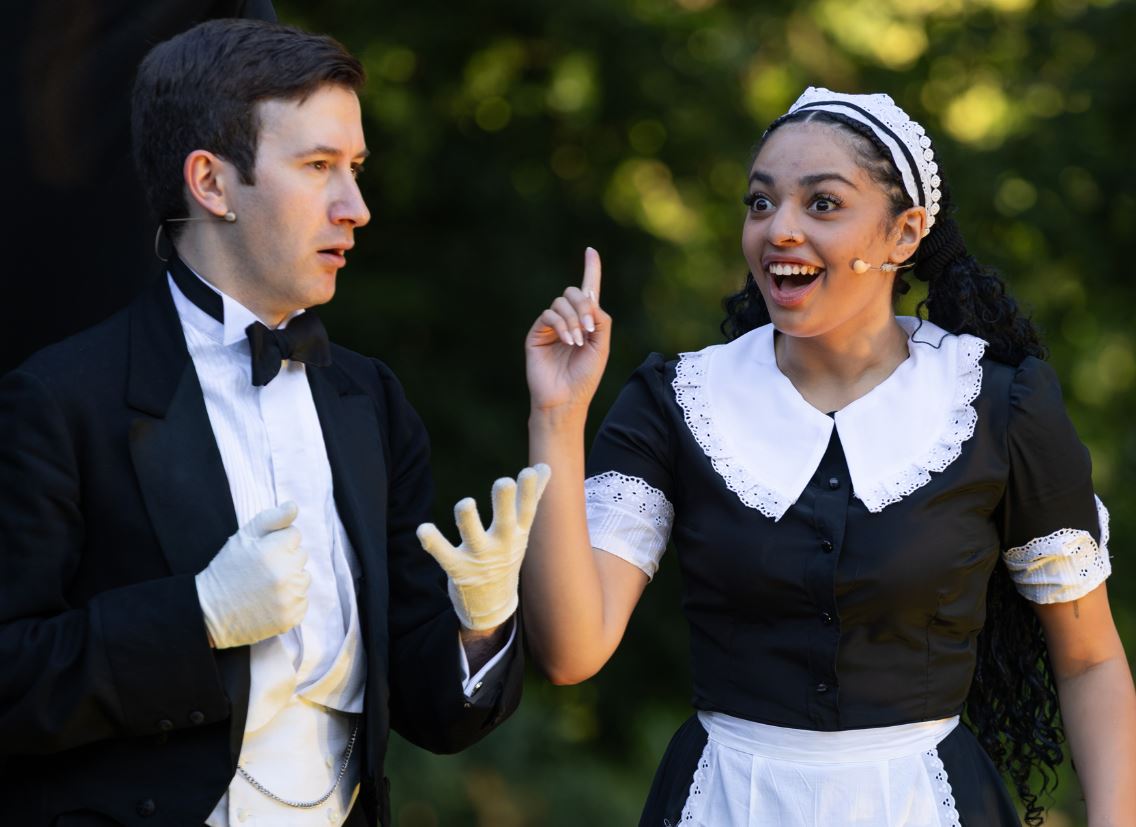
In addition to the suspicious six, we also have the staff; Wadsworth, a butler who might not be all he seems, Yvette, a French maid whose occasional lapses into estuary English hint at a bit of a past, and a cook.
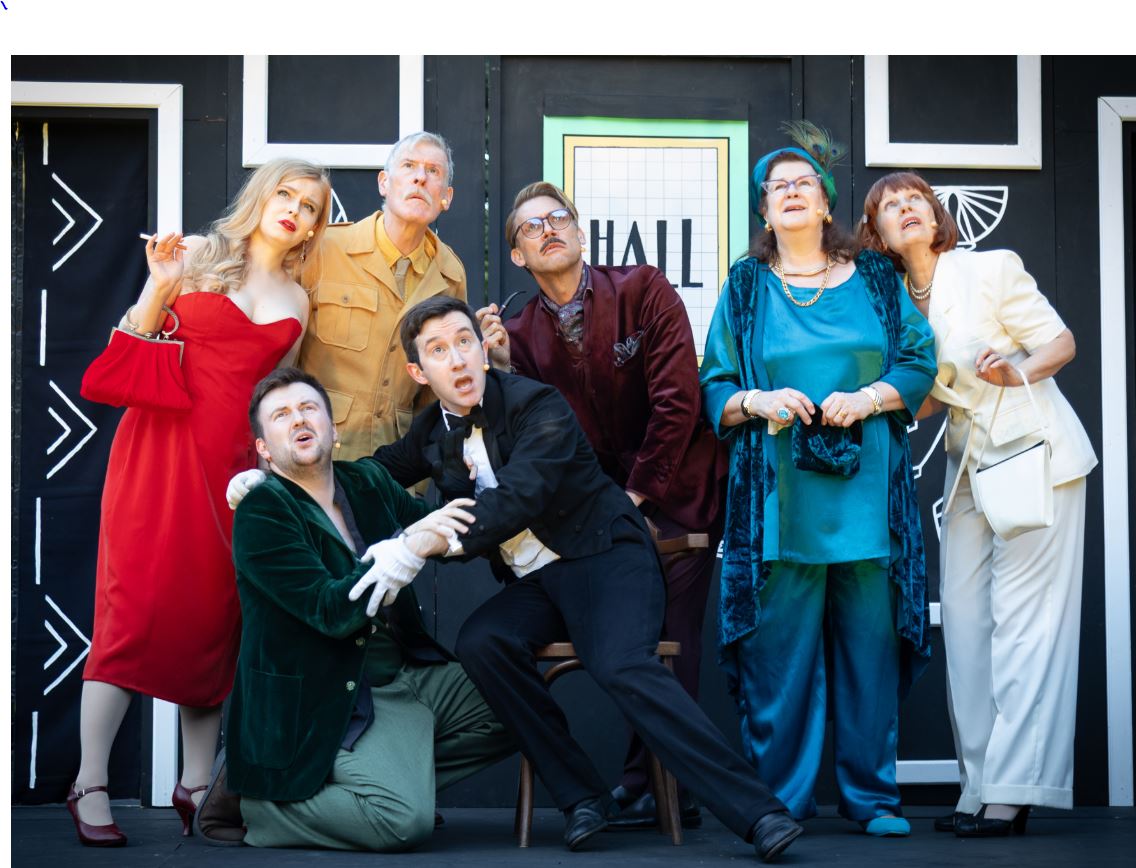
Within the first thirty minutes of the production, one person is dead and the evening turns into a race to uncover whodunnit. What follows is a board-game turned comedy thriller, with its tongue very much lodged firmly in its cheek, as the characters move room by room, hurling accusations, both inviting and dodging suspicion, and trying to avoid being murdered themselves. As the bodies pile up the six guest-suspects become ever more insecure. Their secrets are revealed, the weapons are distributed, the lights go out. It is all very upbeat and silly.
Cluedo is a paean to the great Agatha Christie murder mysteries. The arrival of a number of apparently unconnected guests to a strange location at the behest of a mysterious host has direct echoes of And Then There Were None, whilst its radio broadcast opening and isolated cut-off setting is identical to the initial set up of The Mousetrap.
Little touches were also thoughtfully impressive; for example, the audience seating and picnic rug demarcation areas were divided by the colours of the Cluedo characters in the shapes of the playing tokens used in the original board game.
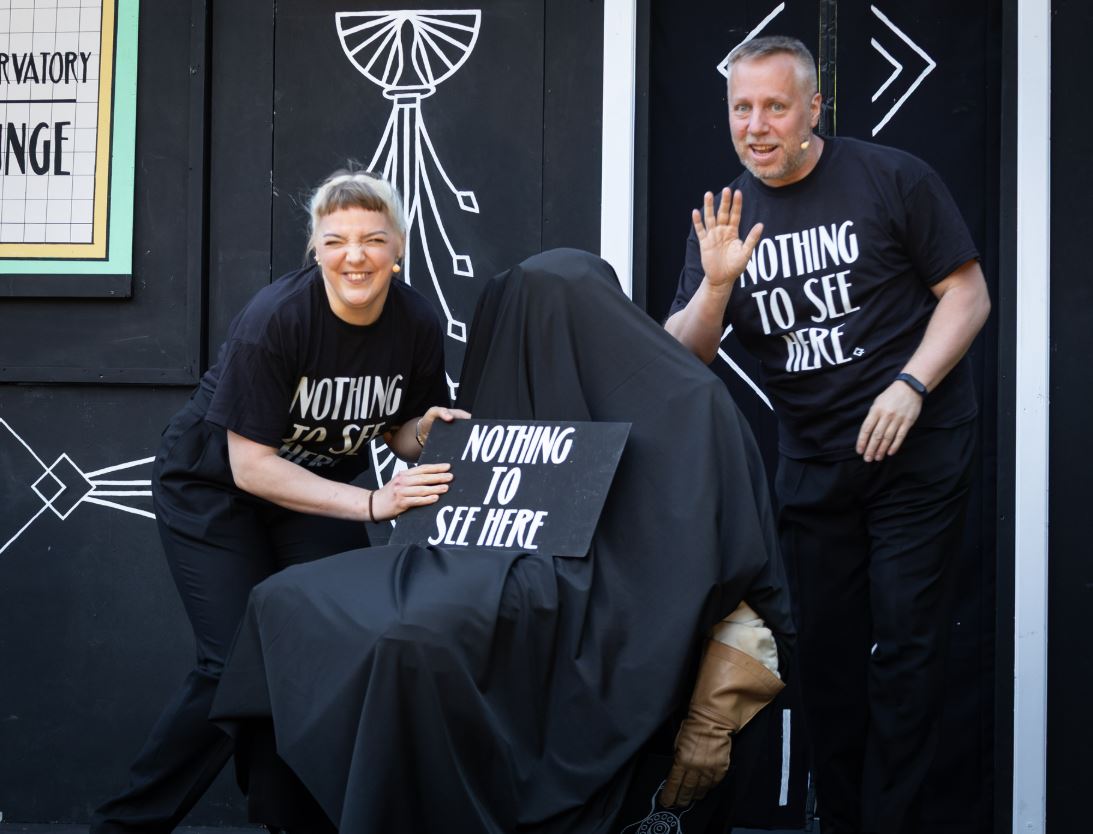
The set also requires significant praise. The basic set was divided into one main playing area delineated by three exit-entrance spaces in appropriate art deco basic black and white designs. The middle of the stage had an aperture which cleverly allowed the action of the play to be communicated: whether that be conservatory, ballroom or lounge.
The inventive and playful nature of the approach to the production was also exemplified by ingenious use of simplistic cardboard drawings of props, whether that be a wireless, wine glasses, dinner plates or the usual array of murder weapons integral to the original game. Another touch worthy of praise was the adroit use of a black sheet held by members of the stage crew whenever a nefarious murder took place.
Rachel Moorhead’s direction (as well as her set design) was on the button. She kept the action moving quickly, moving the characters across the set with a fluidity which added to the fast-moving nature of the piece. Whilst there was the occasional drop in pace, (especially in the dining scene), and a few delays in waiting for cue bites at the beginning of the play, these are very minor first night imperfections which will no doubt be eradicated as the cast become more familiar with the progress of the narrative.
In a play such as this, the strength of ensemble playing is everything, and the hard-working cast uniformly rose to the occasion and delivered a series of amusing, engaging and entertaining characterisations, always staying the right side of parody whilst maintaining a healthy disregard for stuffy pretension.
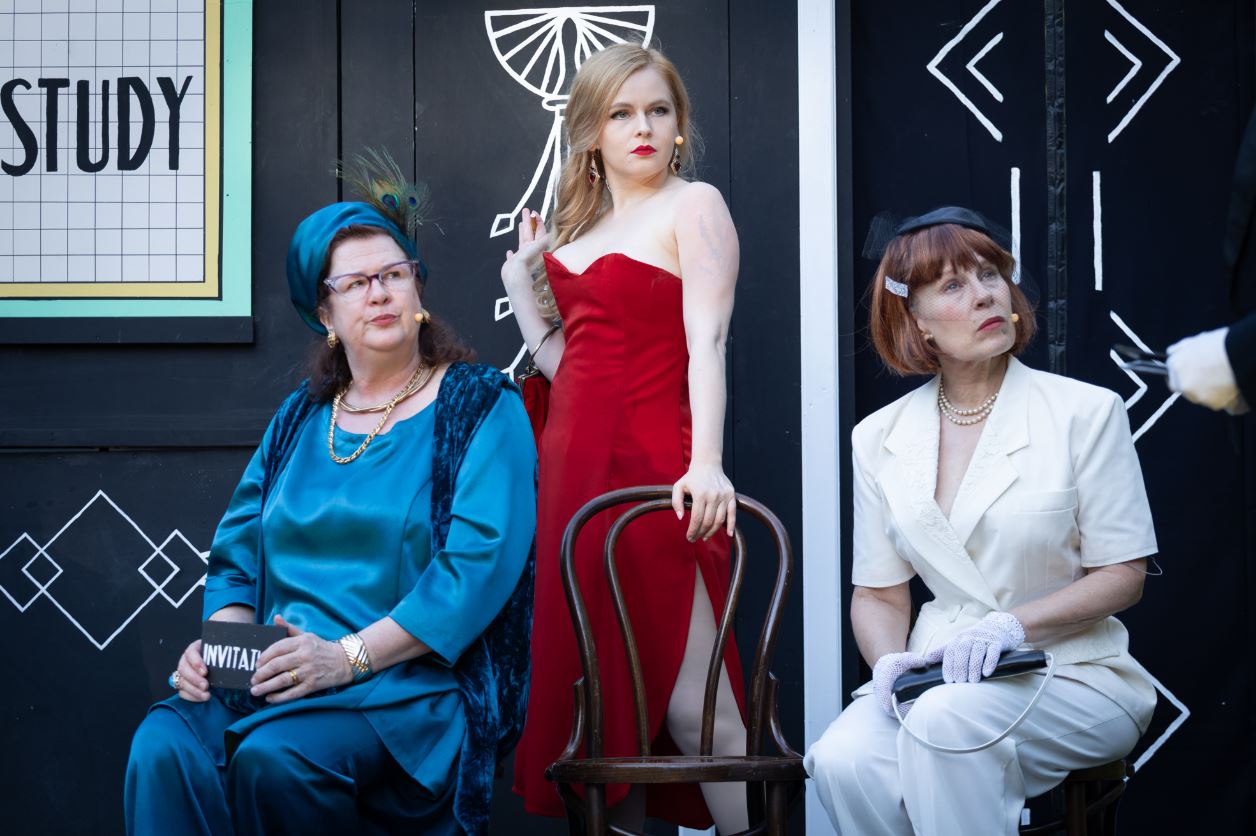
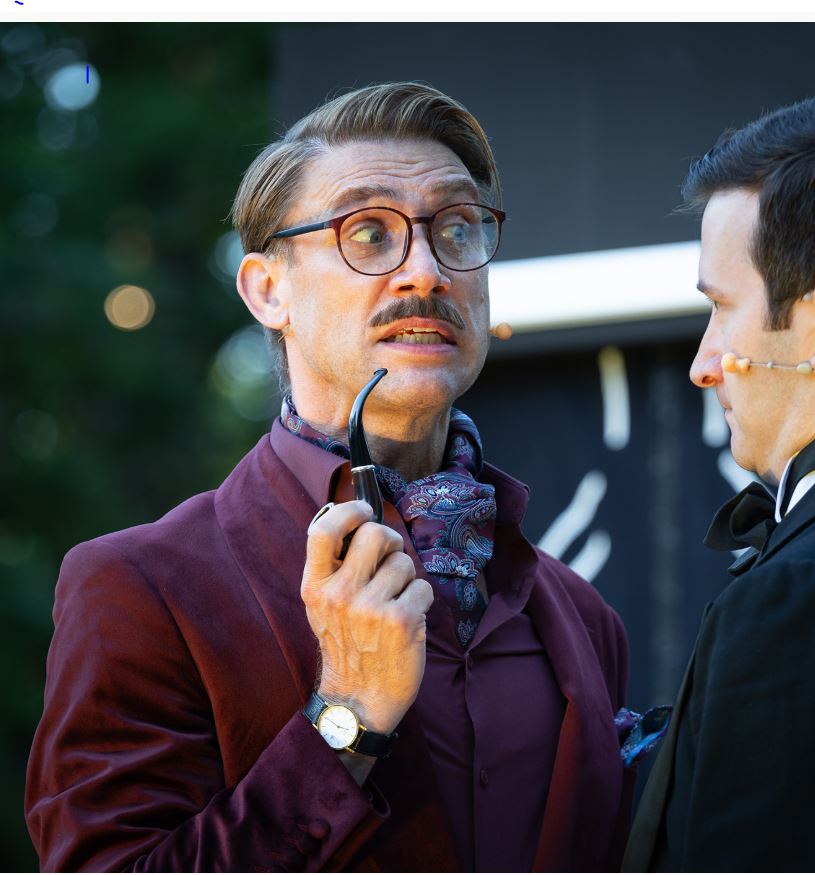
Beautifully and appropriately attired, the staff Wadsworth and Yvette (Daniel Thompson and Julice Liecier) and the guests: seductive, scheming femme fatale Miss Scarlett (Tilly Benson); uptight, pompous dim-witted Colonel Mustard (Robin Ingram); nervous and hesitant Reverend Green (Jamie Gould); confident and world weary Mrs. White (Samantha Moran); pious, devious and occasionally hysterical Mrs Peacock (Alison Griffin); and, effortlessly twirling his vocal moustache in a Leslie Phillips incarnation, Professor Plum (Brodie Bass) all imbued their outrageously broad comic personas with evident relish, enthusiasm and enjoyment, and just the right amount of archness.
Kudos too, to the ensemble team of Daniel Carey, Eleanor Wilson and James Rushbrooke, who kept the action moving with the beautifully timed knowing nods and winks to the audience.

One of the key challenges in this production is the dense heaviness of the script, layering plot upon plot and suffering from trying to pack a quart into a pint pot. As the characters, their secrets and their motives are stacked like a deck of cards, the plot goes around in ever confusing circles like the various rounds of the board game, occasionally unravelling and spiralling out of control. This results in the rather unsatisfactory series of denouements which, despite the game attempts of the cast, especially in a partial complete review of the action by Wadsworth at the end, and a repetitious rewinding of key plot assumptions which eventually becomes more irritating than comical. These serve to dampen the sense of camp fun which the previous seventy minutes has spent building up, stretches credulity and dilutes the overall sense of finality and clarity which is the mark of all good whodunnit endings.
This having been said, there is no doubt that, thanks to the skill and commitment of the cast and crew, Questor’s production of Cluedo completely succeeds in its intentions.
This is not King Lear. There is nothing subtle here, nothing to really think about, no final message, and that is entirely the point. This is just feel-good fun, frothy and light; an energetically and lovingly performed confection ideally suited to a relaxed outdoor post picnic entertainment.
In short, a warm bath of a show best enjoyed on a very warm summer’s evening.
Harry Zimmerman, June 2026
Photography by Carla Marker


