
The Magic Flute
Blowing a Breeze
Magic Flute
by Wolfgang Amadeus Mozart, libretto by Emanuel Schikaneder
West Green House Opera at the Green Theatre, Hartley Wintney, until 19th July
Review by Mark Aspen
When the showman Schikaneder and the ailing Mozart got together in 1791, their concept was to present an operatic entertainment, not for the aristocracy or the gentry of Vienna, but for those who found their pleasures in the down-market Wieden area, near the Prater amusement park. Die Zauberflöte was not presented in Italian, the conventional language of opera, but in a language they could all understand, German. The approach is that of the variety show or music hall, a mixed bag of comedy and spectacle, together with fine singing, all designed largely for fun. Packaged as a fairy-story, it naturally involves good versus evil. So it is also a morality tale, but Mozart and Schikaneder were Freemasons, and it is seen thorough the lens of Freemasonry, regarded at that time as an enlightened liberal force.
Richard Studer, both as director and designer, steers his production of The Magic Flute firmly in the direction of this concept in his inventive light-hearted take on Mozart’s well-loved opera. It is sung in English, and Amanda Holden’s translation is peppered with contemporary idioms. “This guy’s a moron!” is Papageno’s first impression of Prince Tamino.
On the open-backed stage of the Green Theatre, giving glimpses of the façade of West Green House across its lawns, sits a small proscenium arch theatre. It is monochrome like an engraving, and its forestage is emblazoned “Orlando Furioso”, the poetic source of many an opera in the late Eighteenth Century. The theatre in a theatre is a clear reference to Schikaneder, the showman, and could even be his Freihaus Theater auf der Wieden. It has scenery legs depicting an ancient Egyptian temple to Isis and Osiris. Alongside the theatre set are the discs of the Sun and Moon, which feature prominently as symbols of day and night and, by extension, enlightenment and darkness.
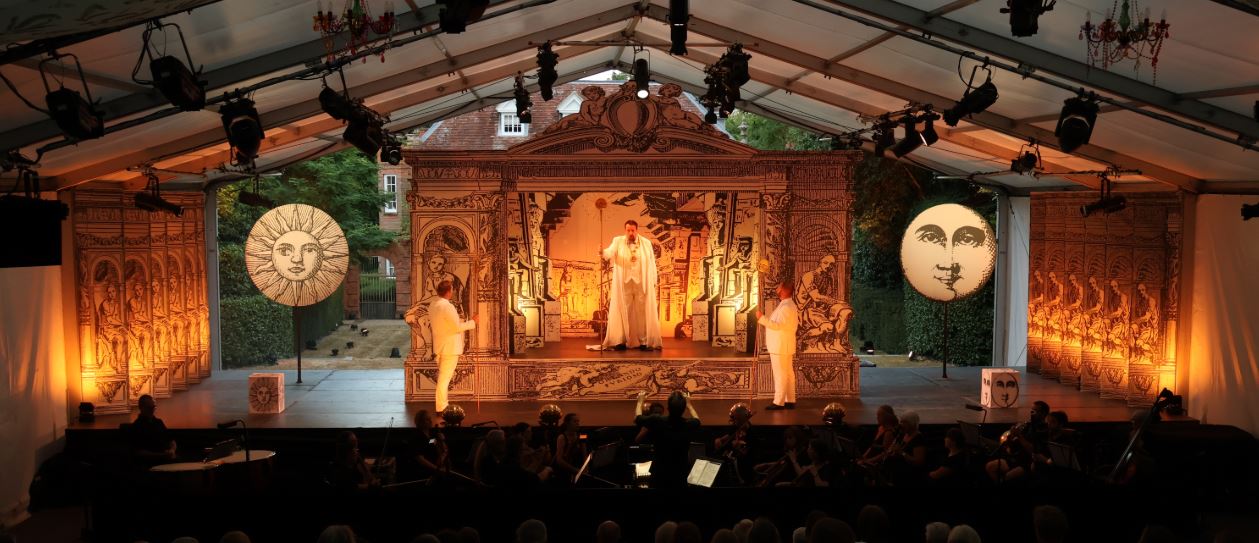
Clearly, the opportunities for lighting designs are manifold, and this is a skill in which West Green excels. Sarah Dell has intricately inter-acted the lighting of the stage-within-the stage (with its period brass scallop footlights), the stage itself and the architectural and landscape beyond in her integrated design. It follows the mood of the plot, but with a subtlety that doesn’t intrude on the action.
There is certainly plenty of action and it starts in the overture, when the monstrous serpent appears. Okay, it’s an oversized goose-like creature, surely unknown to ornithologists. It spreads a blanket on the stage for its pre-show picnic, pours a tea from a Thermos flask . . . and cannot drink it due to its gas-mask-ish beak. It gives up, shrugs and leaves. The actor (uncredited) playing this avian misfit is having great fun; and it still spooks the timorous Tamino. And it is the Three Ladies who call “fowl”!
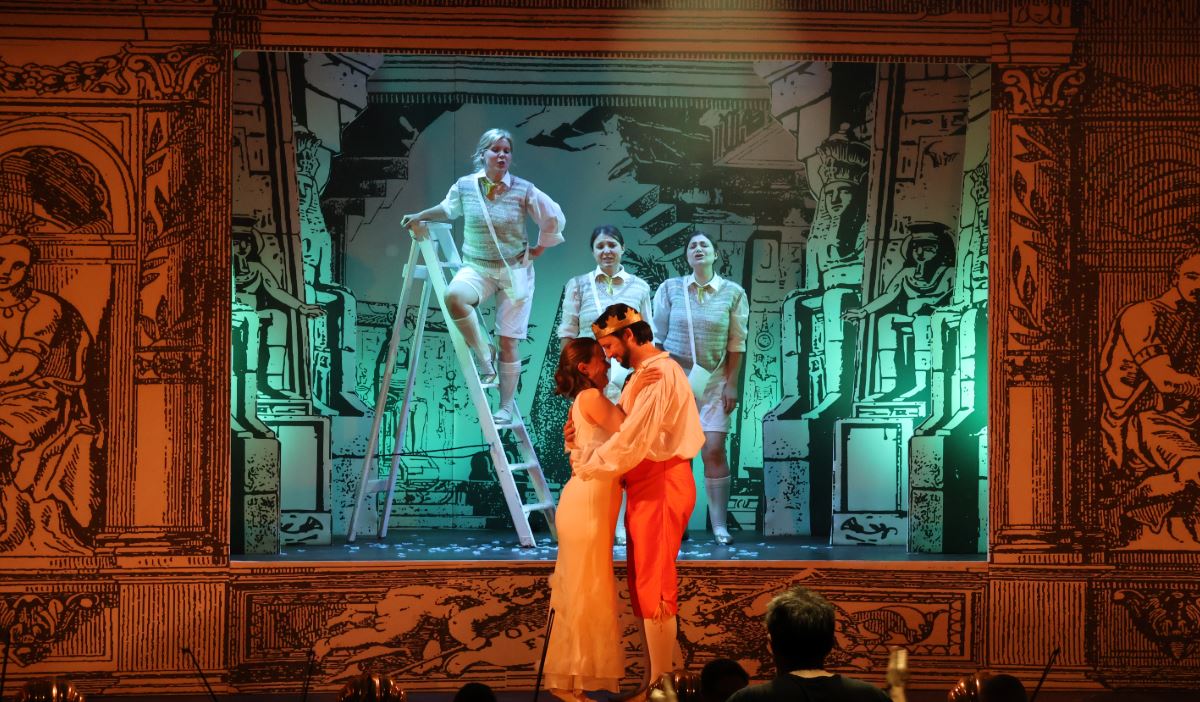
Central to the plot is Tamino’s transformation from that timorousness to courage, as he matures in moral strength. William Morgan in the role takes him on that journey with convincing characterisation. Morgan’s engaging tenor is assured and firm, and makes an impression from his first Dies Bildnis aria: he is given a locket with a miniature portrait of Pamina and immediately falls in love with her. (It is a fairy tale.) His rendition of this love song has real conviction and warmth.
Pamina, the object of his infatuation, is the daughter of the disingenuous Queen of the Night, who convinces Tamino that Pamina has been imprisoned by the high priest Sarastro, whom she misrepresents as being an evil tyrant. Pamina’s tribulations are compounded by the rapacity of Monostatos, the overseer for Sarasto, and Tamino’s apparent indifference to her affections, as well as the trickery of her own mother. In the role of Pamina, Harriet Eyley is enchanting, her beautiful lyrical soprano acting out the nuances of Pamina’s emotional journey. Her aria Ach, ich fühl’s expressing Pamina’s feeling that she has lost Tamino overflows with deep pathos.
The bird-catcher, Papageno is the ordinary bloke of the allegory, who only wants food, drink, somewhere to live and someone to love. But he gets sucked into the adventures of Prince Tamino by dint of being in the wrong place at the wrong time and then lying that he killed the anserine “serpent”. Mark Nathan’s Papageno attracts empathy. One can understand why his character often falls short of what is required of him. There is warmth in his strong baritone, which impresses even from his introductory Der Vogelfänger bin ich ja, explaining his position as a bird-catcher, and his views on life. Poor Papageno is compelled by the temple priests to go through the same trials as Tamino, ritually testing their courage and steadfastness, even when forced to maintain their silence.
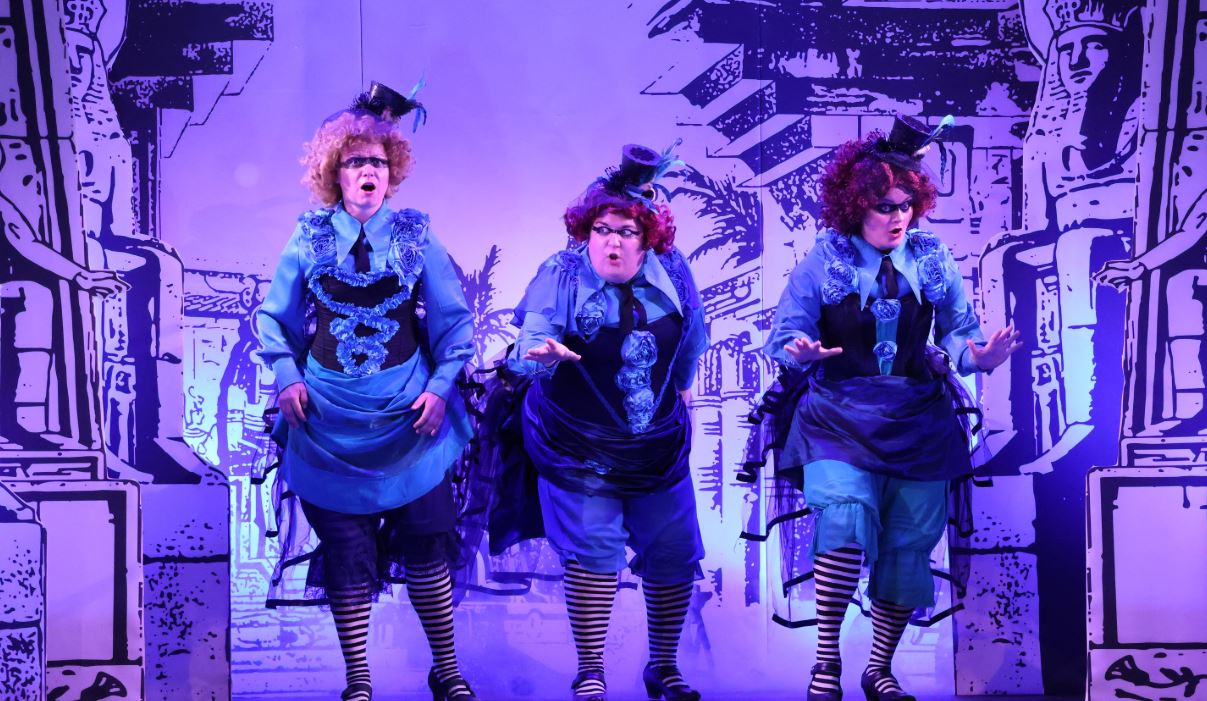
The costume interpretations of Jill Rolfe and her assistants are inspired, and include the Three Ladies in vaguely Victorian stage attire, blue taffeta, hooped stocking and mini-toppers; and the Three Spirits as nineteen-fifties schoolboys in cricket-white shorts and pullovers. The Three Spirits, often played by boy trebles, here are soprano Jennifer Clark, and mezzos Kristina Nikiforova and Angharad Davies-White, all of whom have a charming lightness of touch and beautifully expressed singing. In this production the Three Ladies, sopranos Galina Averina and Lowri Probert, and mezzo Georgia Mae Bishop, seem more foregrounded than usual, and certainly help drive the plot with real gusto.
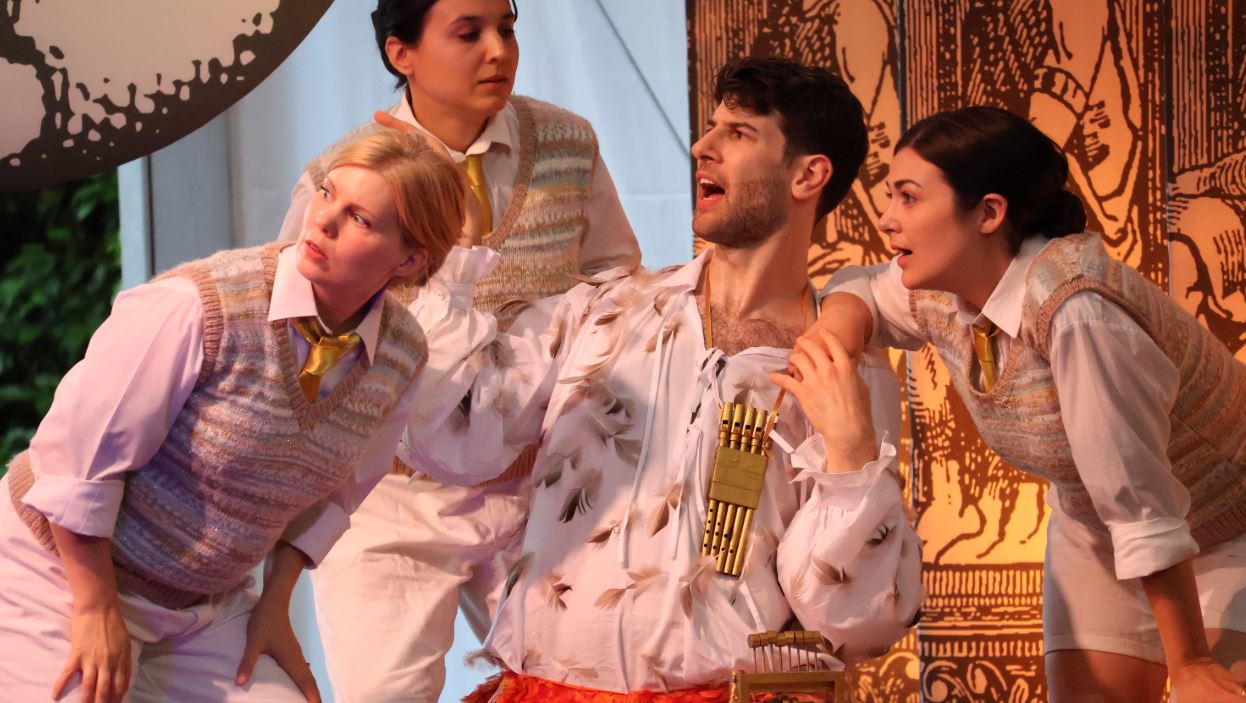
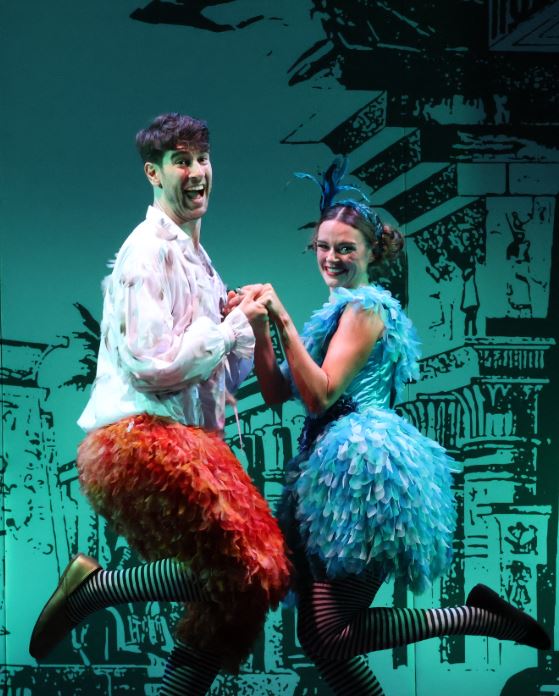
An interesting costume choice is to have Papageno and Papagena both as almost half bird, their thighs generously be-feathered. Perhaps Papageno has almost become his own stock-in-trade. He even says a one point that he feels plucked. Kirsty McLean is a delight as a spirited Papagena, transmogrifying from flirtatious old crone to charming and pretty betrothed, the girl of Papageno’s dreams. McLean’s lyric soprano charms with its clarion tones and simplicity of delivery. Their patter duet anticipating marital, and parental, bliss, Pa-Pa-Pa-Pa-Pa-Papageno is an absolute joy to hear.
In a remarkably talented cast, two performance stand out from an extraordinary team, the roles of the rivals, the Queen of the Night and Sarastro, here in even sharper contrast to each other. Nazan Fikret is gloriously dramatic as the Queen of the Night. Her coloratura convolutions and thrilling range, encompassing those high-Fs, seem to come with ease. The Queen’s first aria O zittre nicht, urging Tamino not to tremble, as she persuades him to “rescue” Pamina from Sarastro, is amazing. One feels hardly able to wait to hear her well-known second aria, Der Hölle Rache, which exhibits how Fiket’s high tessitura comes naturally. It is a tour de force. Both arias are delivered with scary vehemence.
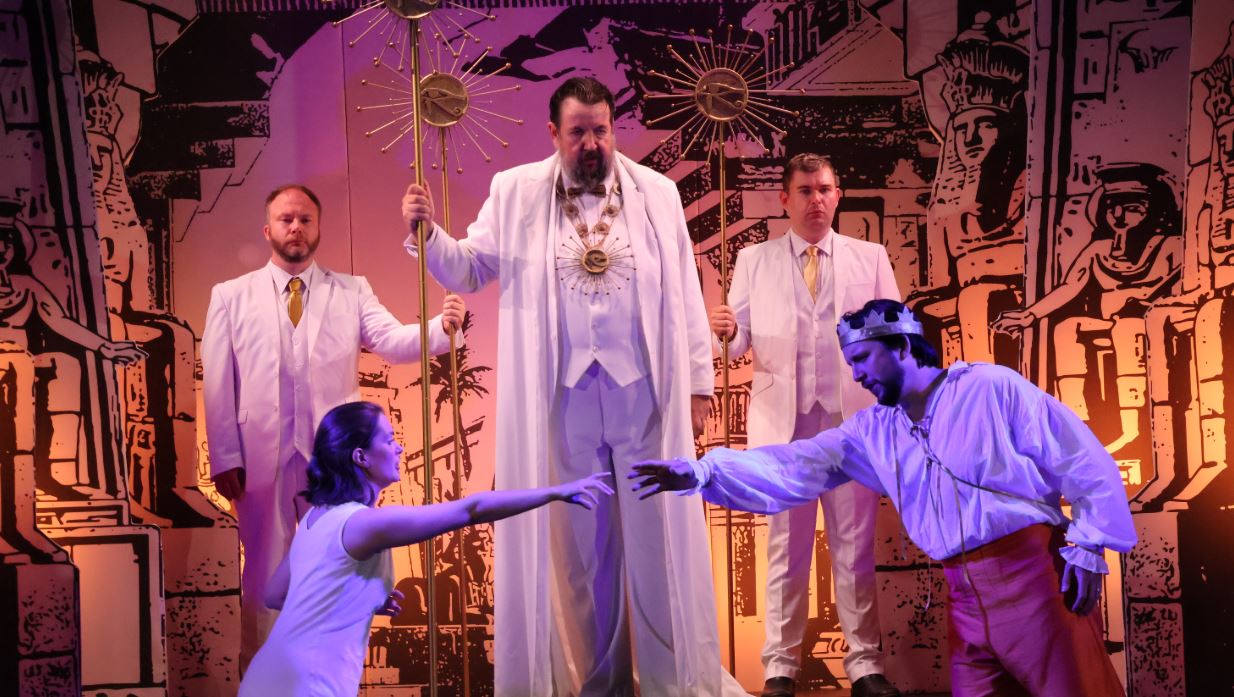
Sion Goronwy’s commanding physical stature brings an imposing stage presence to the role of Sarastro, which is reflected in his richly profound bass voice. His characterisation of the High Priest is as a sage, dignified and open-hearted patriarch. Sarastro has some gorgeous arias. Goronwy imbues the priests’ prayer to his gods, O Isis und Osiris with expressive richness, as he effortlessly plumbs the depths of his register, to the low Fs that few can manage. As he later reassures Pamina that revenge is unknown in the holy halls of his temple where love reigns supreme, In diesen heil’gen Hallen, the warmth and sincerity of his beliefs are beautifully expressed in Goronwy’s velvet tones.
Amongst Sarastro’s followers, Frazer Scott firmly reinforces the bass line with his Speaker, as a figure of authority who shows some sympathy to his charge, Papageno’s plight. Similarly clad in a white suit, tenor Dafydd Allen completes a superfine trio of Celtic vocal prowess.
Making another marked character contrast, is Peter Van Hulle’s thwarted ravisher, Monostatos. Lithe-limbed Van Hulle wears black, and he camps up the part. He clearly relishes these character roles (Bardolph last time at West Green), and has great solo fun with Das klinget so herrlich, when Monostatos is mesmerised by Papageno’s magic bells.
In this intimate production there is no chorus, hence Monostatos’ solo, and most of the smaller parts are absorbed into other characters. And it is played much to the better, giving clarity and insight into much of the music, both vocal and instrumental.
Conductor, Jonathan Lyness has arranged a reduced score for the eighteen-strong West Green House Orchestra, but nothing of consequence is lost from Mozart’s inventive score. The orchestra are clearly enjoying the pruned lavishness of the work, here concentrated in an instrumentation that is integral to the action of stage; and is great fun.
This Magic Flute has a wide-ranging appeal, as indeed was intended for Schikaneder’s playhouse, is broad on comedy and high on all the musical and technical skills to make a really enjoyable production. It’s quite a breeze, but still has the moral tale to tell. Wolfgang Amadeus would approve.
Mark Aspen, July 2026
Photography by R Studer


