
Murder in the Cathedral
1179 Meets 1935 Meets 2026
Murder in the Cathedral
by T S Eliot
Orange Tree Theatre at St John the Divine, Richmond until 7th November
Review by Patrick Shorrock
Just after lockdown, Ralph Fiennes gave readings of T S Eliot’s Four Quartets in the theatre. Even though not actually drama, Eliot’s poetry made for a riveting evening. While Eliot wrote several plays, it is very welcome to encounter the most famous of them in a production by the Orange Tree Theatre. Sensibly they have moved across the road to the church of St John the Divine, Richmond, which gives them very much the right environment for a play that is set in a cathedral, as well as enabling work on the renovation of their theatre building to continue.
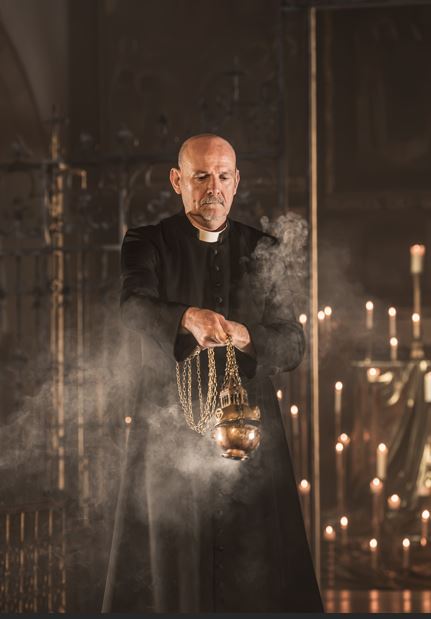
Sacred space being the site of deliberate murder is somehow far more shocking in an actual church. Here, priests in full vestments are in their natural environment, a holy place, fragrant with incense. Rebel Archbishop of Canterbury, Thomas Beckett ascends an actual pulpit when he preaches on Christmas morning.
We are not given much detail about Beckett’s quarrel with his former friend King Henry II. They have been at loggerheads for many years by the time the play begins, as Beckett returns from a seven-year exile in France. Eliot focusses on more general issues about when people need to oppose the state on grounds of conscience, and how they can do it in a way that avoids narcissistic self-indulgence. These were very live issues at the time the play was written, when state power was becoming virulently fascist and antisemitic in Germany.
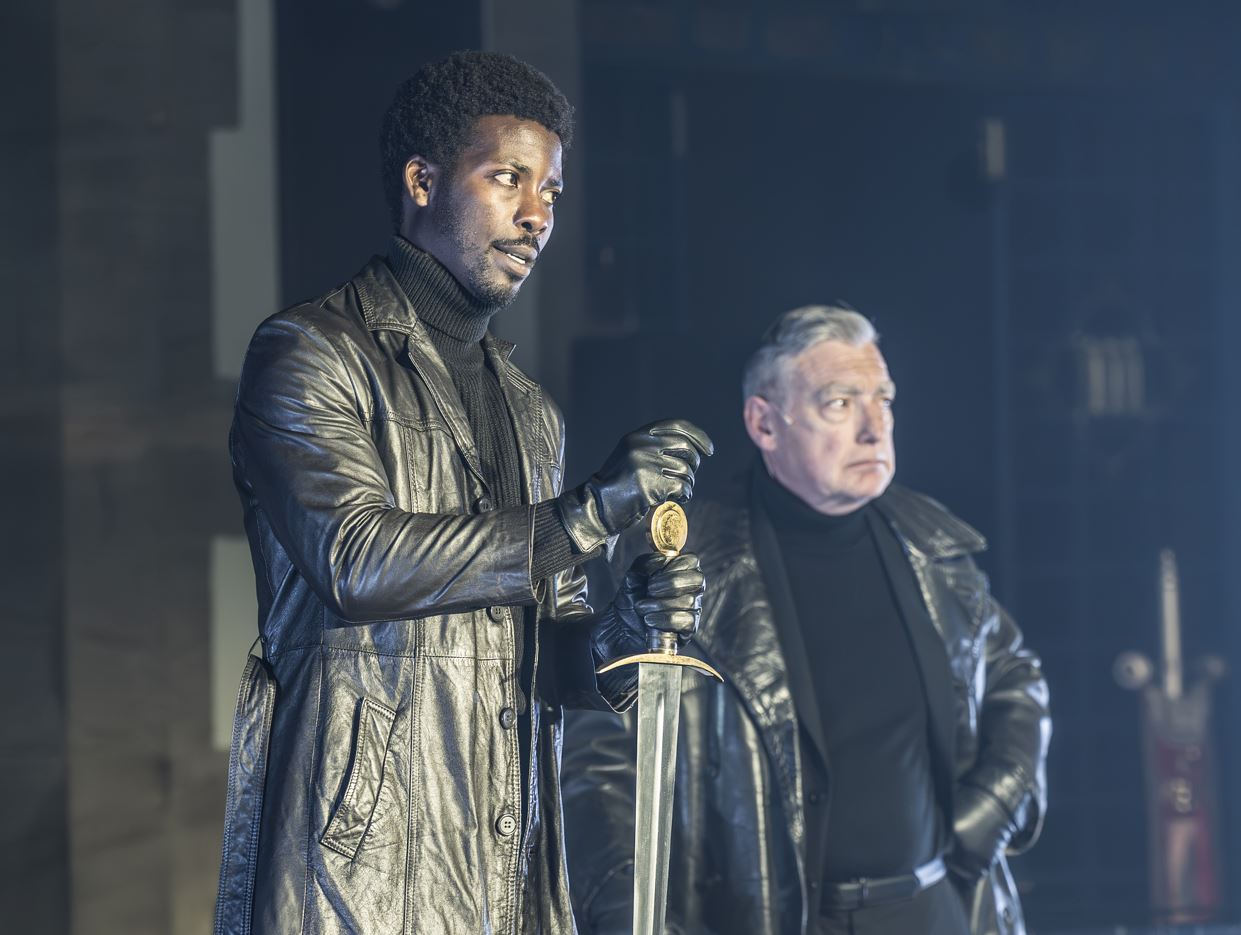
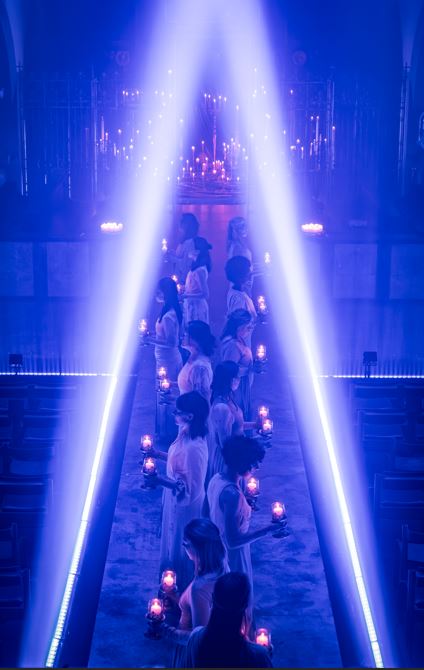
In this production from Tom Littler, 1179, 1935, and 2026 all meet headlong. The tempters who enable us to see into Beckett’s mind wear modern dress, while the murderous knights sport black shirts and leather trench-coats (costumes by Cat Fuller) that could be contemporary or from the 1930s. By contrast, the garb of the clergy – cassocks and vestments – is timeless, as is the chorus of the women of Canterbury, all in different identically stone-coloured dresses.
Beckett famously observes, “The last temptation is the greatest treason:/To do the right deed for the wrong reason”. The play is clear that Beckett’s opposition and allowing himself to be martyred is the right deed, but is much more ambiguous about whether it is for the right reason, possibly because this is something that can only be known by God. Tension is screwed up to an almost unbearable extent when the assassins hammer on the door of the cathedral that the priests have barred, chillingly depicted by the beating of a drum.
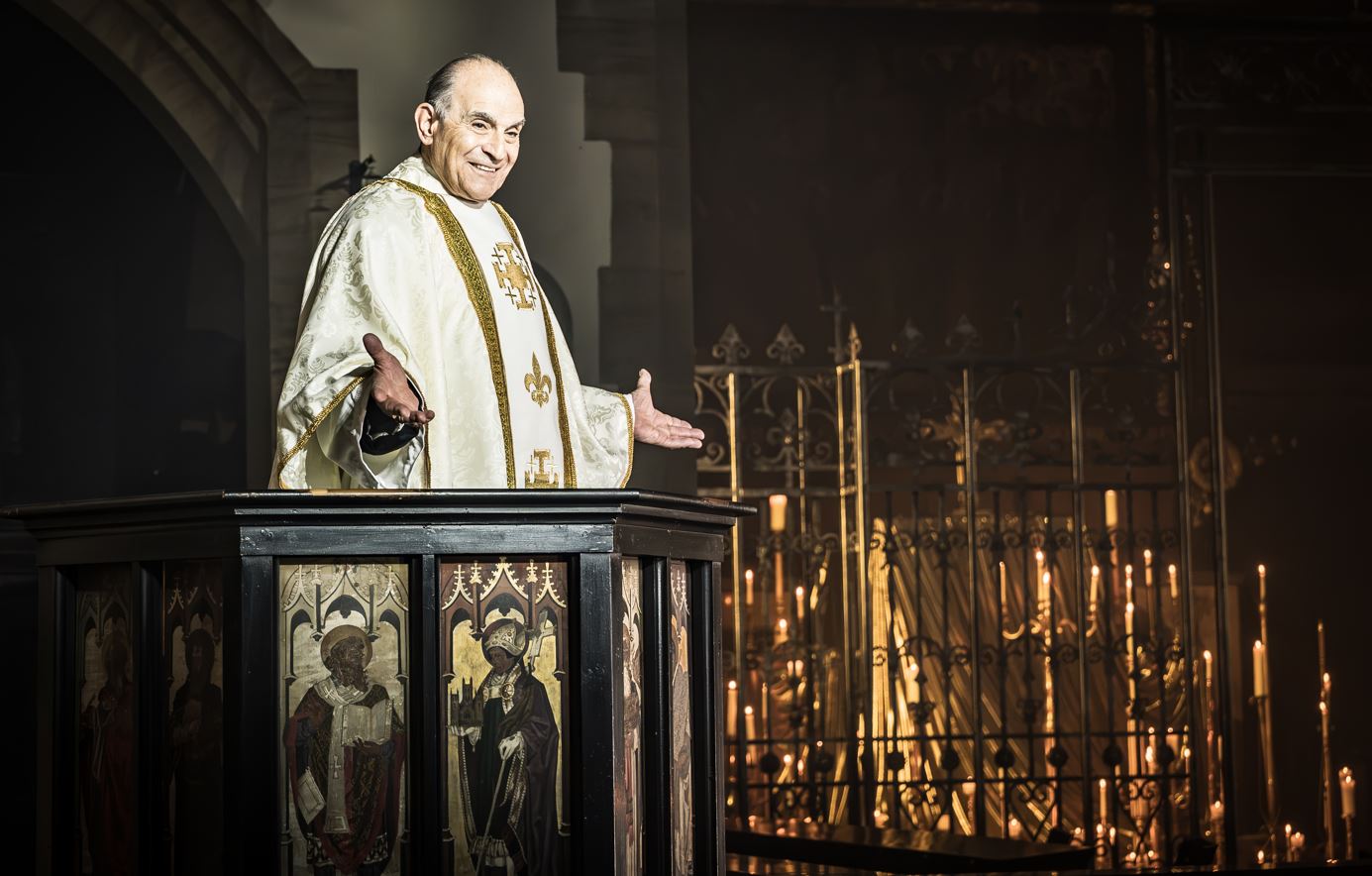
So much of the play is dramatic in ways that feels original and unexpected. We have Beckett preaching a sermon from the Church pulpit on Christmas morning (whilst drily indicating that it will not be a long one and probably his last). After the assassination, the knights have a lengthy session when they break the fourth wall and attempt to justify themselves to the audience. Their evasive excuses are deliberately cringe-making in a way that suggests that the language used by politicians in the face of media questioning was already pretty debased by 1935.
Eliot is uncompromisingly serious in his approach, with elevated, very poetic, often rhyming language, and a chorus of women of Canterbury that signifies his aspirations to Greek tragedy. Whilst this is very on trend, possibly as a result of Christopher Nolan’s Odyssey, theatres have generally struggled to do Greek tragedy successfully without drastic re-adaptation. There is similar risk here, especially in passages such as “I have tasted/The living lobster, the crab, the oyster, the whelk and the prawn;/and they live and spawn in my bowels, and my bowels dissolve in the light of dawn”.
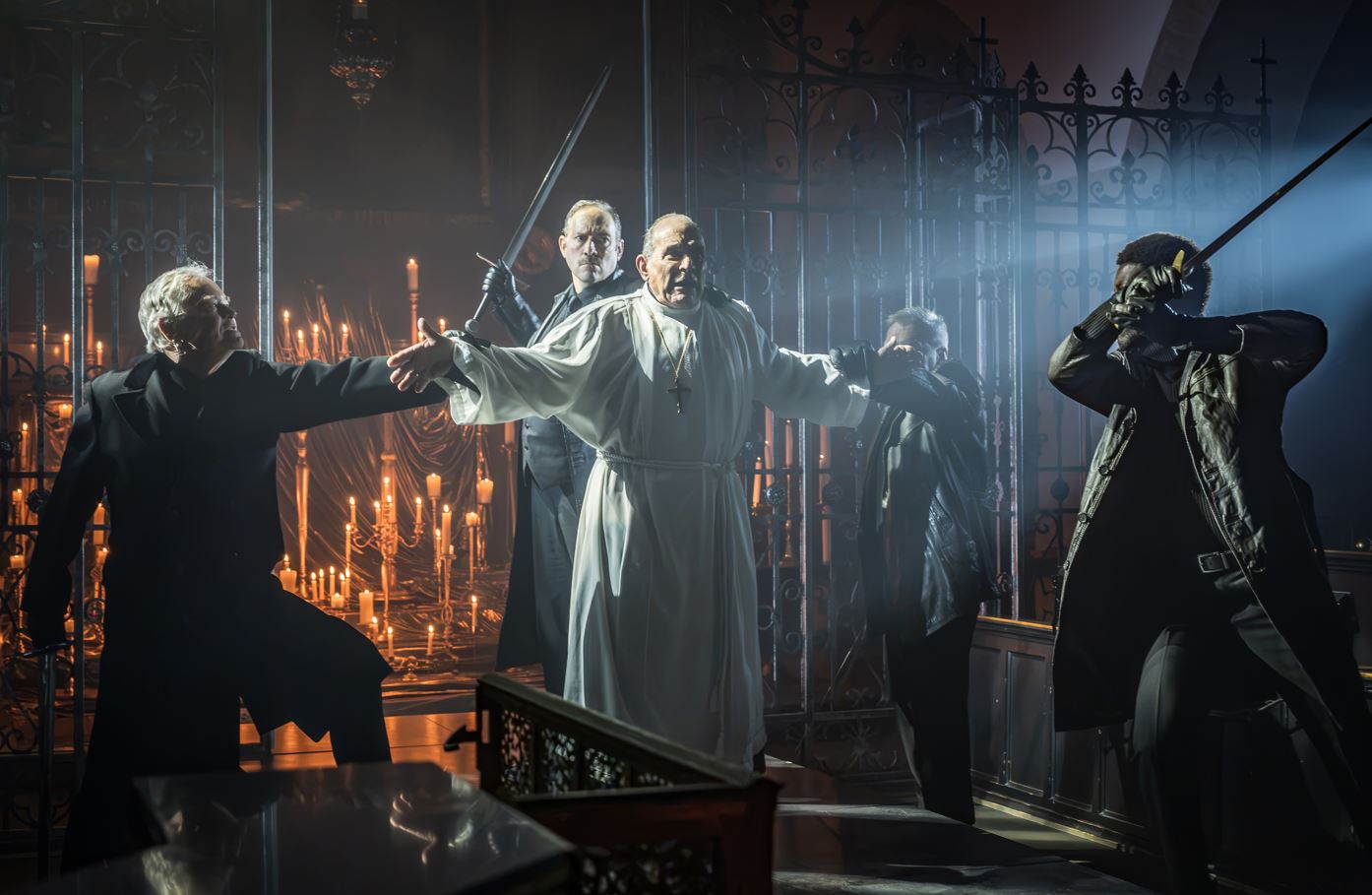
Tom Littler and his cast go for it with complete conviction and complete success. David Suchet has more than enough presence to carry off this high serious style and wears his chasuble with complete naturalness, as though he wore vestments every Sunday. It’s a simple unshowy performance that trusts in the text. The three priests – Michael Lyle, Paul Hickey, and Mensah Bediako – are all very different but come across as men who have said Mass together and known one another for a long time. The knights and the tempters are played by the same actors, which works really well, whether the slick, smooth operator Jyuddah Jaymes, the more overtly thuggish Ben Caplan and Nick Sampson, and the chillingly establishment David Yelland, who looks as though he has come straight from the Athenaeum.
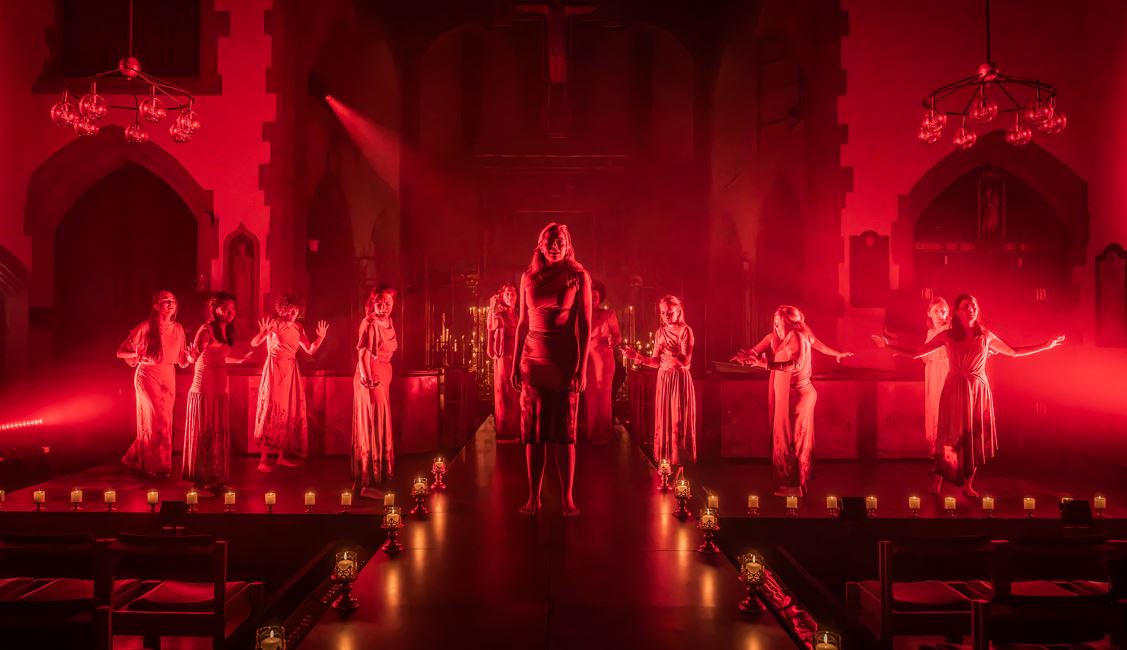
In many ways, the standout performance comes from the Chorus, a community ensemble of eighteen women rehearsed by Francesca Ellis, plus four singers (Sally Cheng, Rebecca Thorn, Mila Carter, and Chyna-Rose Frederick). Much of the play is written for chorus, who declaim individually as well as together, and also sing, which provides helpful variety. Orlando Gough’s music is magnificent -vaguely Mediaeval but bent into a very 21st century sound. It doesn’t try to be too complex — the care to try and ensure that the text remains fully audible is evident — although these harmonies must be quite challenging to sing, and this music would be worth hearing on its own in a concert. Discreet use of a bell to start a scene and a drum to end a speech adds an element of ritual and means that the performers can act naturally within a framework that provides an appropriate degree of formality.
One of the main challenges of using a church as a theatre is that the seats are not raked and there is a risk of not being able to see properly unless you are at the very front. Robert Jones’s set demonstrates full awareness of this potential problem. The raised walkway that connected to the chancel — which is already on a higher level — ensures that everyone has a decent sight of the action. Peter Mumford’s lighting is masterly, discreetly effective at underlying a change of mood or scene, but never making us feel that we are in a theatre rather than a church. This is a seriously impressive performance of a long overdue play by the Orange Tree.
Patrick Shorrock, October 2026
Photography by Marc Brenner


