
Aïda
Monumental
Aïda
by Giuseppe Verdi, libretto by Antonio Ghislanzoni
Instant Opera at the Landmark Centre, Teddington until 11th October
Review by Mark Hamesmoor
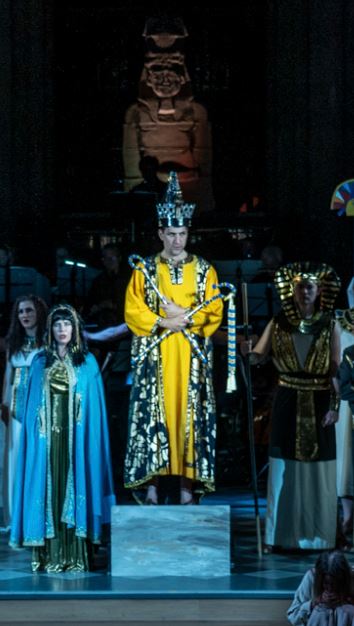
Verdi’s Aïda consistently stands at the forefront of opera repertoire for it’s dramatic plot, rich orchestration and powerful solos. Set in Ancient Egypt, it is a story of war, emotional and political conflict, love and eventual sacrifice.
Instant Opera’s (IO) production was staged at the Landmark Centre in Teddington, a former church of majestic proportions, now converted for use as an arts venue. In the current climate of reduced funding for opera at the main houses, it is a testament to local initiative and talent that a production of this scale can be mounted, achieving a level of performance that is only a hair’s breadth from that which could be seen on the London stage.
The Landmark Centre proved the ideal venue for Aïda, with it’s over-sized proportions and generous acoustics. IO used the venue to great effect with an imposing Egyptian statue as a backdrop, coupled with props and lighting to direct the eye to the front of the stage. Unusually, the orchestra and conductor were behind the performers (there being no practical pit) but this paid off in terms of sound balance with only a small compromise on ensemble between the singers and players.
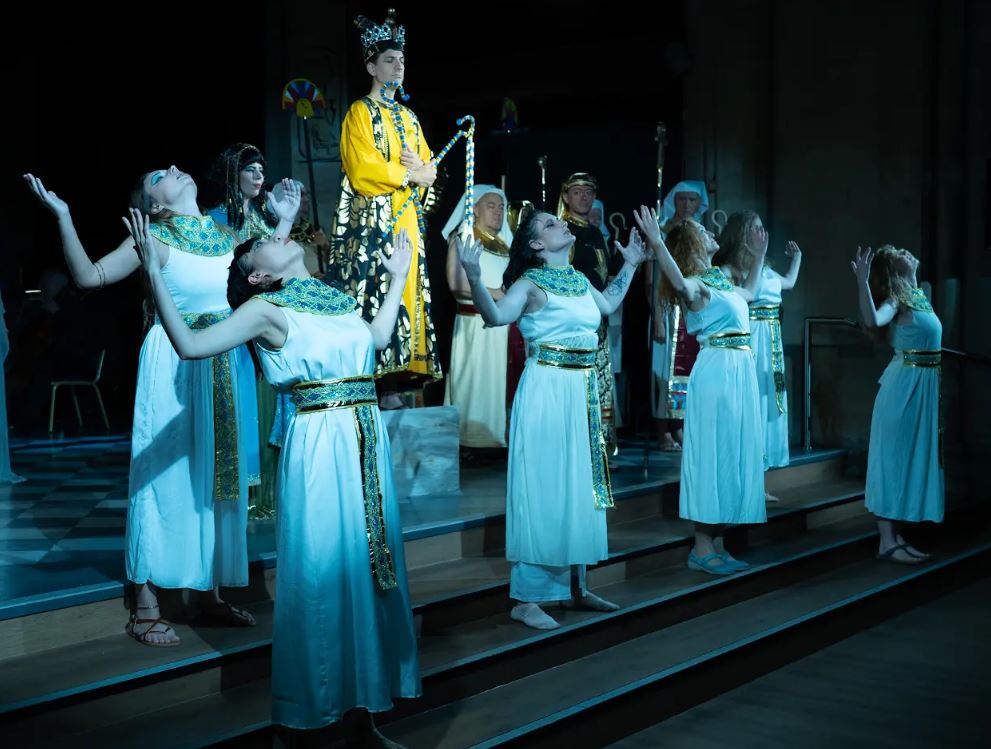
In Act One the main characters are established: Radamès, a young warrior (Anando Mukerjee, tenor), Amneris, the daughter of the Egyptian King (Hannah Aurora Kramer, mezzo-soprano) and Aïda, an Ethiopian slave (Kaylee Norris, soprano). All three performers embodied their roles from the outset, singing their initial arias with confidence and technical security. By the end of the first scene in Act One, the die is firmly cast for the rest of the plot with Amneris and Aïda competing for the affection of Radames. The entry of the King (Tobias Odenwald, bass), with the chorus of priests, ministers and captains, heralds the first of the ceremonial scenes which are a hallmark of Aïda. Odenwald, his tall stature further enhanced by standing on a platform, commanded the stage with the support of the chorus who announce the forthcoming battle to be led by Radamès.
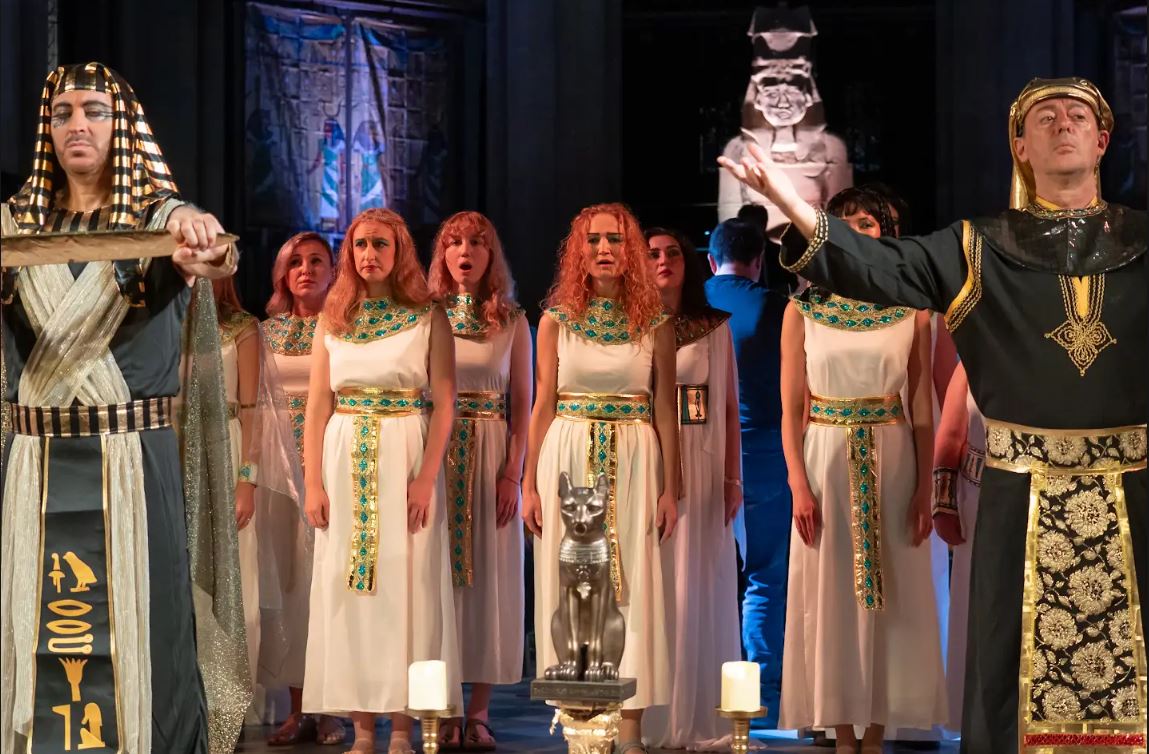
Amneris takes centre stage, portrayed in her chamber, at the start of Act Two. This scene was beautifully realised and augmented by dancers representing Moorish slaves. Amneris tricks Aïda into confessing her love for Radamès and her jealousy is laid bare. In Scene 2, the grand gate of the city of Thebes is portrayed and in this production, the mood shift was represented by sudden white stage lighting. Radamès returns victorious from battle, heralded by the brass section in the orchestra who were indeed triumphant. In a twist of fate, however, Aïda’s father is presented as a captive. The act ends with a section of richly scored music by Verdi, composed of six soloists interwoven with choruses representing the prisoner slaves, the priests and the people. Here the IO production excelled with a perfect balance of orchestra, chorus and soloists. The IO chorus were also realised to their full potential. An imperious king and victorious Radamès presided over an imposing creation of this scene.
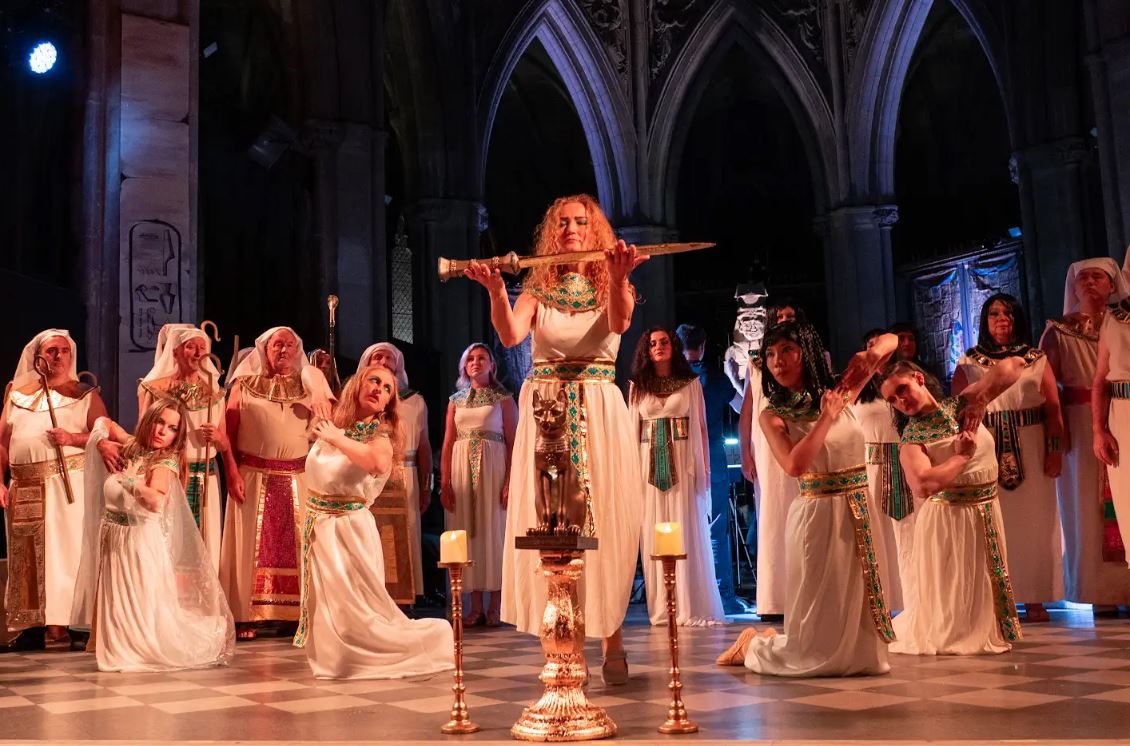
In Act 3 Aïda is torn between her love for Radamès and loyalty to her father and her native land. The intensity of the story develops and the audience is drawn into the plot. At this point, the IO production really started to fly with the characters owning their internal conflicts, which ultimately have no resolution and result in a betrayal of the military plans by Radamès. Aïda convinces Radamès to escape with her into the desert.
The opera closes with Act Four, which portrays the trial of Radamès for treason and his sentence to be buried alive. The burial vault was realised on stage by a series of lightweight blocks, moved into position by the cast as if they were stone. This stretched the imagination a little, but nevertheless, the movement one-by-one marked the inevitability of Radamès’ fate. Once there is no escape, he finds that Aïda has also entered the tomb to die with him. In the final duet, Norris and Mukerjee achieved perfect vocal control with their series of farewells to each other and the world.
Overall this was a very impressive show with great attention to detail, fine musical performances and a very effective use of the Landmark Centre as an auditorium.
Mark Hamesmoor, October 2026
Photography by Colin Clarke and Jon Lo Photgraphy


