
The Cherry Orchard
Not In Mine
The Cherry Orchard
by Anton Checkov, in a version by Ben Clare
Teddington Theatre Club at the Hampton Hill Theatre until 16th October
Review by Polly Davies
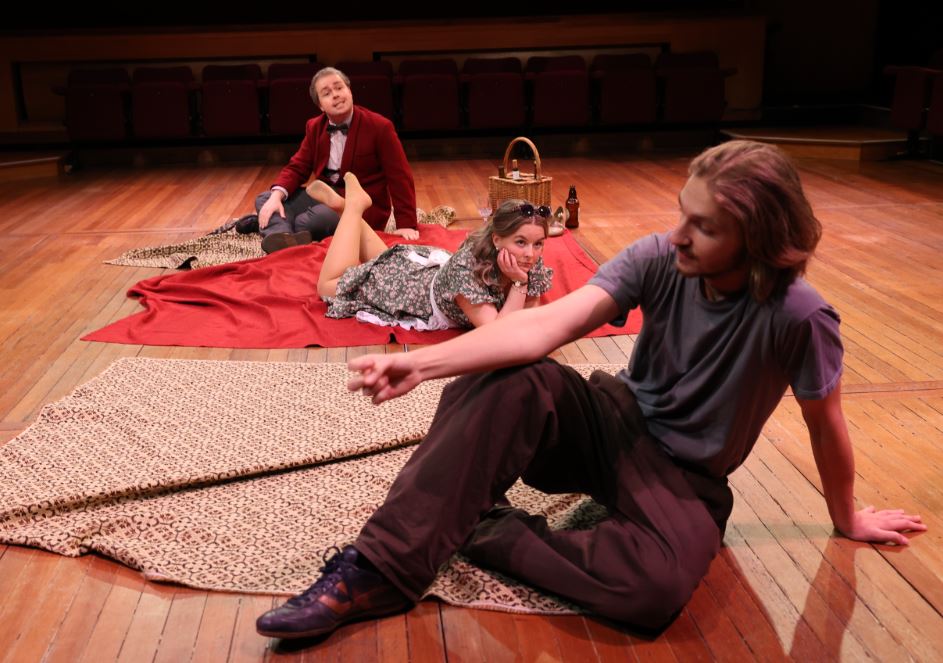
With wars, social media and AI competing to disrupt our way of life it is not surprising that Chekhov’s The Cherry Orchard is having something of a revival. And TTC’s is a fascinating and sometimes intense interpretation of this well-known play.
The plot follows the emotional reunion of Liubov Ranavskaya, a Russian aristocratic, with her childhood home. Her abiding memories are of the large cherry orchard that is a well-known feature of the estate, and the death of her young son. The play is set in the early part of the 20th Century; a time of change in Russia. The emancipation of the serfs at the end of the last century is bringing social change. Life is no longer easy for the elite, and a new middle class is emerging which both resents and seeks to emulate the aristocracy. A communist ideology is emerging which, before long will seed the Russian revolution. Against this background, Liubov and her family have lost the wealth and position they had taken for granted and their family estate is up for sale. And to make matters worse her beloved cherry orchard is likely to be cut down and replaced by Dachas, holiday homes, for the new middle classes.
Ben Clare’s production is set in the round in a studio space at Hampton Hill. A simple set with just a few chairs or blankets under a canopy of paper white cherry flowers serves as both the nursery of the house, a party ballroom and an orchard.
This close-up setting really works for the much of the time especially for the scenes which feature Melanie Richardson’s totally convincing Liubov. Sometimes playful, sometimes desperate, she is every inch the aristocrat. Generous and kind, but quite incapable of adapting to the new world in which she finds herself, and only too happy to run away from it. In such an intimate setting we feel her emotions, share in her despair, and recognise the inevitability of the loss of her old life. Similarly in the scenes where the radical student Pyotr embodies the coming change. Barney Healy-Smith’s soliloquy at the picnic, admirably updated by Ben Clare, really packs a punch. But at other times I found the closeness a bit distracting. Too much watching the backs of people walking about in circles. Similarly, I found the guitar music in the picnic scene, nice as it was, a bit jarring. I was caught up in C19th Russia, and the switch to modern Britain was a distraction.
But overall, it was a thought-provoking and entertaining afternoon. I am sure that Chekhov never thought of himself as a feminist and yet the female characters as portrayed by Sofia Pricolo (Varya), September Taliana-Cary (Charlotta), Cara Bullimore (Anya) and Meaghan Baxter (Dunyasha) are feisty and powerful, despite the social constraints of the time; while the men are either feeble or grasping or both. David Webb’s Leonid is delightfully decadent, as is Luca Vanderson as Liubov’s restless young manservant, happy to flirt with Dunyasha but anxious to return to the bright lights of Paris.
Dominic Lloyd’s Boris Simeonov-Pishchick is an unrealistic optimist, always in need of a loan, but fun, and it was impossible not to feel sorry for Alex Farley’s hapless Semyan Eipikhodov. And yet the star must go to Ian Kinane as Ermolai Lopakhin. Switching between obsequiousness and triumphalism he kept to Chekhov’s vision of a self-made man finding his way in the new world order. But was also recognisable as a modern-day egocentric capitalist. Clever and successful, wanting to be seen as altruistic, but on balance selfish and unable or unwilling to feel or at least show emotion.
A very special mention goes to Muriel Keech. A brilliant switch in this production from aged manservant to long-serving nanny gave her Firs a special poignancy; simultaneously regretting the loss of the old order and her caring role with the still child-like Leonid. I am not sure which was the most affecting, her final speech or the accompanying superb sound effects of the house being closed for the last time, but both were chilling.
Polly Davies, October 2026
Photography by Steve Sitton


