
Blood of My Blood
Habitable Histories
Blood of My Blood
by Joy Nesbitt
The English Stage Company at The Royal Court Theatre, Chelsea until 7th November
Review by Ravenna Vale
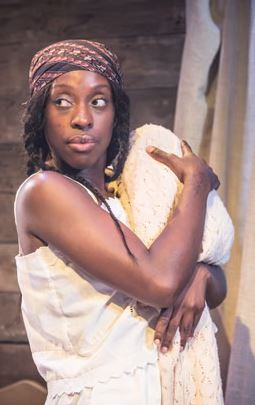
There are histories that refuse to remain buried. They linger in the walls of old houses, in the silences between generations, and in the lives of those who inherit the consequences of events they never witnessed. In Blood Of My Blood, playwright Joy Nesbitt brings these ghosts into the present, crafting a searching, provocative drama about ancestry, ownership and the uneasy question of who has the right to claim a story. Staged at the Royal Court Theatre, this is a production of considerable ambition, emotional depth and startling theatrical intimacy, elevated by an immersive design and a company of actors whose performances breathe extraordinary life into its intergenerational narrative.
The play’s setting is a cabin in South Carolina, bridging 1862 and the present day. Once a home during the American Civil War, it becomes, in contemporary America, a ‘fashionable’ Airbnb, where a pregnant Black woman turns to conjure up the voices of her ancestors in search of answers. Nesbitt understands that the past is not merely a sequence of events to be revisited; it is an active presence, shaping identity, complicating belonging and demanding recognition. The cabin becomes a repository of memory, a contested inheritance and a reminder that history is never as distant as those who benefit from forgetting might wish. What happens when a place marked by suffering becomes a consumer experience? And what does it mean to inhabit a space whose history has been repackaged, sanitised or simply ignored?
These questions are made all the more potent by Natalie Pryce’s remarkable set design. Rather than placing the audience at a comfortable distance from the action, Pryce creates an entire cabin, surrounded by grass that extends into the audience’s seating area. The conventional boundaries between stage and auditorium dissolve. There is no proscenium through which to observe the action as something safely removed from ourselves. The grass beneath the audience becomes more than an aesthetic flourish: it is an invitation to inhabit the play’s world, to feel implicated in its histories and to recognise that the ground on which we sit may carry stories we have never bothered to hear.
The effect is quietly extraordinary. The cabin feels less like a theatrical construction than a place with a life before the audience arrives and a life that will continue after it leaves. Its intimacy lends the production a raw, almost intrusive immediacy, allowing moments of tenderness, confrontation and unease to unfold at close quarters. Pryce’s achievement lies in making the setting, not just the backdrop to the drama, but one of its core arguments. This is a play about the histories embedded in places, and the production allows us to feel, quite literally, what it means to occupy one.
That physical intimacy is matched by an impressive fluidity of performance. As characters move between the present day and their ancestors, the cast navigates the play’s shifting temporalities without reducing its generational connections to a theatrical gimmick. The transitions reveal how much can be inherited beyond blood itself: gestures, instincts and silences that survive long after their original circumstances have changed. The effect is not simply to suggest that the past repeats itself, but to expose the unsettling ways in which it continues to inhabit the present.
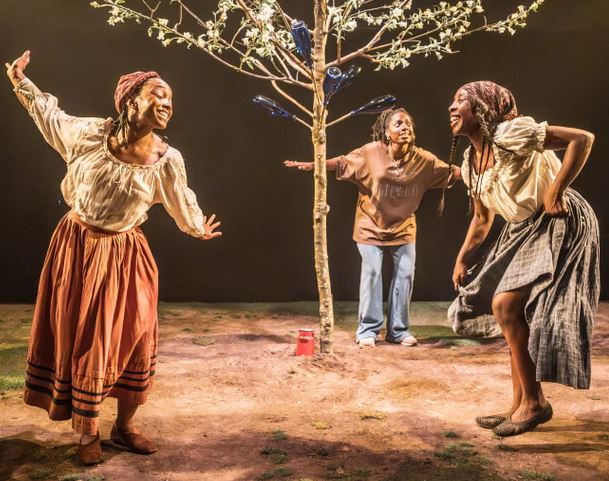
Hannah Morrish is a particular standout. Her transformation between the eager, jumpy Amanda and the cruelly controlled, dismissive Nora is striking in both its precision and its emotional intelligence. The contrast is not only a change in temperament; it is an entire shift in the atmosphere of the room. Amanda’s humorous awkwardness carries a sense of spontaneity and social ease, while Nora’s cold authority seems to close down the space and characters around her. The transition is stark and, at times, shocking. It is a performance that demonstrates how an actor can make the audience feel the difference between characters, not simply through what they say, but through the very conditions under which they permit others to speak.
Jodie Campbell, meanwhile, offers a masterclass in naturalism. Her acting feels refreshingly unforced, attentive to the rhythms and irregularities of actual conversation rather than the polished cadence of theatrical dialogue. The half-formed thought, the hesitant “um”, the throwaway “fuck”, the seemingly inconsequential aside: Campbell understands that these details are not incidental to characterisation but fundamental to it. Real people interrupt themselves, contradict their own thoughts, fill silences awkwardly and say things they might immediately regret. Campbell makes room for all of this. Her delivery possesses an ease that makes the character feel discovered rather than performed, and it is precisely this apparent effortlessness that makes her work so compelling. Such naturalism should be the standard, not the exception.
At its heart, however, Blood Of My Blood is a play about women: their stories, their friendships and their struggle to retain ownership of their own narratives. Its women are not simply vessels through which historical suffering is communicated. They possess contradictory desires, difficult loyalties, sharp humour and relationships that refuse to be neatly categorised. The friendships between them provide the drama with some of its most affecting moments, offering solidarity without pretending that solidarity eliminates conflict. There is a natural, genuine tenderness in the way these relationships are allowed to breathe, and a recognition that women’s lives are shaped as much by their connections to one another as by the histories imposed upon them.
Nesbitt’s achievement is to place these voices at the centre of a story that might otherwise have become an exercise in historical exposition. The women are not peripheral to the past; they are its witnesses, its interpreters and its living continuation. Their conversations, confrontations and moments of mutual recognition become acts of reclamation. In a play concerned with who gets to tell history, allowing women to speak on their own terms is itself a radical gesture.
There are moments when the play’s considerable thematic ambitions threaten to overwhelm its dramatic focus. Slavery, inherited trauma, reproductive experience, ancestral memory and the politics of ownership are enormous subjects, each capable of sustaining a drama in its own right. Occasionally, their accumulation leaves less room for individual ideas to settle and resonate. Yet this is a limitation of proportion rather than imagination. Nesbitt’s willingness to grapple with such complex material is precisely what makes the work exciting.
For a debut play, Blood Of My Blood announces a writer worth watching. Joy Nesbitt is certainly a playwright to look out for.
Ravenna Vale, October 2026
Photography by Marc Brenner


