
Faith Healer
Healing in Ealing
Faith Healer
by Brian Friel
Questors Productions at the Questors Studio, Ealing, until 24th October
Review by Andrew Lawston
In an era of fake news, AI content, social media misinformation, and polarised attitudes on any issue you care to mention, unreliable narrators have increasingly moved from fiction to the forefront of our everyday lives, and as such this evening’s production at the Questors Studio feels particularly timely.
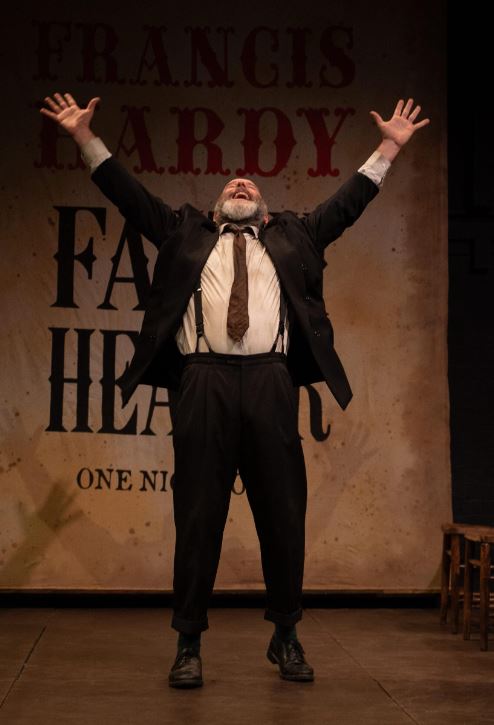
Brian Friel’s Faith Healer is a deceptively simple tale of Frank Hardy, a travelling faith healer who journeys through the Welsh, Scottish, and Irish countryside with his partner Grace and his manager Teddy, attempting to cure the sick. Against black walls adorned with a single enormous poster for Frank’s act, the play is told in four lengthy monologues, each of them almost a short play in its own right. But each of the monologues returns to the same events and relationships, and all of them tell a slightly different story.
Are these characters misremembering, due to long years and the effect of alcohol, or are they deliberately lying? And are they lying to the audience, to each other, or to themselves?
Some of the differences are minor enough. As the play opens, Frank talks at length about his partner Grace, describing her as a Yorkshirewoman and as his mistress. When Grace later appears for her own monologue, she speaks with an Irish accent and is emphatic throughout that she was Frank’s wife. And some are more of a matter of perception. Frank and Grace recall their vicious arguments, while Teddy acknowledges them, but describes the couple as being almost childlike in their outlook.
Other discrepancies are more ambiguous. Grace gives a one account of a tragic event in their lives, where Frank appears compassionate, grief-stricken, and engaged. Teddy’s account, however, has Frank marching away from the scene without looking back, pretending not to hear his manager calling after him.
The audience is invited to speculate on which account of events may be the closest to reality, but to a certain extent this doesn’t feel important by the end of the night. It’s not truly important whether the song Frank plays at the start of his shows is an apparently random choice (Frank’s version), a deliberate joke by Frank to confuse the audience (Grace), or the song they played at their wedding (Teddy’s account). The important question is why some of the characters are misremembering or distorting facts, and what it says about them and their relationships.
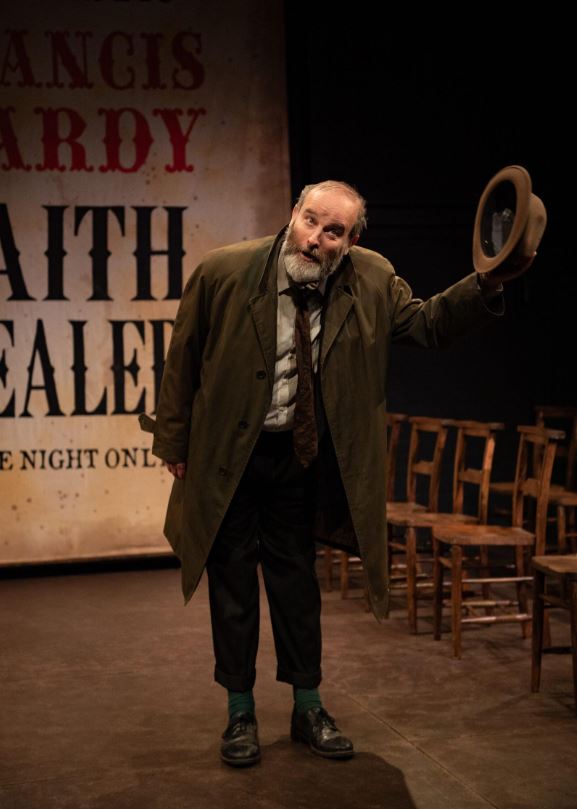
Frank opens the show with a charismatic performance from David Lemkin. He stands among empty wooden chairs, presumably the backdrop to one of his performances, all twinkling roguish charm, joking about his initials standing for “Faith Healer” and wondering what path he might have taken in life with a different name. He recites the names of Welsh villages he drove through as a calming mantra, and talks openly about the nights he knew that his “gift” was not going to work and no one would be cured.
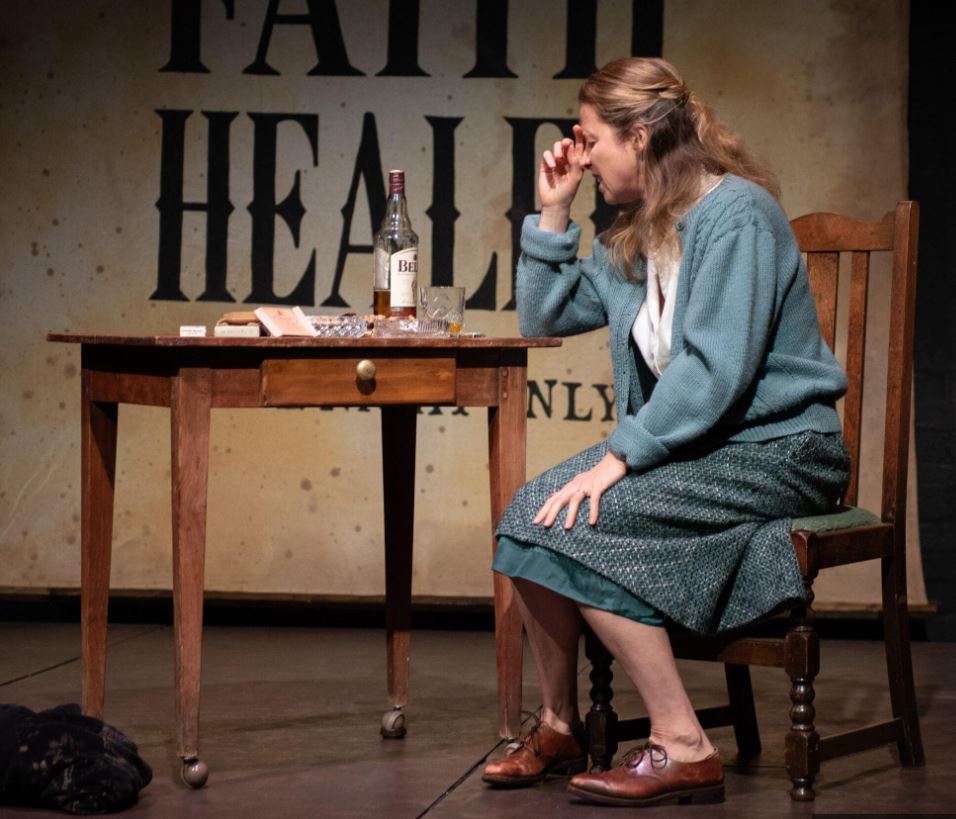
Frank eventually makes way for Grace, and we encounter the human cost of Frank’s alcoholism and cruelty. His devoted widow is still fiercely loyal to him in some respects, and assures the audience that she’s getting better, measuring her progress in the number of hours that she sleeps, the amount of whisky she drinks, and the number of cigarettes she smokes each day. Sarah Sharpe has to convey the broadest emotional range of the three performers and the audience is gripped throughout her monologue.
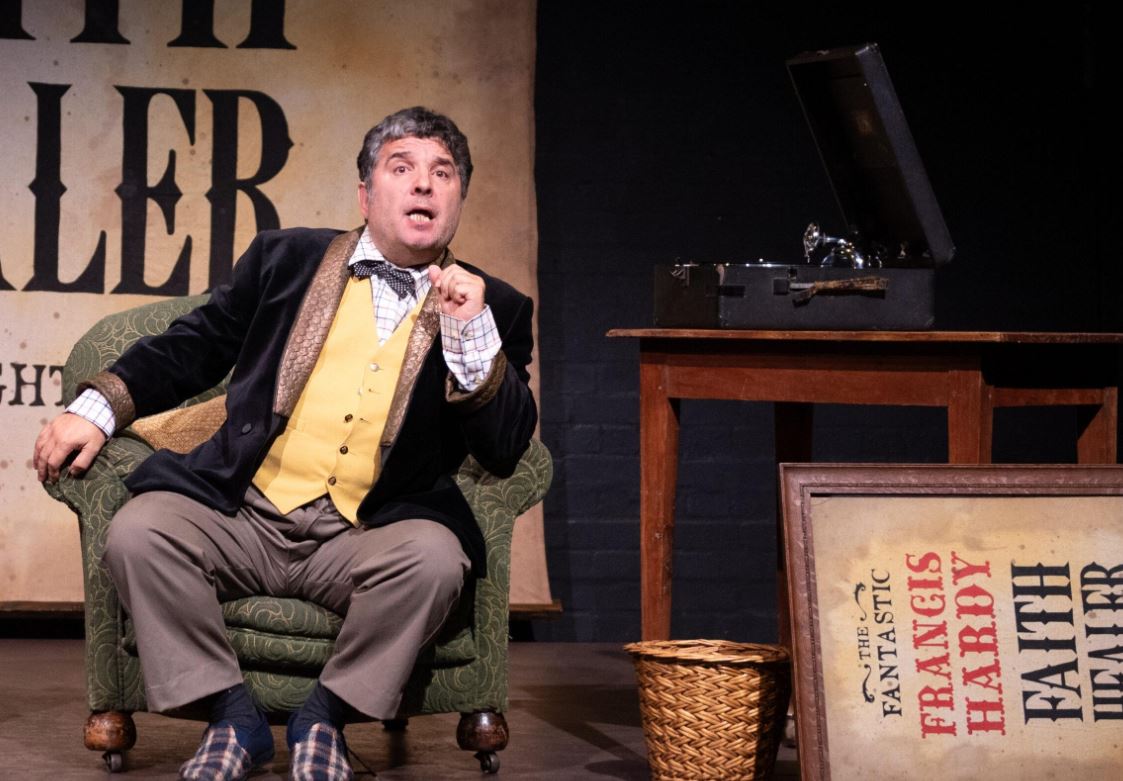
After an all-too-brief interval, Teddy takes the stage. As Frank’s manager and Grace’s admirer, he is something of a peripheral figure in their own accounts, so it’s fascinating to see him come to the fore, and give what he clearly believes is the definitive account of their lives on the road. David Erdos plays the part with a broad cockney accent, punctuating his speech with the theatrical greeting “dear heart”, and telling colourful stories about his bagpipes-playing whippet. While Frank and Grace both delivered stories that are frequently bleak with flashes of humour, Teddy’s tone is more comedic for the most part, drifting towards the darker moments as his story progresses. By the end of his account, you’re not sure whether he’s told the complete truth, but Erdos does convey the manager’s deep love for the couple, encapsulated by the poster that he claims is his only memento from his long career in show business.
Frank returns to the stage for a final monologue, the furniture cleared away and the poster taken down, and rounds off the story with his own viewpoint once again, contradicting some of what Teddy has just told the audience and providing more detail about his fateful return to Ireland.
Director Roger Beaumont has given the actors room to fully explore their characters and stories in this often bleak play that gives the audience much to consider and discuss on their way out into the streets of Ealing at the end of the night. A series of such lengthy and intense monologues is an ambitious undertaking both in terms of the actors’ stamina and memories and holding the audience’s attention, but the artistic gamble has certainly paid off and Faith Healer is a challenging but rewarding production.
Andrew Lawston, October 2026
Photography by Jane Arnold-Forster


