
Tosca
Warmth With Steel
Tosca
by Giacomo Puccini, libretto by Luigi Illica and Giuseppe Giacosa
English National Opera at The London Coliseum until 11th December
Review by Claire Alexander
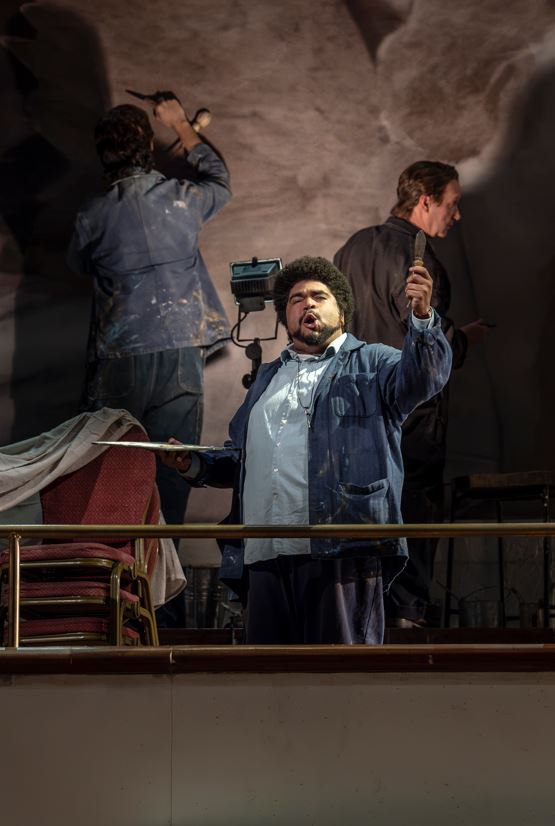
Puccini’s Tosca has never lacked for drama, but English National Opera’s new production gives the familiar thriller a fresh political urgency. Directed by Annilese Miskimmon, her concept relocates the setting from Napoleonic Rome to an unnamed European state on the brink of conflict, with much of the opera unfolding in and around a bland concert hall. The concept underlines the opera’s enduring themes of artistic freedom, state repression and personal sacrifice, while leaving Puccini’s white-hot emotional core intact. As audience we are greeted with a cavernous brutalist concert hall of a set which contrasts stunningly with the elegance of the London Coliseum. Although the setting is an ‘unnamed’ state one cannot help but see the parallels to a Soviet state in the Cold War, or perhaps a rather more current conflict from the same region. This theme extends to the nicely observed costuming designed by Evie Gurney.
Tosca is one of opera’s most tightly constructed dramas. Floria Tosca, a celebrated singer, is deeply in love with the painter and political dissident Mario Cavaradossi. When Cavaradossi offers refuge to fellow political dissident and escaped prisoner, Angelotti, he attracts the attention of the sadistic chief of police, Baron Scarpia. Scarpia soon realises that Cavaradossi is his route to finding Angelotti. But when the two dissidents escape to a cottage in the country, Scarpia instead encounters Tosca searching for her lover. Tosca pleads for her lover’s freedom, ending up yielding to Scarpia’s own brutal sexual advances in return for Cavaradossi’s life. The resulting struggle between love and tyranny drives the opera towards its devastating and fatal conclusion as Tosca realises Scarpia’s betrayal. The final scene is probably one of the most searing in all opera and has been staged in many different ways to match Puccini’s masterful score. Needless to say this production is no exception.
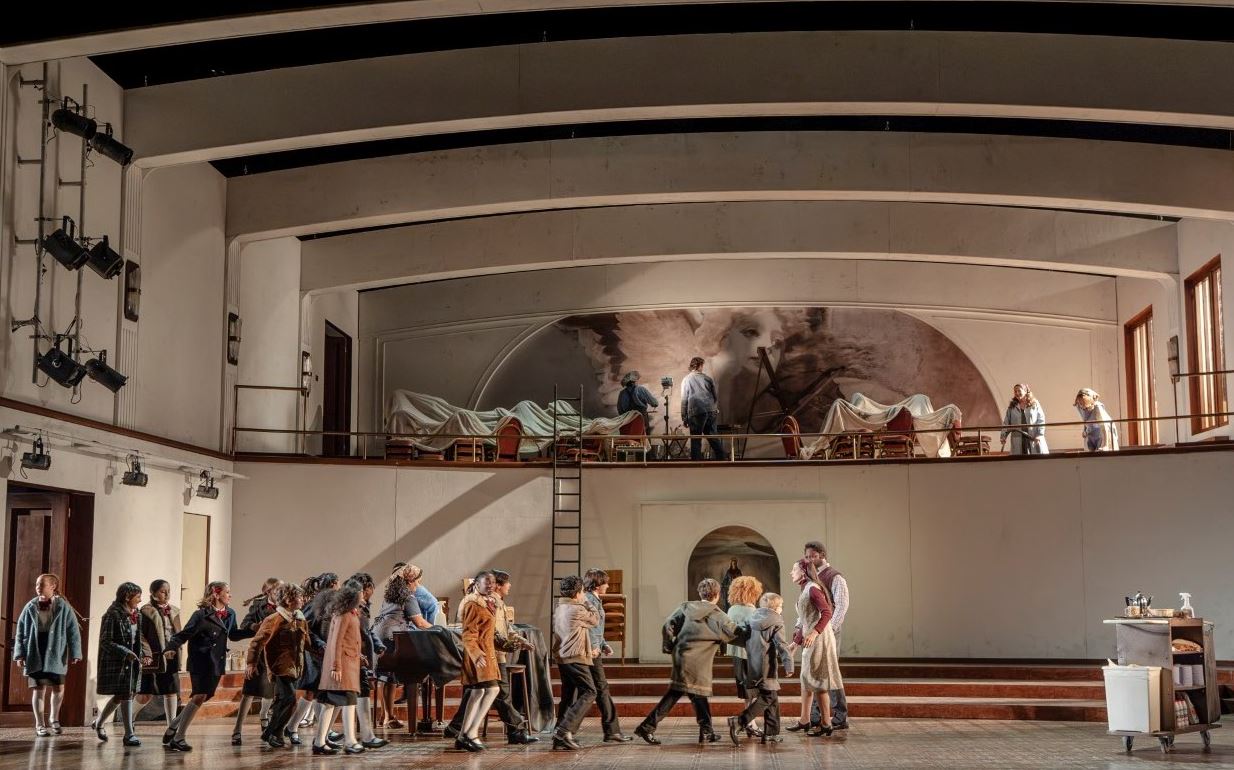
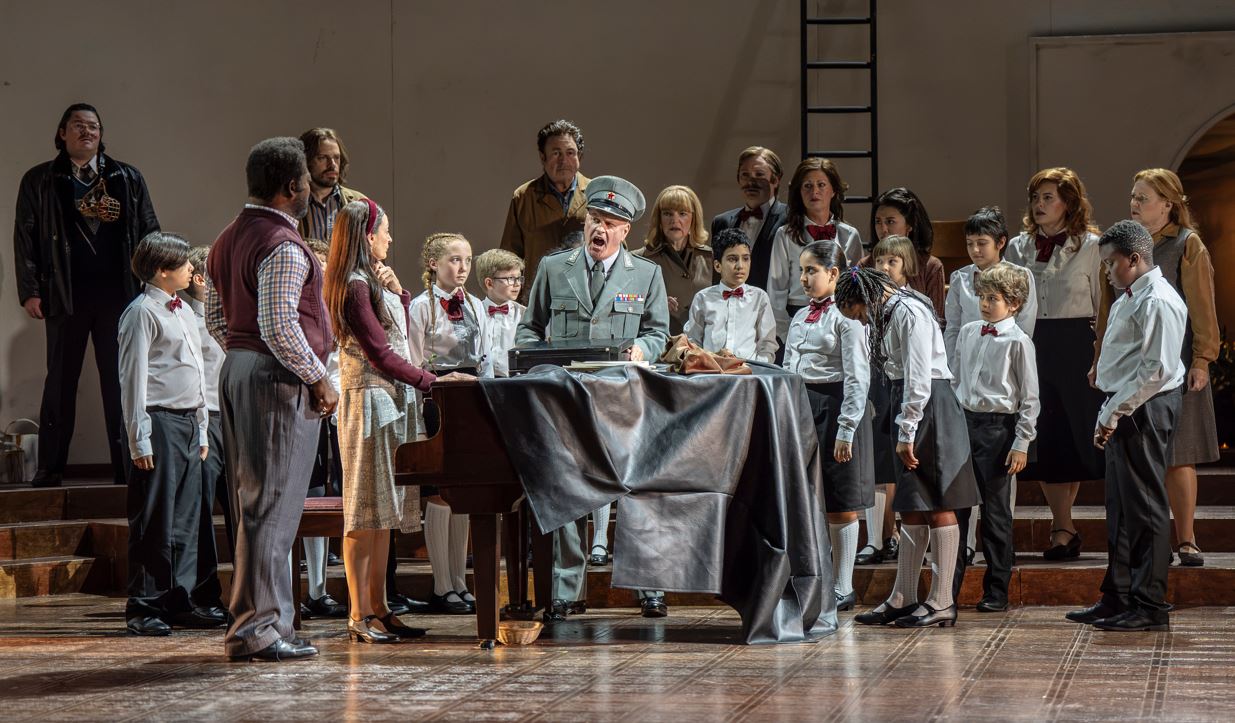
The choice to place this production in the setting of an atmosphereless concert hall in what feels like a provincial town in a state under occupation from an authoritarian power is inspired but brave. The everyday, unremarkable, even languid, activities of the concert hall, the children’s chorus rehearsing, the musical quartet turning up for their rehearsal that never quite happens, soon fall to the increasingly menacing threat of the ‘occupying’ power. The rehearsal continues at gunpoint as does the enforced whitewashing of Cavaradossi’s mural of Angelotti’s sister (Attavanti), his ‘muse’. The dark passion of Puccini’s score continues amidst the desecration of the arts as books, music and musical instruments are placed as if to a bonfire. All enhanced by some memorable detail such as the silhouette of the soldier as he nonchalantly, yet threateningly, smokes his way through the final denouement; and the beautifully observed and sustained performance of Attavanti as she nervously edges her way onto stage during the preset.
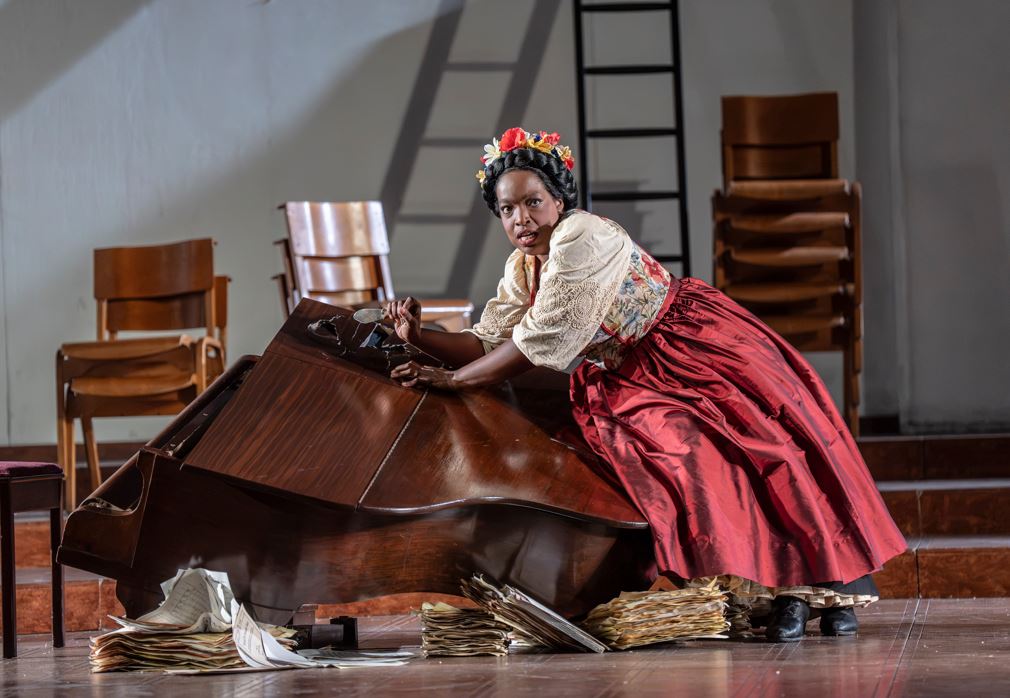
Musically it does not disappoint either. As Tosca, Axelle Fanyo commands the stage from the moment she appears. Her portrayal balances the character’s volatility and vulnerability, presenting Tosca, not merely as a victim of events, but as a woman whose artistic identity becomes an act of resistance in itself. Vocally, Fanyo combines warmth with steel. Her singing of the aria Vissi d’arte is one of the opera’s defining moments and was one of the highpoints of the evening, and she makes it the more powerful with authenticity, simplicity and restraint. In her ENO debut, here is a name we will hear more of. As Cavaradossi, Chaz’men Williams-Ali sings with an open ringing tone which captures the painter’s idealism and courage. As Scarpia, Christopher Purves proves a formidable antagonist. He creates a charismatic portrait of power that does not rely on melodrama. I also particularly enjoyed Robert Heywood’s performance as the Sacristan who sings with clarity and honesty. As Angelotti, Alaric Green finds the challenging combination of urgency and musicality. The Year 5 and 6 children from Marlborough Primary School provide a mesmerising innocence.
Orchestrally this production provides one of the evening’s highlights. Led by conductor Ben Glassberg the orchestra play with precision and nuance, beautifully bringing out many of the individual instrumental moments. I was especially impressed by the synchronicity and presence of the off-stage score played from within the pit. Puccini’s score alternates between explosive theatricality and moments of aching lyricism, and Glassberg relishes both.
In so many ways this production succeeds at a thrilling level, most especially the climax. There are some searing moments especially at the end of Act One when the occupying soldiers enter the concert hall where music, performance and effects (lighting by Lee Curran) powerfully combine. The whole production resonates politically with the contemporary and the historical, provocatively posing questions about the desecration of the arts.
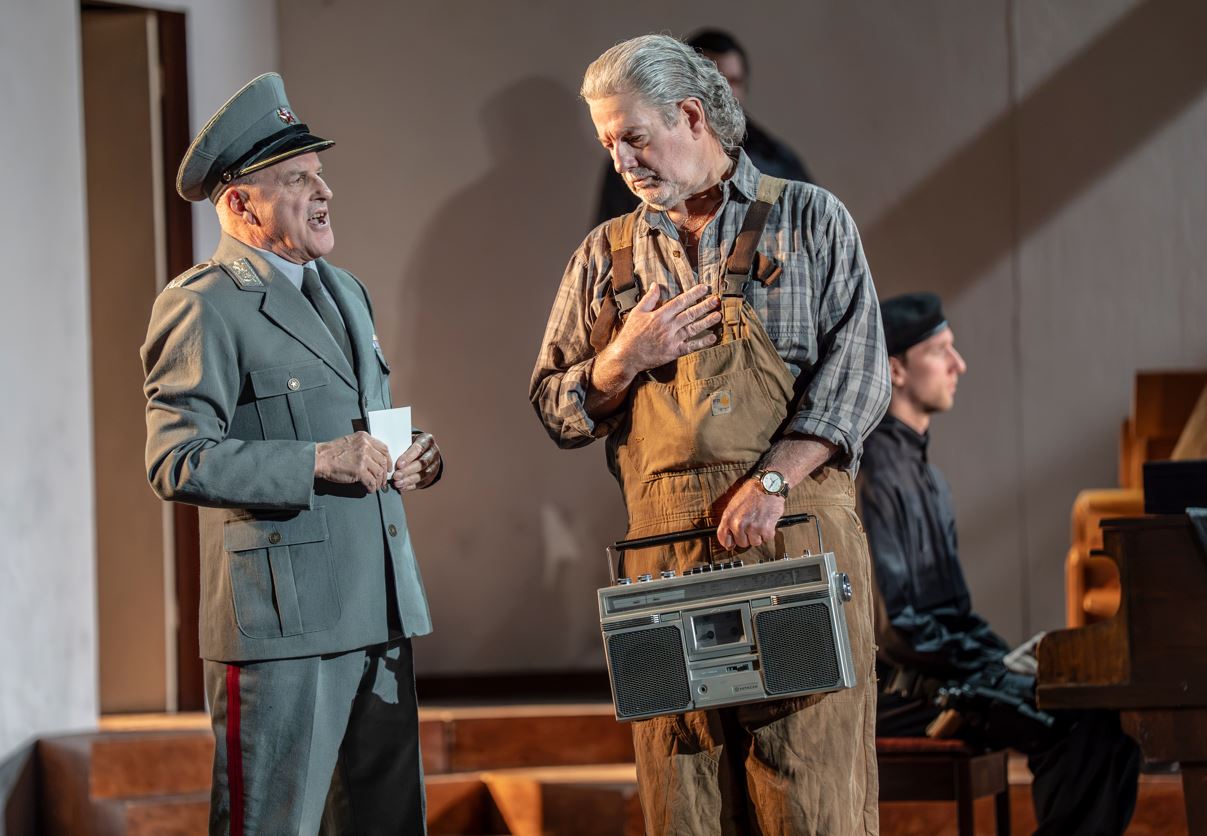
My only reservation however is how an opera that relies overwhelmingly on passion, political and personal, translates into this (by its very definition) passionless and atmosphereless setting. At its heart many of the relationships are intimate and it was interesting to see how this could play out on the enormous stage and I wasn’t sure it always worked. In the advance publicity much is made of the constant menace throughout the production, but on reflection I wanted more growing threat from the occupying power. There was an understated violence throughout, but a bit more strength and commitment to this would have more powerfully drawn the contrast between the passion and the threat, without losing its authenticity. All the individual components were there but there seemed to be an emptiness which I couldn’t quite pinpoint. But perhaps that’s the point.
Ultimately, this is a compelling and emotionally charged Tosca. Miskimmon’s reimagining never obscures the essentials of the story. This serves as a reminder that censorship, political violence and the abuse of power remain everlasting contemporary concerns. ENO’s production succeeds both as a political drama and as a showcase for one of opera’s greatest scores. Puccini’s masterpiece emerges as urgent, human and devastatingly relevant.
Claire Alexander, October 2026
Photography by Ellie Kurttz


