
I Can See the Sun
Lost and Flound
I Can See the Sun
by Tania Khan
Light The Night Theatre at the Hope Theatre, Islington until 21st November
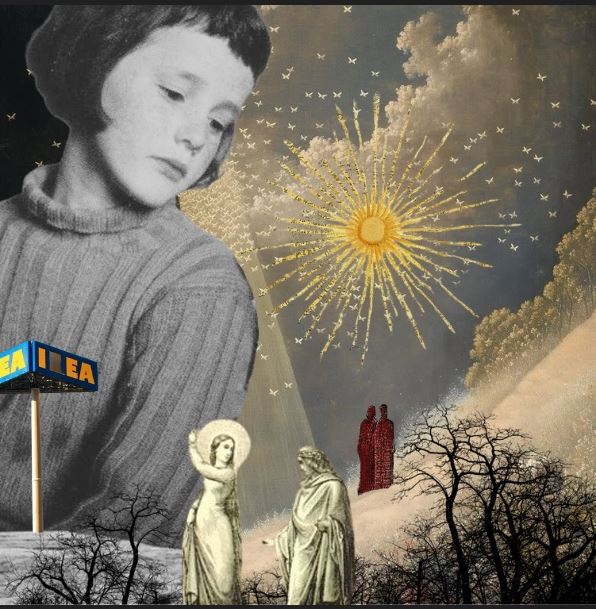
Following a year-long development process supported by ArcolaLAB, Light the Night Theatre presents a revised version of I Can See the Sun at the Hope Theatre in Islington, a cosy place above the famous Hope and Anchor pub. Taking its inspiration from Dante’s Divine Comedy, this is an ambitious but ultimately unsuccessful production which left me bemused about its purpose and content.
With the action set in the ‘dark woods,’ the small fifty-seat black-box theatre has been transformed into a forest, complete with autumnal leaves, trees and branches, and eerie lighting from the ‘blood moon’. The design makes excellent use of the intimate space and succeeds in creating a convincing atmosphere.
There is an unusually long introduction to the play, during which a variety of music is played at considerable volume before the lights finally begin to dim. It is then that we meet a mother and daughter who have become lost in the woods after their car breaks down on a trip to IKEA, having mistakenly taken a wrong turn at Goole. For much of the opening section, the audience sits in darkness listening only to their conversation, before the lighting gradually reveals the dusky woodland setting, the two women and their bag of IKEA shopping. I’m not sure, even now, why the two women left their car and walked through a wood but nevertheless, it gives a good spooky setting for their ‘adventure.’
Writer-director Tania Khan takes the role of the daughter, Grace, with her mother Lucy played by Karen Cass. Grace is in a reflective mood and uses the framework of Dante’s Divine Comedy to explore the tensions within her family relationships, using both her life experiences and their current predicament to draw parallels between the circles of Hell described in Dante’s Inferno.
Dante’s epic work, The Divine Comedy is an Italian poem written in the 14th century which imagines the author’s journey through the afterlife, guided firstly by the poet Virgil and later by Beatrice, the woman he loves. Dante divided the first part of the poem, Inferno into nine circles of hell with each circle punishing a different type of sin. It would be advised to have a basic understanding of this before seeing this play, as, despite some exposition from the characters on stage, there is a general acceptance that the audience is familiar with this premise.
As the women struggle to find their way round in the darkness of the wood, they come across a balaclava-wearing hiker carrying a large bag. Their suspicions aroused, the pair set upon him and tie him up, but eventually, the hiker, Noah, played by Ethan Dillon as the last of the three-person cast, becomes part of a triumvirate who work together to stay safe and dry until daybreak. Is he Virgil? Is he Beatrice? The questions are asked but left unanswered and we learn that Noah is on a pilgrimage to return his grandfather’s ashes to the place he was born.
Noah carries a guitar in his large bag and eventually uses it to perform a stripped-back version of David Guetta’s Titanium, accompanied by Grace, referencing some earlier discussion of Saturn’s moon Titan. While the scene feels somewhat disconnected from the main narrative, it remains an enjoyable diversion and provides an opportunity for the cast to display their musical abilities. But it is symptomatic of a disjointed play that contains so many elements including rhyming sections, philosophical musing, discussions of etymology, strange malapropisms, and an indictment of the English psyche linked to the weather.
The play is billed as running for sixty minutes, but once the lengthy pre-show introduction is discounted, the actual performance feels considerably shorter. Despite this, the pacing is decidedly slow. The dialogue needs to be snappier, the section where mother and daughter huddle down while loud music is played could be entirely erased, and I am baffled as to why we had ten minutes of the cast silently building a shelter from twigs. Make some changes and there is perhaps scope to add more substance to what is undoubtedly an intriguing concept (or series of concepts), and to explore the allegories and connections with the Divine Comedy in a more satisfying way. While the production has moments of promise and occasional flashes of humour, it never fully develops its ideas and ultimately feels lacking in depth, dipping into many areas but never fully exploring them.
Fi Mead-McNish, November 2026
Photography courtesy of Light the Night


