
Opera Gala
Under Canopy and Candlelight
Opera Gala
West Green House Opera at the Green Theatre, Hartley Wintney, 17th July
Review by Helen Astrid
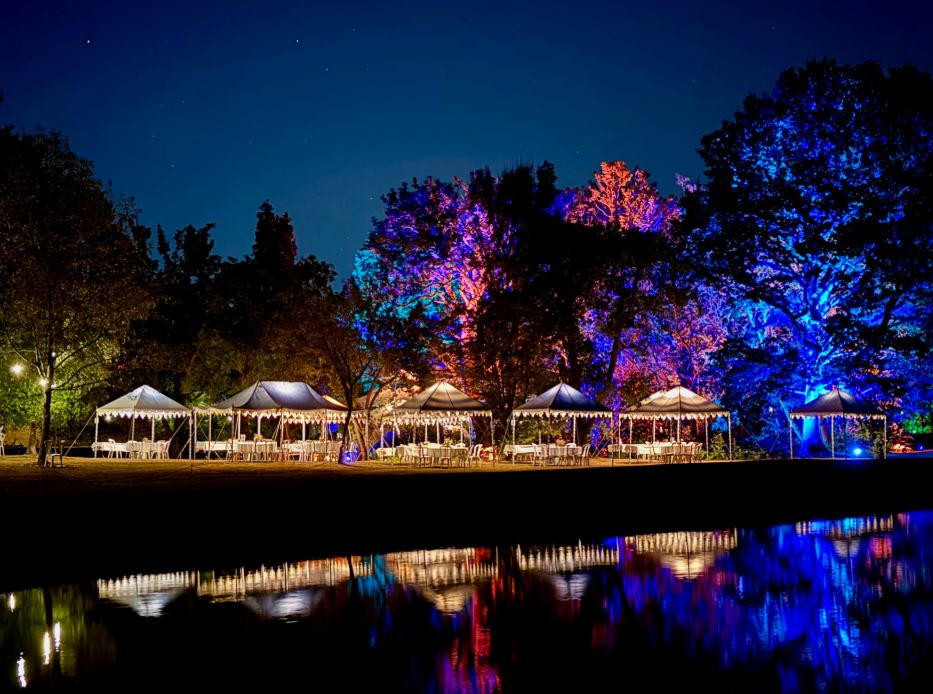
If ever a fairy-tale, magical setting was required for an opera evening, this is it. Tucked away in the Hampshire countryside, West Green House’s gardens and grounds provide the perfect backdrop for an outdoor performance under canopy — a venue choice that is nothing short of sheer perfection. The house itself, a Georgian Grade II* listed property commissioned by General Henry Hawley, who purchased the estate in 1720, adds its own theatrical flourish: busts set into roundel recesses on the first floor of the west façade — depicting Bacchus and four Roman emperors — glared down at the performance and audience with evident disapproval throughout the evening.
Friday’s Opera Gala, featuring just two soloists, soprano Jenny Stafford and mezzo-soprano Katie Bray, with the orchestra of English National Opera under John Andrews, was a fitting start to their far-too-short season. Much like the three other, more established G opera festivals, Glyndebourne, Garsington and Grange Festival, this set-up has so much to offer in its intimacy.
Programming a gala evening is never easy, but this one struck a nice balance: expected traditional repertoire alongside a few refreshing surprises.
The first half opened with Mozart’s sprightly overture to Le nozze di Figaro, followed by Cherubino’s Non so più cosa son, sung with gusto by Bray. Stafford’s bright, steely soprano then soared effortlessly through Dvořák’s Song to the Moon from Rusalka, ending on a commanding top B flat. Next came Dido’s Ah! Belinda from Purcell’s Dido and Aeneas, which felt an odd choice for a gala evening and didn’t sit easily as a transition into Tchaikovsky’s Letter Scene from Eugene Onegin — delivered, however, with brilliance, sensitivity and superb Russian diction. The first half closed with a beautifully blended pairing of voices in Ah, perdona al primo affetto from Mozart’s La clemenza di Tito, though this might have benefited from being billed earlier, allowing the toe-tapping Polonaise from Eugene Onegin to send us off to our picnics instead.
The second half offered a few more of the obligatory gala favourites, including Lehár’s Vilja’s Lied from Die lustige Witwe, sung with absolute mastery by Stafford — her voice entirely at ease in the pianissimo top register, a moment of real vocal refinement that stood out among the evening’s more extroverted numbers. After a surprising, momentary memory lapse at the start of Bizet’s En vain pour éviter , the Card Aria from Carmen, Bray was quickly forgiven; the beauty and evenness of her tone soon took over.
An unusual but hugely welcome inclusion followed: Weber’s overture to Euryanthe, which draws directly on themes recurring later in the opera itself, most notably the eerie, chromatic music associated with the ghost of Emma in Act III. This idea of the overture as a preview or distillation of the drama to come, rather than a generic musical warm-up, is something Wagner would take to an entirely new level in his own overtures and preludes. Weber’s imaginative orchestral colouring — hushed strings, eerie tremolos, carefully chosen instrumental combinations conjuring atmosphere — is a clear ancestor of Wagner’s use of the orchestra as an active dramatic participant, rather than mere accompaniment. Weber died in 1826, when Wagner was just twelve, yet his influence on the younger composer is unmistakable.
Bray’s rendition of Porter’s non-operatic Let’s Do It, Let’s Fall in Love, delivered with the aid of a microphone, felt somewhat at odds with the otherwise unamplified character of the evening, and didn’t quite sit comfortably within the programme. It would have been wonderful, too, to hear a duet version of Novello’s We’ll Gather Lilacs — superbly lit in violet hues by lighting designer Sarah Dell — and for the grand finale, Lowe’s I Could Have Danced All Night from My Fair Lady, performed together rather than separately. It’s always a pleasure to end an evening with both singers, who for the most part excelled throughout.
But the real highlight of the evening was the setting itself: the stunning house and lush gardens, designed and maintained by antipodean Marylyn Abbott — former executive of the Sydney Opera House and founder of the West Green House Opera — which stole the show entirely.
Helen Astrid, July 2026
Photography by Charlotte Daykin


