
Eugene Onegin
Duel Personality
Eugene Onegin
by Pyotr Ilych Tchaikovsky, libretto with Konstantin Shilovsky, based on the verse novella by Alexander Pushkin
The Grange Festival at The Grange, Northington, Alresford until 12thJuly
Review by Mark Aspen
The overture of Eugene Onegin immediately stresses themes associated with the shy, eager romantic teenager, Tatyana. And clearly the opera is really about Tatyana, a view held held ever since its premiere in Moscow in 1879. Dostoevsky said so, and even Tchaikovsky himself declared that he felt more for Tatyana than he did for Onegin.
But in the overture of director Max Webster’s production we get fifteen Tatyanas for the price of one! These persistence of vision images of her emotions (and actions) are one theatrical conceit used to enhance a production of Tchaikovsky’s opera of “lyric scenes”. The images are the chorus, initially all dressed in variants of feminine pinks and purple pastels. The other conceit is to similarly echo actions (and emotions) by a lithe and kinetic group of six dancers.
In Eugene Onegin Tchaikovsky paints a compelling picture of early nineteenth century Russian life, evoking the social atmosphere of the time, and pitching the mood Act by Act by means of the music for the dances. Dance is an essential element in the opera, as the whole plot pivots around a single dance, a wilful provocation by Onegin.
The triple-time courante as the peasants celebrate the harvest on the widowed Madame Larina’s farm has an unsophisticated joy. Then, later they let their hair down, with good natured drinking, flirting and socialising during the waltz to celebrate Tatyana’s name-day.
Arthur Pita’s choreography is fresh and inventive, and a delight to watch. Interestingly the music turns to a more staccato mazurka as the unfounded and ill-considered spat between local well-connected, but well-liked, young Vladimir Lensky and his friend Eugene Onegin, whom he has brought to visit his family and friends in the country, turns nasty. The scene seven years later, when all has drastically changed, in the high society St Petersburg ballroom, presents a strong contrast. Pita’s supercharging of the then with-it fashionable polonaise, which takes the formalised dance and criss-crosses it with powerful jetés battus, is a triumph.
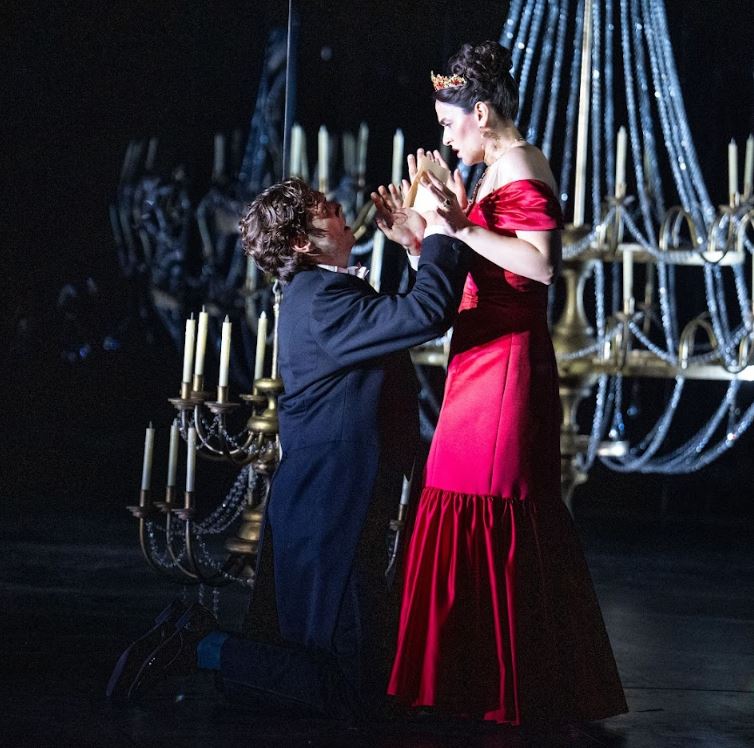
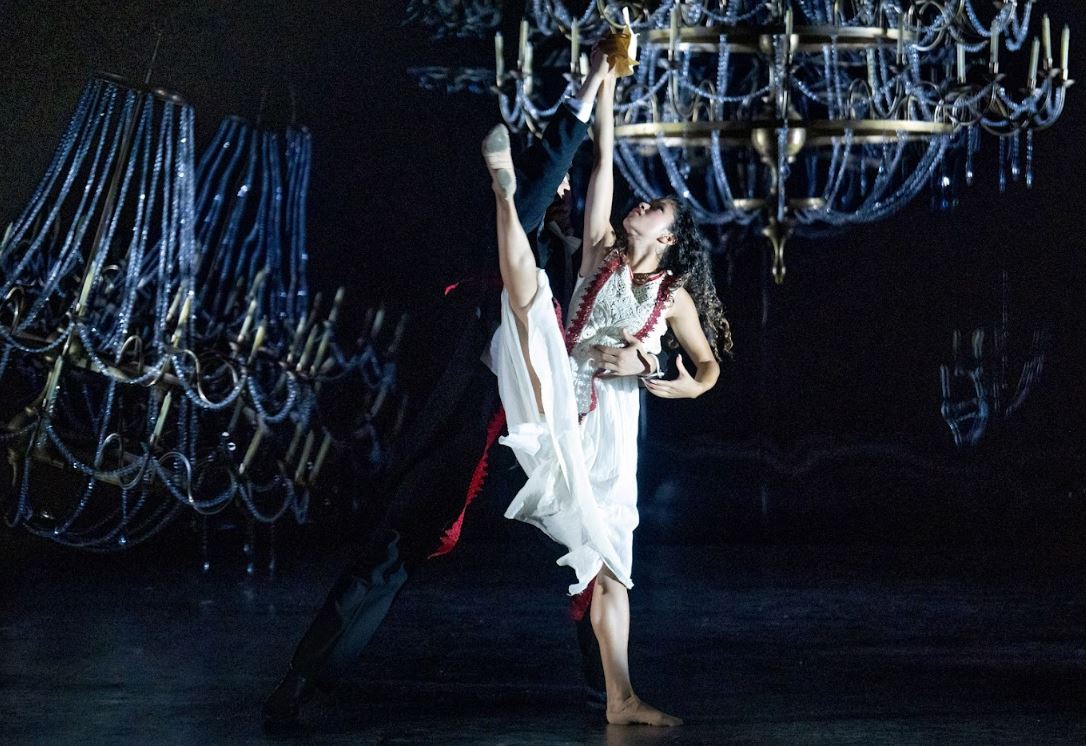
Designer Frankie Bradshaw, away from her usual London theatres, has created inventively economical sets, as epitomised in this final Act in the St Petersburg ballroom. There are just three, albeit large, chandeliers and four smaller ones, but together with lighting designer Jack Knowles, she has conjured the illusion of hundreds, the room extended to infinity by the use of mirrored walls, a veritable Versailles. This is populated by myriads of elegant figures, in fact the twenty-four chorus and six dancers, now all in male attire, in the black frock coats of the white-tie dress suits of the time. The tables have now turned from the pink frocks of the opening.
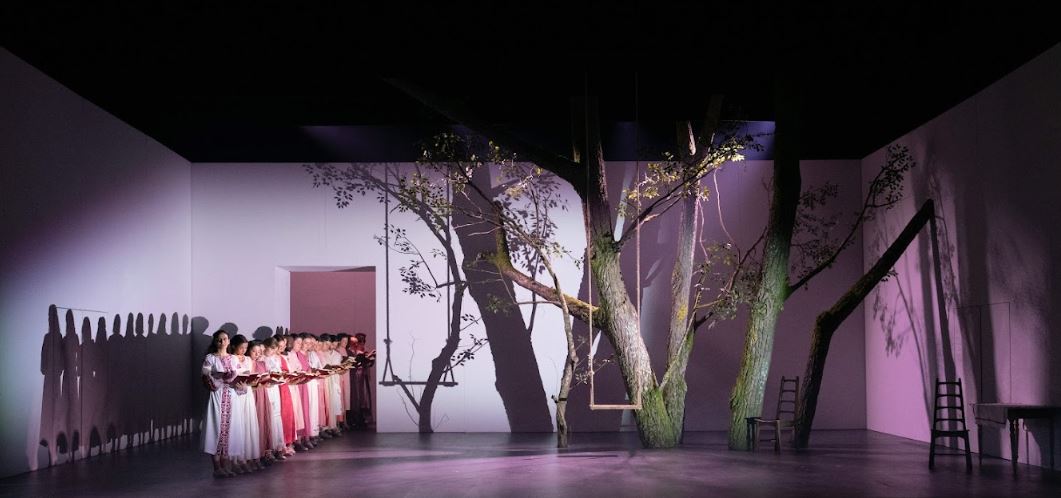
The first half in its bucolic setting is simply a few trees within the box-set, whose plain white walls are the canvas for Knowles’ magic. However, the post-interval duel scene takes place on the narrow forestage with closed tabs. The drapes are dramatically underlit in blood-red, casting ominous shadows. The result, though, is far too cramped, with nowhere for Lensky to fall when he is fatally shot. This is not an intimate scene: it requires a feeling of vastness to underline the sheer emptiness of what the two young men are doing, for neither of them wants this duel. Could not the mirrored walls of the Act Three ballroom, just behind the curtains, have been used as an icy void? It would still enable the transition into the next Act to happen, which is in fact used to inspired dramatic effect. Onegin is transposed across seven troubled years into the ballroom setting, as dancers gradually undress his past clothing, to present a new different, although not redeemed, man to dress him anew in the clothing of society.
Eugene Onegin is a study of the impulsiveness of youth, two young men and two young women (not unlike La Bohème). The eponymous Onegin is in his early twenties, while the others are still teenagers, he considers himself superior to these country types, albeit they are country gentry, when Lensky, his companion from university and the grand tour, takes him to his home village. Lensky wants to introduce him to Madame Larina, and more especially to her daughter Olga, Lensky’s beloved fiancée, Tatyana’s sister. Tatyana has immersed herself in the romantic novel as an avid reader of the Mills and Boon of the time. She sees Onegin as the archetypical heartthrob and she is overcome in an explosive coup de foudre that overwhelms her senses (and her judgement) and leads her to write that unguarded letter to him that very night.
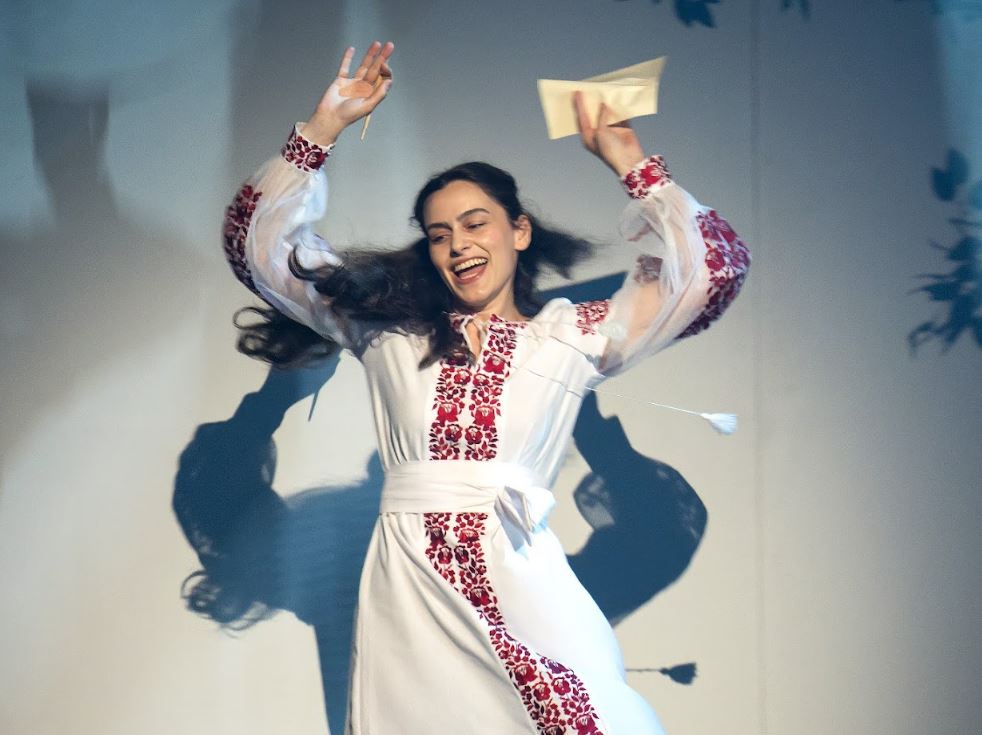
Armenian soprano Ruzan Mantashyan excels in the role of Tatyana. She is much sought after in the European opera houses and it is easy to see why. She is a consummate actress, completely absorbing, whether as the willowy youngster lost in her books and her daydreams, or as the aristocratic society beauty she later becomes. Mantashyan’s body language speaks volumes, the sideways looks when she first sees Onegin, the turmoil and the resolve as she writes the letter, her dread at sensing his reaction, and her hard to maintain imperiousness as the mature woman rejecting him in return, all hit the mark.
The letter scene is a long extended aria, as Tatyana prevaricates, shall-I-shan’t-I, weighing the risks and potential rewards of exposing her feelings towards Onegin. Mantashyan effectively expresses these changing emotions, although there is plenty of help from the orchestra (particularly the oboe and harp) in conveying Tatyana’s thoughts. Here Mantashyan is a tour de force and the audience is totally engaged.
Mantashyan’s fine soprano is sinuous and silky as the teenage Tatyana, longing, lovestruck and lost in her dreams, yet confident and mature as the establish society figure. Her concluding scene is sung with an emotional intensity that enthrals, as she waivers in a moment on her feeling towards Onegin, and then composes herself. Her resolve is firmly decisive, and she leaves with dignity.
Onegin may be arrogant and self-centred, but he is a child of his times. Turgenev coined the term “superfluous man”, being of noble birth, but a “spare”, his roles made effectively redundant by political reforms. He is a man with no defined place in society and with time on his hands.
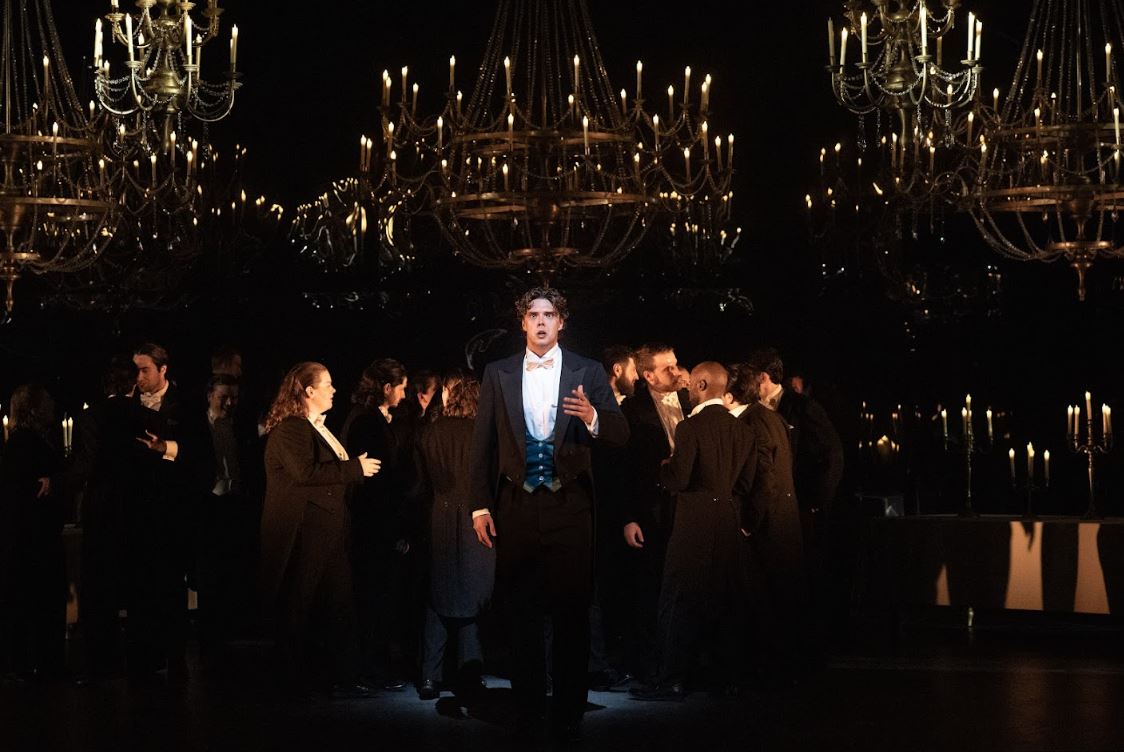
Russian baritone Vladislav Chizhov makes his UK debut as Onegin, and, my, he certainly looks the part, tall, upright and detached. Onegin is a complicated character, and Chizhov manages to crack the surface, and gets more out of the part than just the haughty, scornful snob, suggesting to Tatyana that she should be more modest in expressing her feelings. His “Do try to learn some self-control” utterly crushes Tatyana. Yet he does show a hint of protectiveness. Much later, Chizhov subtly captures Onegin’s unease at meeting the now aristocrat Tatyana, and his consequent disquiet and belated repentance. Chizhov’s sleek and secured baritone pairs impressively with Mantashyan’s performance.
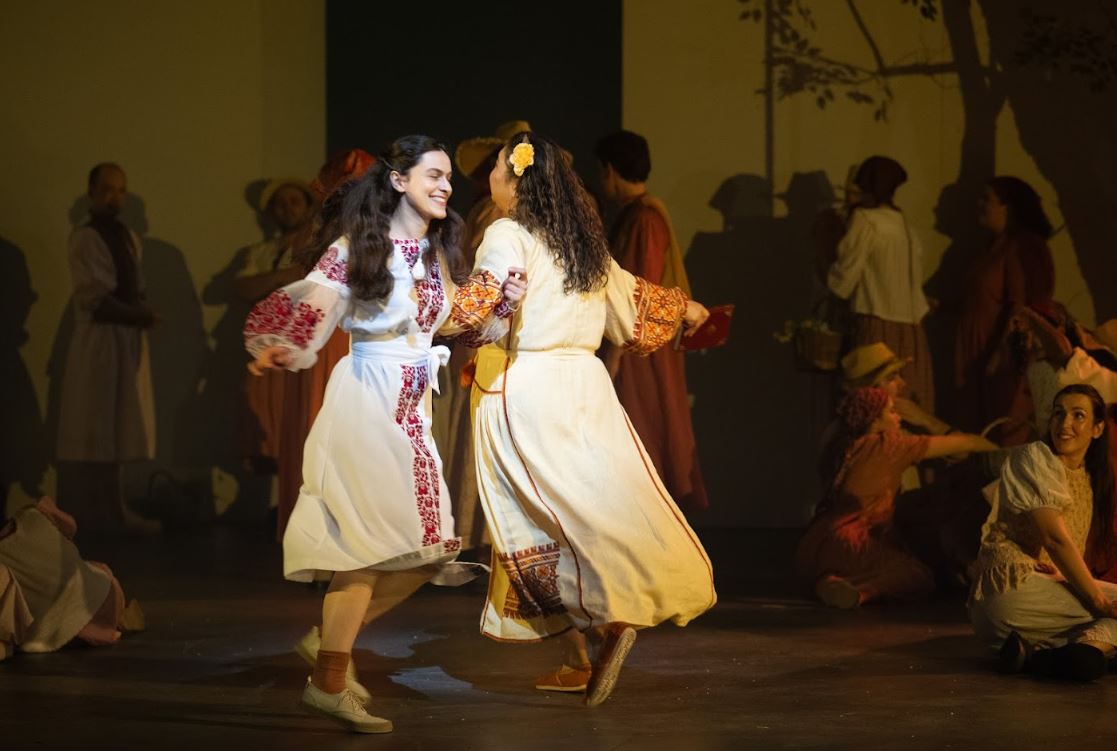
For all Onegin’s suavity, his chafed response to hearing gossip at his expense, is purely adolescent mischief in deciding to flirt with Olga at Tatyana’s name-day party. However, Webster’s decision to make this a very explicit advance on the none-too reluctant Olga seems misplaced, until one realises that the change in lighting at this point perhaps indicates that this is only as Lensky’s misinterprets it. Korean-American mezzo-soprano Alice Chung plays a very vivacious Olga, lightly flitting across the rural scenes, her supple voice adding to her lively appearances.
Welsh tenor Ryan Vaughan Davies makes a very personable Lensky, the sort of chap you would like as a pal, bright, smiling and friendly. Lensky is head over heels in love with Olga, his fiancée, and Vaughan Davies’ rendering of his arioso “How happy, how happy I am!”, a love song to Olga, is heartfelt and vocally tender and finespun, as befits a poet. When events take their fateful turn, and Lensky waits at dawn in the duelling site, Vaughan Davies sings the Kuda, kuda aria with intense pathos, “Where have you gone, golden days of my spring?”, as he knows he may never see his beloved Olga again. Delivered with an emotional catch in the voice, it is profoundly moving.
After the fatal shot is fired Onegin, who wants the duel even less than Lensky, he takes his dead friend in his arms, hugging him tightly. In contrast, Lensky’s second Zaretsky (an uncredited cameo role adroitly sung by baritone Peter Edge), who has in fact bent the rules, is total blasé and matter-of-fact.
To lighten all this heavy tragedy, Tchaikovsky introduces the role of the blithesome Monsieur Triquet, a French tutor who has composed a ditty for Tatyana to honour her name-day. He is old enough to get away with flirting with the girls, but Toby Spence seems a little to young for the role. (He’s not. Spence has had a remarkable career. Cancer treatment some fourteen years ago robbed him of his voice, but by strength of personality he regained his voice and his career soared as he gained acclaim in top roles in opera houses worldwide.) Spence sings with admirable precision, but one feels his picture of the flamboyant Triquet could be much more big and open. (In fact, Tchaikovsky cribbed Triquet’s piece form a Parisian music-hall song La Somnambule.)
The bedrock to the first two Acts, is Larina and Filipyevna, the mother and nurse of the two young sisters. Long together, they share reminiscences and are recognisable matronly characters as they gossip and laugh. Two very experienced and highly respected mezzo-sopranos are cast in these roles, which they comfortably inhabit. Their long duet of shared memories also gives us the backstory to the family.
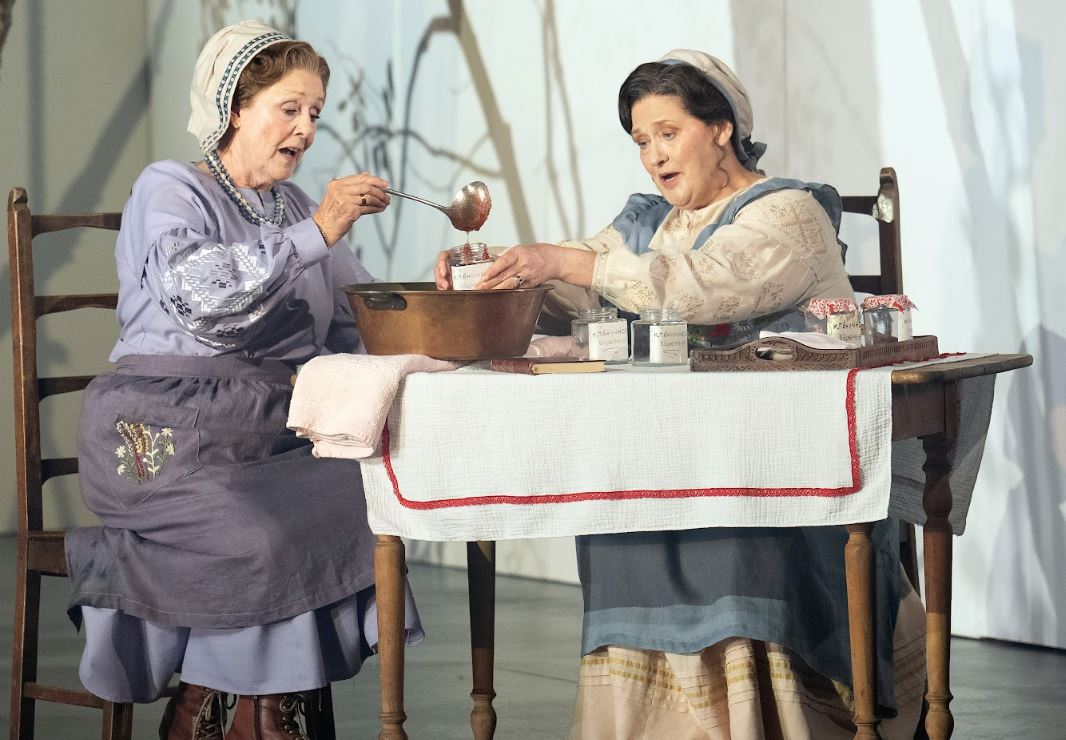
Diana Montague’s generous lyrical mezzo is well suited to the warm-hearted motherly Madame Larina as she busies herself getting everything right in the home and the farm. Catherine Wyn-Rogers plays the loyal servant Filipyevna, who is now a fond member of the family and has great affection for the sisters, whom she has nursed from babies. Of lowly background, she has an innate intelligence and is sharply observant. These characteristics permeate Wyn-Rogers’ portrait of Filipyevna, which is sung with great warmth and spirit.
Another of many highlights in this production is the single-aria role of the elderly retired General, Prince Gremin. Seven years on from the ill-fated meeting with Onegin, Tatyana
is now his dignified, beautiful and noble wife, to whom all the guests defer. There is a mutual devotion between Tatyana and her much older husband. Prince Gremin’s aria, beautifully expresses how he feels. He calls Tatyana an angel, who “brought me life and youth, yes, youth and happiness”. Kazakh-Serbian bass Mark Kurmanbayev sings radiantly in this tender, passionate aria, richly and sonorously expressed. However, as Gremin he seems several decades too young.
Lidiya Yankovskaya conducts the Bournemouth Symphony Orchestra in a spirited performance that is rigorous and rousing, yet romantic and lyrical, taking the score on the roller-coaster of emotions that is Eugene Onegin
Tchaikovsky used the term “lyrical scenes” to describe the opera’s realism, a term in Russian literature that prefigured Italian verismo by almost a century. It probes the predicaments and passions of real people, and Webster’s Eugene Onegin is a polished and stylish production that does just that. It wins with some outstanding vocal and instrumental music, inventive use of dance and movement, and great visual impact. And all is done with restless energy.
Mark Aspen, July 2026
Photography by Richard Hubert Smith


