
The Unfriend
Glad to Be Alive
The Unfriend
by Steven Moffat
Playful Productions at Wyndham’s Theatre, West End until 9th March
Review by Mark Aspen
The West End blockbuster comedy, The Unfriend is a story that could almost be true, but isn’t.

Now, here is a true story, which could almost be untrue. Some years ago, following an event that my wife attended in the USA, we were enjoying a lunch on the sunny harbour-side in Boston, Mass. Suddenly a heavy downpour sent us all rushing into the restaurant’s small building. Sardine-packed together, commiserating, we all were soon chatting. When the sun soon came out again, our fellow diners invited us to join them on their table, where they’d been having a party. Naturally, we asked what they were celebrating. “Oh, it’s Joe. He came out of prison this morning”. When we open-mindedly inquired what he had been in for, the reply was totally light and matter of fact, “Homicide”. As the quite convivial lunch drew to an end, we were invited to continue the party chez Joe’s that evening. It may have been churlish, but we didn’t go … and Joe seemed a really nice chap.
So it was immediately easy to understand the unfolding predicament that Peter and Debbie, a nice, civil and very English married couple, find themselves in when, on a cruise, they meet Elsa, a lady of overpowering vivacity, a merry widow from Denver, Colorado. Holiday friendships are usually ephemeral and invitations evaporate, but ebullient Elsa is insistent, incessant and persistent and e-mails are exchanged. But, when they return home to their neat new-build semi in suburbia, Debbie googles “Elisa Jean Krakowski”, and discovers she is suspected as being a serial murderer, including of her father and successive husbands. However, Elisa has already invited herself to stay with Peter and Debbie and their two teenage children at their home!
Hence, we have the spring-loaded plot of The Unfriend, a funny and furious farce, but without all the doors. It is television talent transferred to the stage by well-known co-creators of TV’s Sherlock, Mark Gatiss and Steven Moffat. Moffat is a BAFTA winning writer for television, including a long stint as lead writer of Doctor Who, but The Unfriend is his first stage play. Gatiss, who also is a writer and producer for the small screen, and well-known as an actor, here makes his debut as a director.
The Unfriend had its first outing at the Chichester Festival, before a run last year at The Criterion and has now bounced back into the West End with a vengeance. Press night was also a star-studded guest evening, and its packed audience welcomed the show with exuberant bubbling enthusiasm, a warmth that contrasted with the sleety streets outside the theatre.
Designer Robert Jones’ set also presents a warm picture, the blue sea and sky across the rail of the cruise ship’s luscious luminescence, and then Peter and Debbie’s home, the split set simultaneously showing the living room and the kitchen. Upstairs, lighting and video designers, Mark Henderson and Andrzej Goulding, reveal animated silhouettes of the occupants. This area is later used to interject the Denver broadcast about the, albeit unsubstantiated, rumours about the “Killer at Large”, Elisa Jean Krakowski.
Well, a warm welcoming scene for the arrival of Elisa. But, she has had a change of plan, much, at first, to the relief of Debbie and Peter, who have been trying to work out how to put her off. However, she is at the front door! She had been planning to first stay with Barnaby, a widower whom she had also just met on the cruise ship. She has come directly from Heathrow, awash with Louis Vuitton luggage, because her host Barnaby has suddenly died!
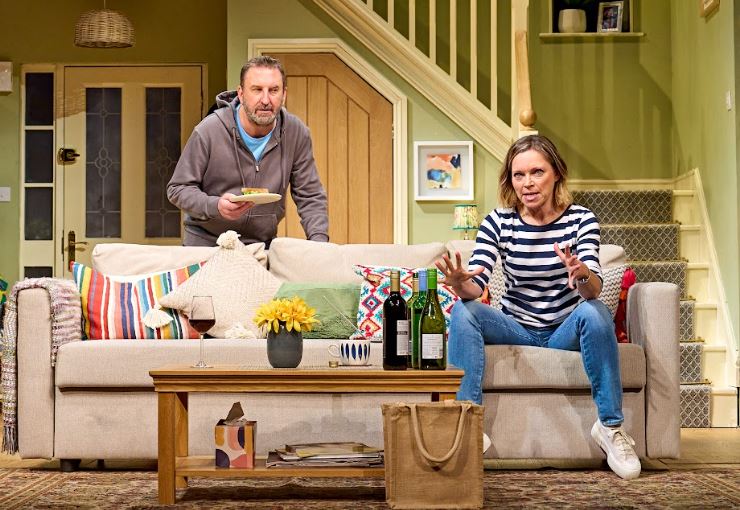
The play is a wonderful character study, an exposition of the crippling effects of niceness. Debbie and Peter are rabbits caught in the headlights of their own politeness. Ironically their dithering negativity is no match against Elsa’s confident positivity. When they try to be assertive, it’s a case of I used to be indecisive, but now I’m not so sure.
Of course, as an audience we are not so sure too. Is the Denver community on a witch hunt for someone they see as a too-large-for-life busybody? Is this all just an elaborate practical joke by Elsa? Is Elsa a kind soul trying to do good, as she sees it? Or is she a murd… no, no, that’s unthinkable. What would we do?
Amongst the quick-fire quips, there are many incisive insights that really ring true. Peter is first seen on the ship looking for the news on his laptop, whist trying to ignore the garrulous Elsa on the next deckchair. “Why?” comments Debbie, “It only makes you angry”. Peter is a Guardian reader (other newspapers may have the same effect). He says, “I don’t know what to think until I read about it.” Celebrated comedian Lee Mack electrifies the role of Peter, his body language almost, but not quite, exaggerating the excruciating embarrassment of a man caught out by trying too hard not to be caught out. He also gets some nice throw-away lines, some quite subtle, “What else can you do with the inevitable?”

Elsa is a gift of a role, and Frances Barber makes the most of it, playing it as big as it deserves. She interprets with insight both Elsa’s acerbic charm, if that is not too much of an oxymoron, and equally her manipulative, yet would be benevolent, nature. Elsa is an enigma, and can be two opposing things at once; witness some of her observations, like the gimlet-sharp, “She has a pretty face; if you can find it.” Barber also knows how to pitch Elsa’s non-sequiturs.
Sarah Alexander has the difficult role of Debbie, a character who has the serious task of keeping the whole thing grounded. She is the mum, protective of her children and trying to keep her husband from making a fool of himself as he attempts to defend the family against the perceived threats. Alexander accurately portrays the practical mum, philosophical but anxious, the self-styled “up-tight” member of the family.
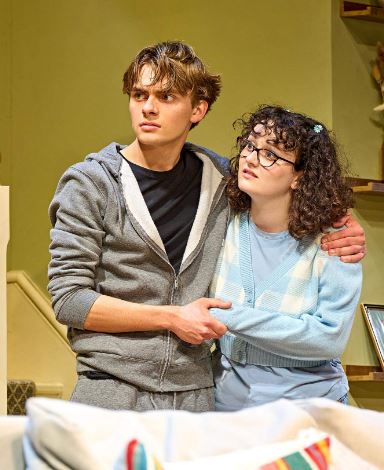
The two teenagers are acted with precision, painting pictures that could be seen, perhaps unfairly, as typical of awkward adolescent mulishness. Maddie Holliday plays the stroppy daughter Rosie, and Jem Matthews, the lairy video-game obsessed son, Alex. Both are spot-on.
Debbie and Peter may be worried sick about Elsa being with their children, but Alex and Rosie not only get on like a house on fire and quickly become great friends, but Elsa manages to bring out the very best in the two youngsters, everything we know that lies buried under teenage angst. They become loving, helpful, active and positive.
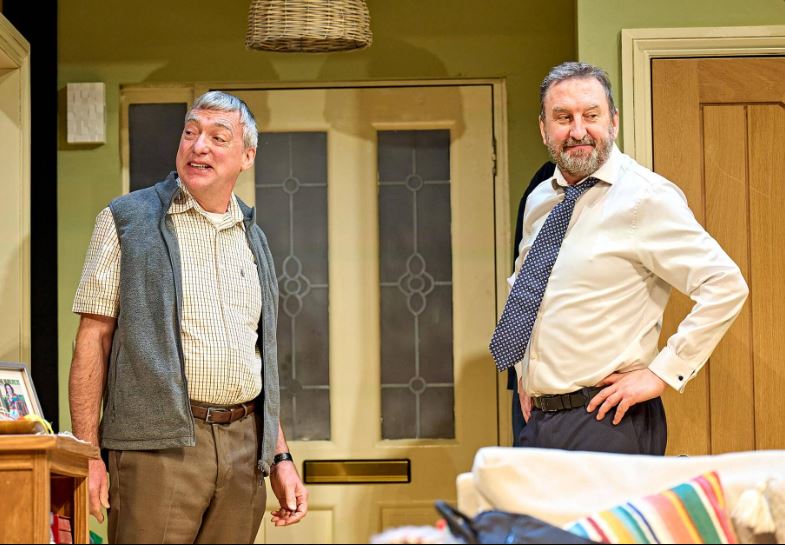
Moreover, Elsa becomes quite a hit in the neighbourhood. Even the local bobby, PC Junkin, has become quite besotted with Elsa, and settled into the house in her behest. The trouble is, he has been sent around to inquire about the unexpected death of Barnaby. Then there is the lugubrious man from next door, The Neighbour: Peter never bother to find out his name. He has been waging a low-level war of attrition about the rebuilding of their garden wall. Elsa calls him “passive-aggressive”. He is relentless with his stock openings, knowing that Peter is “a busy man”. All these gnat-bite approaches fall on Peter’s deaf ears. Nick Sampson is completely dead-pan in the role, notching up the comedy with a simple shrug or nod. Muzz Khan, as PC Junkin, is equally at home with the dead-pan humour, and indeed becomes the butt of some toilet-pan humour, including some scatological slapstick with a lavatory brush. (Don’t ask!) Together with Alex’s farts, there is quite a lot of reliance on chamber-pot comedy. (Perhaps it is the only safe ground for jokes nowadays.)
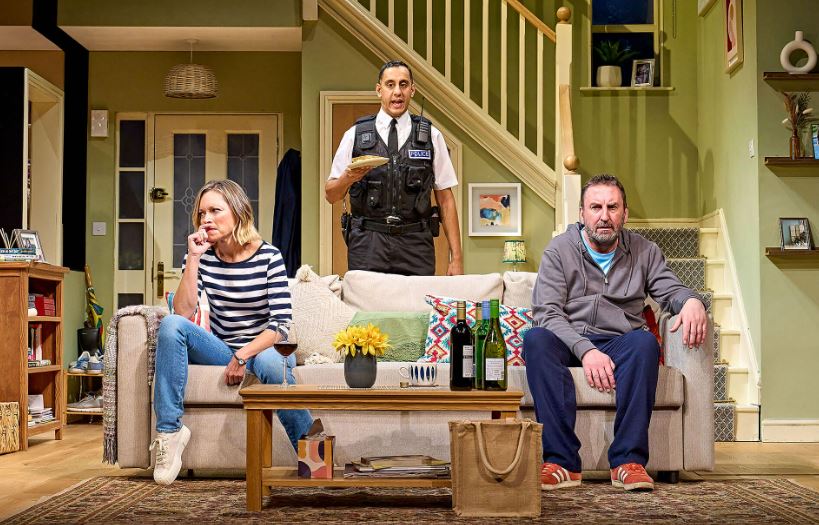
Mark Gatiss is quoted in conversation with Steven Moffat as saying the play “moves like a train and is incredibly funny”. It is true that, once it has got up steam, The Unfriend is certainly fast-paced, but like a train, it takes a while to build momentum, and occasionally it stops at a station for some prolonged gags.
Gatiss and Moffat’s pedigree shows through in that the play. Scattered with TV tropes and conventions, it feels a little like a sit-com that could be serialised into twenty-five minute chunks. Such is the danger of moving from small screen to big stage, but this in some ways adds to its appeal. Nevertheless, it does remain “incredibly funny”, and thoroughly deserves its rip-roaring sell-out success.
Under all its knockabout fun, The Unfriend is an inventive and insightful examination of human psychology. It takes us on a clever journey towards thinking, well, that’s alright then … until its very end.
Embarrassment is a great moderator: “I’d rather die than be impolite”. But would you?
Mark Aspen, January 2024
Photography by Manuel Harlan


 Mark Aspen
Trackbacks & Pingbacks