
Pressure
Stormy Weather
Pressure
by David Haig
Teddington Theatre Club, at the Hampton Hill Theatre until 27th January
Review by Gill Martin
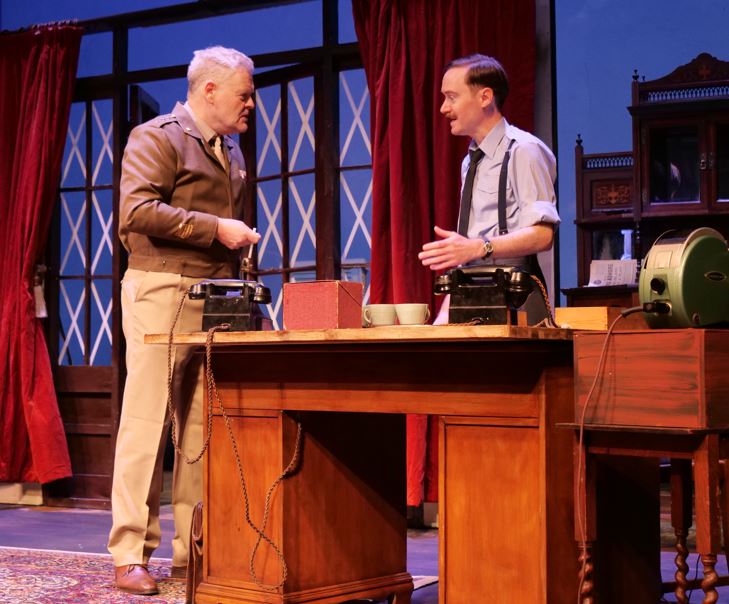
Storm Isha had just loosened its grip but Storm Jocelyn was now battering Britain on the opening night of Pressure, TTC’s docudrama, subtitled 6th June 1944: The day the weathermen fought the war, and meticulously directed by Clare Cooper
Weather hardly ever drops out of the headlines, with horror stories of floods, fires and famines. Meteorologists and climate gurus take centre screen night after night with their dire warnings and predictions.
Back in the dark days of World War Two never was the task of predicting the weather for one of the most vital missions so crucial. The operation: the D-Day landings for the largest ever invasion fleet of almost 7,000 ships, putting ashore over 875,000 men on the beaches of Normandy.

It was the summer of 1944 when meteorologist Dr. James Stagg was assigned the rank of Group Captain Royal Air Force Volunteer Reserves to report Eisenhower. ‘I’ve never been near an aircraft,’ he cheerfully admits.
America’s Five Star General Dwight ‘Ike’ Eisenhower is in charge of European operations and has set the date of “June 5” for the landings.
The weather would be key. And Stagg, as chief meteorological adviser to the Allies, holds the key as he works night and day on caffeine and cat-naps in his ill-equipped HQ at Southwick, Portsmouth. ‘I’m a scientist not a gambler,’ says the man whose word will trigger the go-ahead for the Allies’ invasion of Normandy to liberate France from Germany.
If he gets it right he’ll have set in motion one of the most successful military assignments ever attempted. Get it wrong, and he’ll bear responsibility for the death of thousands of young men.
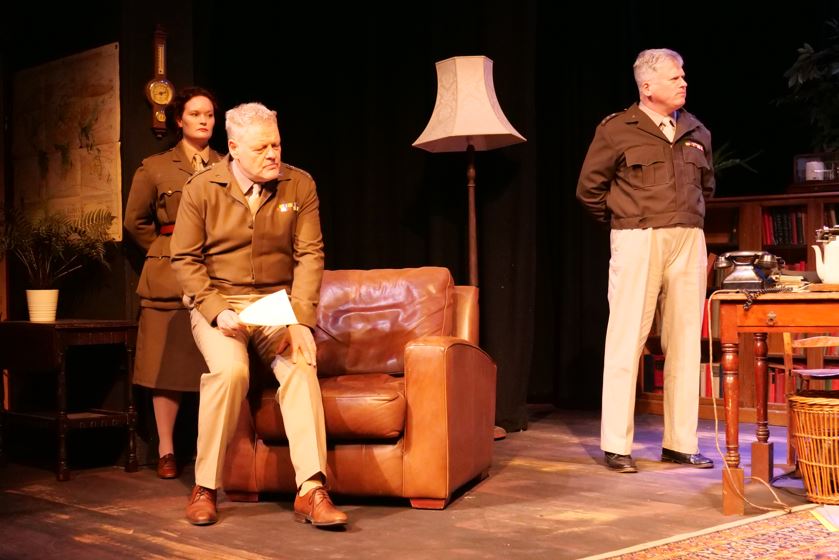
Stagg is up against a vehement opponent in his American counterpart, bull-headed Colonel Irving Krick, whose outdated forecasting seems based more on old weather patterns and optimism – and a denial in the existence of the Jet Stream.
Stagg is more the pragmatist, a tenacious hard-headed Scot, who bases his forecasts on hourly scientific readings and precise knowledge of the complexity of British weather.
He explains that a south coast summer’s day could be boiling hot at ten o’clock, rain at midday, with the Punch and Judy man packing up in horizontal rain and then 80°F by late afternoon. Long term forecasts were but guesswork, he maintains.
Tension mounts as the set backdrop displays a countdown, day by day, even hour by hour from Friday June 2nd 1944. A cloudless blue sky gradually changes as we grasp what is Eisenhower’s dilemma. Whose advice should he trust? The gung-ho Colonel? Or the more meticulous Stagg who is predicting that Operation Overlord on Ike’s favoured date could encounter disastrous weather with storm force winds, high seas and low cloud.

Tension mounts too in Stagg’s personal life as his wife is about to embark on a second dangerous childbirth. Her blood pressure is perilously high, putting her life and that of the baby at risk. Secrecy around Operation Overlord, code word for the Normandy landings, is such that if Stagg dares to dash to her hospital bedside he could face a charge of desertion. Pressure piles on pressure.
Emotions and personal problems can have no place in the theatre of war, which makes the characters less empathetic. There’s a lot of jangling phones competing for attention among a welter of weather maps and charts as the clock counts down in this tense drama of war and weather.
What’s lacking are more three dimensional characters. Chain-smoking Ike (Marcus Ezekiel) has his forthright toughness, Krick (James Woodburn) his bombast, but Stagg (Alex Pearce) is left with his isobars and calibrations. And because he’s a Scot the obviously non-Scottish Woodburn must say Aye so many times the word sticks out like a Sassenach’s thumb on Burns Night (25th January, during the run).
Mercifully all the American accents and military tones sound authentic to an English civvy ear, thanks to a strong supporting cast.
The most fleshed out character is the only woman: Kay Summersby (Lydia Kennard), Ike’s driver for the past three years. Under her brusque no-nonsense manner and stiff khaki tunic of the British Motor Transport Corps (seamed stockings optional), there beats a soft heart.
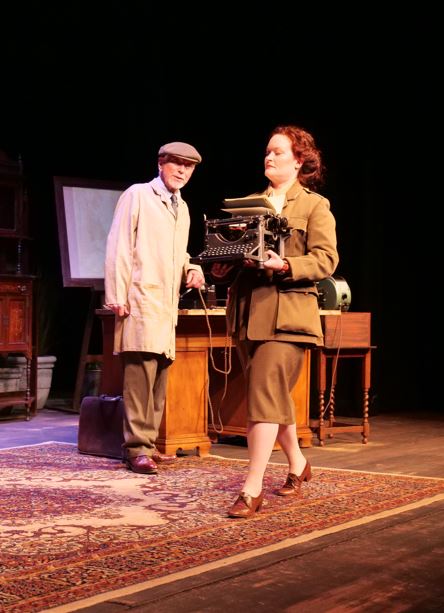
She’s obviously in love with her boss. Rumours abounded at the time about the married General and his loyal chauffeur. (His biographer denied a physical relationship, and her autobiography termed it an unconsummated love affair. We witness odd glances and a gentle touch when she tucks a tartan rug over his exhausted sleeping body.) The nearest they reach to orgasm on stage is when they share the mouth-watering treat of a rare if not forbidden fruit: an orange. They also share breakfasts of the powdered egg variety, as Britain was enduring strict rationing
Divorced and contentedly childless Lieutenant Summersby empathises with Stagg’s anxiety over his pregnant wife. Ike has also lost a son.
Despite the desperate urgency of their work in the meteorological HQ there is still room for flashes of humour. The borderline nerd Stagg cannot understand why weather maps and charts are less than exciting. While his military colleagues have cold steel, bombers and warships his weapons are anemometers, barometers and thermometers.
‘How can the weather ever be boring?’, asks our hero, whose father was plumber to a Scottish laird. While other countries have a predictable climate there is nothing predictable about British weather. ‘It’s why we talk about it,’ he explains.
Gill Martin, January 2024
Photography by Kim Harding


 Mark Aspen
I really don’t understand why reviewers feel the need to recount the entire plot of a play in a review. Gill Martin seems to have more to say about the weather on Tuesday than the production she is reviewing. It was a tension-filled, tightly crafted drama that was superbly acted and directed. The entire ensemble cast was note-perfect. The play itself gives insight into a little-known but immensely important figure in history, and recreates the war-time atmosphere in such a way that the audience- who are well aware that D-Day did happen, albeit 24 hours later – is carried along into the tense, fearful days before, when months of planning and thousands of lives were subject to the whims of the British weather.