
Sleuth
A Mega Hustle (6,1,4)
Sleuth
by Anthony Shaffer
Bill Kenwright Productions at Richmond Theatre until 18th May
Review by Mark Aspen

Those of us who enjoy cryptic crosswords will love Sleuth. And there is plenty of sleuthing in Anthony Shaffer’s best-known play. The mood was set on press night by being told, critically, that the cast would be “smaller than you think”. But don’t worry if you are not the cryptic sort. If you enjoy detective stories, you will love Sleuth. If you enjoy games, you will love Sleuth. Plays with plays are commonplace, but Sleuth is a whodunit within a wheredunit, within a whydundit.
Sleuth is about revenge and about the self-sustaining spiral of revenge. A cuckolded husband arranges to meet his wife’s lover, ostensibly to discuss the circumstances of a divorce, but a trap is set… then another, and another. It is a brilliantly written detective thriller, set within a psychological thriller whose dark mood darkens as the play progresses.
Andrew Wyke, a late middle-aged writer of detective novels, is urbane, witty and erudite; but he is also arrogant, cynical and sadistic. His work has been very successful, and mainly comprises a series of stories about his aristocratic amateur detective, StJohn Lord Stephens, who effortlessly solves crimes about which the police, epitomised by Inspector Plodder, remain baffled. His success has enabled him to live in a large period mansion, and to dine alone on caviar and champagne. He lives alone, apart from his domestic staff, because his wife Marguerite has left him for another man.
That man is Milo Tindle, a young self-made businessman, who is urgent, wily and energetic; but also is antagonistic, cocky and sarcastic. His background is comparatively modest. His English mother died young, but had married Milo’s father an Italian watchmaker, who changed his name from Tintolini, because he loved Britain. He was able, however to give Milo a public school education. Milo’s travel agency business is just about breaking even.
Milo’s foreign blood gives Andrew reason to sneer and Andrew’s affected lifestyle gives Milo reason to sneer, for Andrew is a snob and Milo an inverted snob.

Milo is invited to Andrew’s house, and what a house it is, an oaken baronial mansion in a remote corner of Wiltshire, and full of slightly disconcerting objects, indicative of Andrew’s passion for practical jokes, for games and for puzzles. It has an ancient Egyptian sarcophagus; a number of automata, including Jolly Jack Tar, the (creepy) laughing sailor; and, as an example of Andrew’s obsession with obscure games, his set of the board and playing pieces for senet, the board game of Pharaohs, four times as ancient as chess.
In this vein, designer Julie Godfrey’s set and its concomitant special effects are impeccable, from Jacobethan heavy oak panelling, to a baronial stone fireplace and robust staircase. As the action gets nasty, it is underlined within Tim Oliver’s atmospheric lighting design and Andy Graham’s sound design, which includes some tongue-in-cheek choices of incidental music, Tea for Two or “I’m in Heaven” from Cheek to Cheek. Subtly, silhouetting of implied very nasty action, in light and music, is quite shudder-inducing. Sleuth is a tech-heavy show, witness the number of practical props (Kate Forrester), as porcelain is smashed when bullets fly. The whole creative team are exceptionally talented and highly, well, er … creative.
When Andrew invites Milo to his house for an evening tête-à-tête, Milo is intrigued, but plans to take the opportunity to convince Andrew to divorce Marguerite. However, Andrew ostensibly does not require convincing. But can Milo keep her in the manner to which she has become accustomed? Andrew has a nefarious plan to both their advantages. Commenting on their respective positions, Andrew sardonically overserves “Sex is a game: marriage is a penalty”.

Milo however becomes entangled in another sort of game, and does not at first realise that it is all an elaborate ruse to humiliate him.
With its quick-fire sophisticated wit, mannered development, and more twists than a jeroboam corkscrew, Sleuth is a hard call for the actors in the principal two-hander. Both actors, though, are well up to the task and are outstanding in their roles. Todd Boyce, playing Andrew Wyke, and Neil McDermott as Milo Tindle, are both well-known TV soap actors (Coronation Street and Eastenders fans seemed to form much of the audience), but both are equally adroit on the stage.
Boyce, chisel-faced, dapper in a green velvet smoking-jacket, exudes an air of casual menace, suave yet unpredictable. He delivers lines like “Romance! Marguerite! She couldn’t get Johann Strauss to waltz”, with a natural insouciance, although sometimes they come a little too fast. We see a man whose brain can do a loop-the-loop almost effortlessly.
Both men wear masks, figuratively and literally (another technical challenge, head-mikes for the masks). The masks hide intentions, for this play gives masterclasses in manipulation. Milo is also coerced into wearing a clown costume (drawn from a large laundry basket that Trish Wilkinson’s costume department must have had great fun filling).
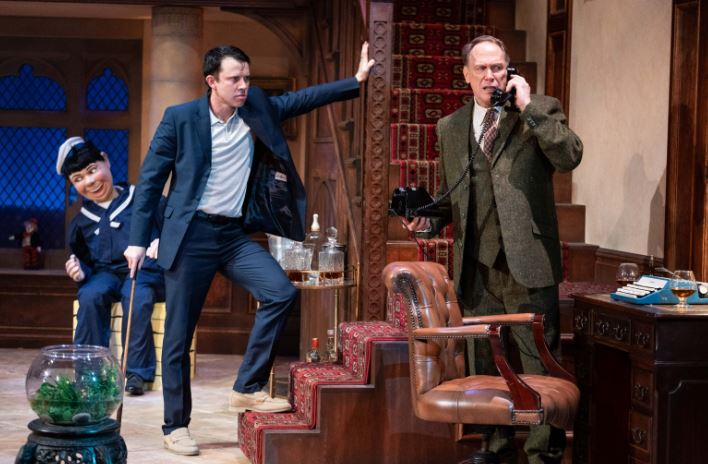
McDermott pitches his portrayal of Milo between the slit-pocketed lairy barrow-boy and the well-educated earnest sophisticate. His Milo is a man who knows when he has been had, and is not going to let it rest there. Milo has perhaps the biggest emotional journey of the two during the course of the play, and McDermott convincingly follows those triumphs and horrors. (Milo endures a psychological torture worthy of the KGB.) Here is a character proud of his Italian heritage and hence, stereotypically, a love of opera. McDermott shows his singing competence with a burst of an aria from Pagliacci (the Pag of Cav and Pag), Milo taunting Andrew with an image of Canio, the cuckolded head of a circus troupe.
“Detective facts are different from detective fiction”, Andrew remarks. And the second half opens two days later with Inspector Doppler from the Wiltshire Constabulary, investigating the sounds of a shooting. The anagrammatically subterfugent Tom Mendriclet plays this small but pivotal role with great aplomb and much padding.
Inspector Doppler has an approach a bit too thrusting for the police rulebook, but gets results. Andrew should know the undisciplined police officer from his own fictional characters, but is too imprudent in his response to a potential murder investigation.
Two other minor characters, the ventriloquial Detective Sergeant Tarrant and PC Higgs, are played ephemerally but convincingly by William Goodison and Kenny Right.
Sleuth is a black comedy and, by the bye, one that spoofs the detective story à la Agatha Christie. It also takes a side-swipe at class warfare. It homes though on studying manipulation and psychological weaknesses. (Milo taunts Andrew with a charge of impotence over his Nordic mistress Téa.) Director Rachel Kavanaugh has created an intelligent, perceptive and thoughtful balance of all these angles, and has neatly peppered it, a play involving games, with little puzzles. One example is the use of Stephen Sondheim’s Bring in the Clowns, which not only comments on the intricacies of the intense plot, but notes that Sleuth was partly inspired by Sondheim, a friend of Schaffer, who, like Andrew, loved games and puzzles.
The main theme though is revenge. “Vendetta” might be a word popular in Italian opera, but revenge is said to be a dish best served cold. Milo might have done better by not microwaving it.
And the cryptic crosswords that is Sleuth? 2 across followed by 1 down, brilliantly executed.
Mark Aspen, May 2024
Photography by Jack Merriman

 Mark Aspen
Trackbacks & Pingbacks