
Falstaff
Bulk Bye
Falstaff
by Giuseppe Verdi, libretto by Arrigo Boito
West Green House Opera, Theatre on the Lawn, Hartley Wintney, until 21st July
Review by Mark Aspen

What makes a rogue a lovable rogue? If Sir John Falstaff is the epitome of the loveable rogue, maybe we should ask those Elizabethan play-goers who wanted Shakespeare to resurrect him from the dead after Henry IV. Or perhaps we should ask Signor Verdi, who, although not speaking English, loved Shakespeare and is said to have always kept an Italian translation of The Merry Wives of Windsor at his bedside.
Verdi was in his eightieth year when he wrote Falstaff. His first attempt at a comic opera, Un giorno di regno, was when he was in his twenties. Its poor reception disheartened him and tragic opera became his forte for the next six decades. It was his librettist, Arrigo Boito who re-kindled the dormant Shakespeare comedy idea, when he dropped an outline for Falstaff on his desk. Boito knew of Verdi’s bardolatry; there had already been a Macbeth and an Otello, plus Verdi had long toyed with the notion of a King Lear. That would have been quite something.
Verdi it seems was something of an anglophile. Shakespeare is quintessentially English. But then too is the oak, hearts of oak, Armada battleships and Tudor staircases. And director Richard Studer’s set design is thoroughly oaken. The walls are light oak and a triple-level stage is floored in the same light oak. There, pre-eminently arising from centre stage, is Herne’s Oak, Windsor Great Park’s fabled landmark, fashioned from fretted ply in … oak. The set remains unchanged throughout the action, and functions variously as the Garter Inn, Ford’s house and the parkland around Herne’s Oak.

Studer’s costumes, realised by Jill Rolfe, are picture-book Tudor, think doublet and hose, gable bonnets, farthingales, ruffs and buskins. The ladies wear mediaeval steeple-hennin headdresses, even when doing the laundry! The costumes are stylised to point up the comedy, and Falstaff’s wig of bouffant silver curls say something of the character, as he drags behind him a ten-foot long paper bill itemising his food and drink account with the Garter Inn. Everything is bright and vibrant, befitting the nature of the action.
And the action is straight in there with boisterous confrontation between Falstaff and the local worthy Dr Caius, who has been burgled. He accuses Bardolfo and Pistola, Falstaff’s men, who summarily eject the hapless victim. But they draw the line at being embroiled in Falstaff’s latest scheme to boost his fading finances, and flourishing libido, by seducing a pair wealthy Windsor wives. They refuse, as a matter of honour, to be the messengers taking to Alice Ford and Meg Paige two identical love letters he has prepared for them.
Falstaff’s outburst expresses his outrage, “L’onore! Ladri … Può l’onore riempirvi la pancia?” (Honour! You thieves … can honour fill your belly?). This is Falstaff the egotist, a man with the self-awareness of a hippopotamus. He goes on “Che è dunque? Una parola. C’è dell’aria che vola.” (What is it then? A word. A lot of hot air.)
Yet Falstaff is a rascal we hate to love. He’s larger-than-life, almost literally as his huge belly, that is a source of pride, certainly is. He may be an old roué, a chancer, but he’s a big-hearted one. He may be a lecher, but he is a likeable lecher. Australian baritone Simon Thorpe catches this nuance, acting out the part with gusto, as his rich resonant singing voice express the energy and the life-force of his character, a Falstaff whose pride in being immenso, enorme refers equally to his ego as to his bulk.

Sir John, however, has not reckoned with the cunning of the conspiratorial foursome of Alice Ford, Nanetta the Fords’ daughter, their housekeeper Mistress Quickly, and Meg Page, Alice’s friend and confidant. After Alice and Meg have compared letters, and blown his duplicity, this band of ladies become the chastity belt that protects the virtue of these merry wives from Falstaff’s lechery.
Galina Averina portrays the gleeful guile of Alice Ford with a vivacious edge, her silky lyrical soprano giving a lightness to the part, as an intelligent woman, who is not going to allow herself to be duped. An equally determined character is Meg Page, Falstaff’s other potential paramour. Felicity Buckland, (known to her friends as Fizz) adds a buzzing energy to a feisty buoyant Meg, and her attractive and strong mezzo give the role real bite.
Alice’s plans to gull Falstaff are, however, nearly scuppered by her husband, who hearing from the affronted Bardolfo and Pistola about the letters, sets up his own plan for Falstaff’s downfall. Ford presents himself to Falstaff as Fontana, a would-be but inept seducer of Alice, looking to Falstaff as a go-between … and he is willing to pay handsomely. But when Falstaff boasts that he is already ahead of the game, and shows the letter he has already received from Alice, hinting that she would be available that afternoon “dalle due alle tre”, the hours when her husband will be absent, Ford jealousy is almost impossible for him to supress. All this require great comic timing as an actor, but Canadian baritone John-Kristof Bouton rises to the part, nicely expressed in an ironic duet with Falstaff on the nature of love.
As we know, the seduction does not succeed, and the second scene of Act Two, which takes place in Ford’s house, is given over to a fast-moving, raucous farce as the two competing schemes to hoodwink Falstaff and defend against his amorous advances both clash. The scene culminates in Falstaff, hiding a laundry basket, being dumped unceremoniously into the Thames. It is worth noting that the performance space at West Green House is not the Theatre on the Lake this year, where the dunking could have been for real! And indeed the lake has been used to great effect as in the 2022 production of L’elisir d’amore. However, Simon Thorpe is no doubt relived that this year’s location is The Theatre on the Lawn.

The Theatre on the Lawn is an atmospheric setting for Falstaff. The upstage is open, giving a vista towards the façade of West Green House across its terraced lawns. This wide perspective gives ample space for Bardolfo and Pistola to hurry back and forth in the background on various errands, carry messages, or ale-kegs, or generally making mischief. As twilight falls, Neil Dakyn’s landscape lighting and Sarah Bath ’s inspired stage lighting designs combine to conceive a lush depth, especially apparent in the final scenes in Windsor Great Park.
When Falstaff returns besodden, bedraggled and morose, to the Garter Inn, one cannot help but feel sorry for him as he curses the world. But when he calls for “un bicchier di vin caldo”, he is soon revived by that jug of mulled wine. He may call himself vecchio John, but he has absolutely no intention of growing old gracefully, for he doesn’t learn his lesson.
When Mistress Quickly, the Ford’s housekeeper, arrives with a further prospect of a liaison with Alice, Falstaff initially is on his guard and wants nothing to do with it, but she persuades him. She is clearly a better seductress than Falstaff is a seducer, and when she describes Alice as povera donna, he misses the sardonic undertone and falls for it a second time round. Mezzo Carolyn Dobbin rich mezzo is certainly seductive as she accentuate the falling notes of povera donna. It’s Mistress Quickly’s bantering nature of that make Falstaff so gullible, but the proposed location is exotic and gives Falstaff that frisson of expectation: he is to meet Alice at midnight at Herne’s Oak, disguised as the hunter’s ghost. (Incidentally, Carolyn Dobbin is also a portrait artist and Falstaff is one of her favourite subjects.)
Soon the four ladies are again plotting. As a slight quibble, a lot of this plotting and Nanetta’s lute “playing” (the orchestra’s harpist) takes place on the lowest level stage left, where there is no sight-line for most of the audience, causing much neck-straining in the middle of the stalls.
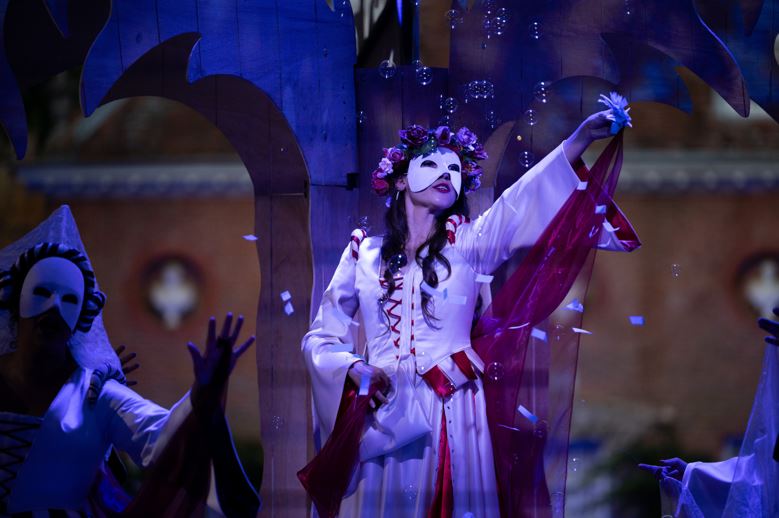
As the Ford’s youthful daughter, Spanish soprano Lorena Paz Nieto makes an attractive and charming Nanetta, the honeyed effervescence of her singing most apparent in the scene before everyone arrives in disguise in the park. Her disguise is as the Fairy Queen, and she directs her co-conspirators to fly as agile spirts, “sul fil d’un soffio etesio” (on the breath of a perfumed breeze). It is exquisite, as bubbles float from the oak’s crown; a moment of pure magic.
Nanetta has just had a secret tryst with Fenton, her sweetheart, in spite of her father’s disapproval. Welsh tenor Trystan Llyr Griffiths portrays an earnest and charming Fenton, underlined in dal labbro il canto estasiato vola (from my lips, a song of ecstasy flies) as he woos Nanetta in fulsome terms. His love song is abruptly truncated as the woman hurry to disguise him, ready for another ruse to save Nanetta from having to marry her father’s choice of the wealthy, but elderly Dr Caius. Another West Green stalwart, Jonathan Cooke plays the thwarted Dr Caius, exhibiting his fine tenor voice, known for its versatility.
Pistola, played by bass Simon Wilding, also seen in last year’s Sweeny Todd and the character tenor Peter Van Hulle’s Bardolfo between them do a lot of the heavy lifting to move the plot along on its dizzying pace, and are crucial in the taunting of Falstaff in midnight scene at Herne’s Oak. Bardolfo indeed ends up “marrying” the unfortunate Dr Caius during the woodland shenanigans, although one wonders why his trademark port-wine-overdose nose does not glow beneath the thin veil and give the game away.

The mistreatment of Falstaff in the final scene does seem particularly vicious in this production, leading one to think enough is enough. Yet, in spite of all, Falstaff is very magnanimous in accepting in the end that he has been had. The joke is on him, and he even does a little patter duet reprise of his brief dalliance with Mistress Quickly.
In the end, lovers are reunited, marriage (real and shame) contracted and all (may be) resolved. Shakespeare might have it that “all the world’s a stage” but it is pointed out in a rousing finale that “all the world’s a joke”. It is an impressive finale as all the character come in one by one in the crescendo of the finale fugue, which includes every instrument in the orchestra.
The West Green House Orchestra works its socks off throughout the opera as Verdi whirls the music along with his own jokes, with melodies and motifs, tunes and textures, and ever-changing rhythms and harmonies. Conductor Jonathan Lyness whisks us through all Verdi’s musical japes with panache.
But, as Falstaf says, “tutto nel mondo è burla!” The joke’s on us.
Mark Aspen, July 2024
Photography courtesy of West Green House Opera


 Mark Aspen