
The Barber of Seville
Sharp Practice
The Barber of Seville
by Gioachino Rossini, libretto by Cesare Sterbini after Pierre Beaumarchais
West Green House Opera, Theatre on the Lawn, Hartley Wintney, until 28th July
Review by Mark Aspen

The whole cast needs to be very sharp in The Barber of Seville, for it is amongst the busiest of operas. Patter songs come thick and fast, and it is foremost a frenetic farce, furiously paced. Rossini intended his Il Barbiere di Siviglia, and it is presented here in Italian, to be pure fun, with none of the darker undertones of Beaumarchais’ plays, which are evident behind the comedy in Mozart’s Le Nozze di Figaro, which is effectively its sequel. Even sober-sided Beethoven enjoyed Il Barbiere, although he was sniffy about Rossini’s more serious works.
Director Victoria Newlyn, who also had great fun with Donezetti’s L’elisir d’amore on the lake in 2022, fittingly lets West Green’s production let rip as a rowdy romp, played for laughs.
And straight in with great gusto, is the West Green Orchestra. Conductor Matthew Kofi Waldren animates the action during the overture. The cast, again with much busy-ness, act out the backstory. The elderly Doctor Bartolo has become the guardian of Rosina following the death of her wealthy parents. He hopes to marry her to get her substantial inheritance as a dowry. Wary of other, more eligible, suitors he moves his household from Madrid to Seville, where Rosina is confined to the house, under the watchful eye of Berta the housekeeper and Don Basilio, her singing teacher. However, Count Almaviva has fallen in love with her, and follows them to Seville, disguised as Lindoro, a student. So we know where we are; a useful quick intro to a newcomer to the opera, but it does distract from the overture itself, which should be previewing the action in the music.
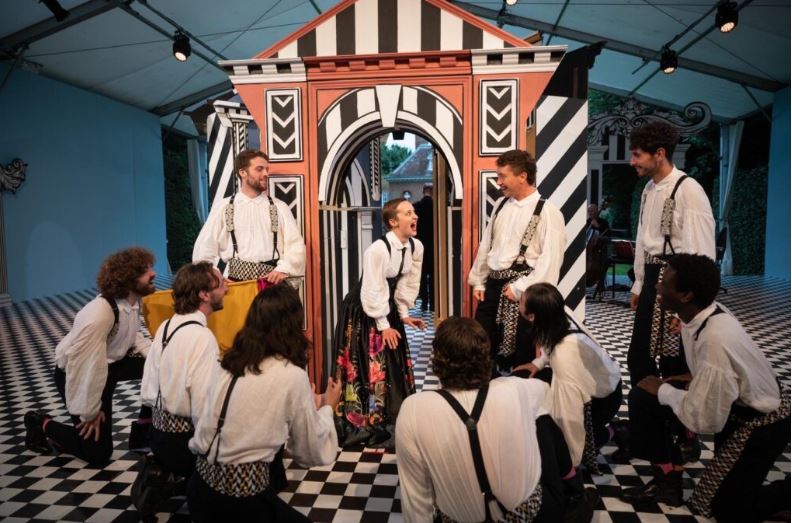
The over-loud troupe of musicians that Almaviva has employed in the opening scene to accompany his dawn serenade under Rosina’s window have costumes that hint at toreadors’ outfits. Almaviva’s own calzoncillos are the same checked pattern in black and white as the stage floorcloth. Designer Laura Jane Stanfield has a stylised bullfighting theme that runs through both the costumes and the set. Its inspiration seems to be the Mudéjar latticework prevalent in the architecture of Seville, most evidently alluded to in the black and white reticulated pattern of Figaro’s frock coat, worn over mustard breeches and waistcoat. All the costumes, indeed, are quite eclectic, styles ranging from puzzling, to ironic, to humorous. Without period wigs, hairstyles are very 21st Century.
The set itself comprises a number of arched doorcases on trucked platforms, decorated with chevrons, again in Mudéjar black and white. Some have a scrolled pediment reminiscent of Figaro’s moustache, quite a barber pomaded trademark. The trucks are constantly moved around the stage, mainly by the busy chorus. Newlyn has wide experience as a choreographer, evident in the movement used by the cast to emphasise the action, particularly its farcical and comic elements, of which there are many. But why keep moving the set? The peripatetic arches, even rearranged in different configurations don’t seem to inform very much on the setting of each scene. All this buzzy busy-ness tends to overload the senses, especially against the visually dizzying design, intruding where the effervescent music, quick-fire libretto and witty farce are enough to set the pace.
The eponymous barber, Figaro is of course intended to be at the epicentre of the energetic action. Rossini gives him two tongue-twisting arias right at the beginning. Largo al factotum must be amongst the best-known operatic arias, where Figaro tells how he enjoys being the best barber, gossip-monger, assignation broker and general fixer for a fee. Once Almaviva recognises him as a former member of his retinue, he is quick to employ Figaro to help him in his quest to gain access to Rosina, the next patter aria follows quickly. The address of his barbershop is Numero quindici a mano manca, number fifteen, left hand side. Dominic Sedgwick tackle these vocal acrobatics with agility. His Figaro is not the usual comic turn but has more subtlety, his strong baritone adding a lyricism to the banter, emphasising the wily factotum’s confidence rather than his cockiness. There is a self-satisfied twinkle and twirl … eye and moustache respectively.
Maltese tenor Nico Darmanin, whom we saw as Don Ottavio in Glyndebourne’s Don Giovanni last autumn, presents a rather laid-back but dignified Count Almaviva as he makes the emotional transition from anxiety about Rosina’s acceptance of “poor student” Lindoro to full confidence in his standing as noble. He has a light nasal quality to his measured lyrical tenor, and clearly enjoys the role of the determined lover, disguise first as a drunken, or slightly sozzled, officer of the military veterinary corps; then later as a more over the top singing tutor in flower-power wig.
Katie Bray’s Rosina seems a rather coy character at first in her aria Un voce poco fa, the voice she just heard. It has thrilled her heart, but instead of a heart-felt soliloquy, Bray demurely confesses to the chorus. Her beautiful soprano here has a precision, and has little glissando stresses on the important words. However, as the action progresses, her coloratura increasingly decorates her words in her defiance of Dr Bartolo, in her playful daring subterfuges engineered by Figaro, and in her declarations of affection to Almaviva.

Grant Doyle‘s Dr Bartolo balances the intimidating lustful guardian with the pompous self-important local worthy. He brings out the comedy in the man’s vanity, helped by Stanfield’s pink frock coat and matching accessories; and in his irascibility, which is suitably expressed when he takes a pratfall over the pouffe. He can gallop his rich baritone into a turbo-patter, as in A un dottor della mia sorte, chiding Rosina, and warning her he’s rumbled Figaro’s plot, for “a doctor of my standing”, can’t be foiled.
Trevor Eliot Bowes, who made an impressive Sarastro in The Magic Flute earlier this summer, steals the stage as Don Basilio. His combination of creepiness, craftiness and comedy is priceless. As the spin doctor extraordinaire, beetle-browed Bowles’ flexible physicality, elastic expression, and dour demeanour paint a larger than life portrait of the character. And my, is his resonant bass voice a delight. His rendering of the Calumny Aria is as acrobatically amazing as it is musically mesmerising. He delares La calunnia è un venticello , “calumny is a little breeze” as he proposes to defame Almaviva’s reputation
Scottish soprano Jeni Bern is a remarkably versatile performer, in roles as varied as Aunt Norris in Mansfield Park, or the chief scientist on a polar expedition in Anthropocene. Here she has a delicious cameo as the idiosyncratic Berta, Bartolo’s housekeeper, and plays it to the hilt. Her regretful ditty Il vecchiotto cerca moglie, “an old man searching for a wife” reflects on her own age. Bern flirts with the chorus as Berta tells how she still has a little tickle, a tingle, un pizzicore, un solletico, from time to time.
To some extent, and notwithstanding remarkable solo singing, many of the ensemble pieces are even better, particularly the quartets and quintets. This of course is Rossini’s intention to enrich the musicality of the piece. Jonathan Lyness’s reduced orchestration, although weighted towards strings rather than woodwind, does put much more onus on the singers. The chorus are admirably strong and supportive in this respect, and have a oneness that bites. Waldren’s conducting allows this balance without losing the joyful elements of the score.
This balance is also evident in the musical interlude just before the procrastinated elopement of Rosina with Almarviva, where the music evokes an impressive thunderstorm. This storm is an opportunity to showcase the skills of the lighting designer, Sarah Bath. The impassive lightning flashes inside the auditorium are seen again outside from its open upstage, across the vista towards West Green House, synchronising with Neil Daykin’s architectural lighting.
Rossini is reputed to have written The Barber of Seville in just thirteen days, although many musical themes and passages were recycled from various other of his works. This was his hyper-busy period at the beginning of the nineteenth Century, when he wrote forty operas in under twenty years. Busy-ness was Rossini’s hallmark. So, if West Green’s production is frantic merry-go-round, it fits the maestro’s style, and is performed with panache.
Mark Aspen, July 2024
Photography courtesy of West Green House Opera

 Mark Aspen
Trackbacks & Pingbacks