
La Bohème
Bohemian Blues
La Bohème
by Giacomo Puccini, libretto by Luigi Illica and Giuseppe Giacosa, based on a novel by Henri Murger
English National Opera at the London Coliseum until 19th October
Review by Susan Furnell
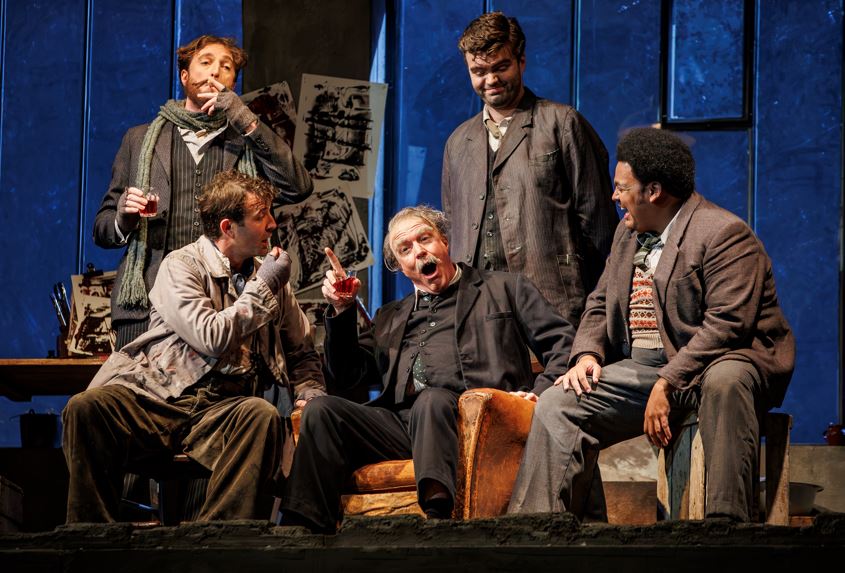
La Bohème has always been close to the heart. From my first experience of shedding tears at an opera at a Chicago Lyric Opera production in the 1980s, to being swept away by the grandeur of Zeffirelli’s sets at The Met, Puccini always creates magic and emotional intensity for me. So when I finally decided to see the Jonathan Miller production, noted for its modern setting, I was intrigued to find out how the production would work for this timeless love story.
My expectations have always been high for a Jonathan Miller production of any opera. However, I initially had some reservations about going to the first run of his La Bohème in 2009 and its subsequent revivals after reading reviews describing its “modernity” and “hyper-realism,” and some mentions of “clumsy” translation which I assumed to mean “harsh” and “jarring”. However, curiosity finally won me over as it is now on its fifth run and must have something special to be brought back again and again. What would I find?
Miller has been on a long-standing mission to strip out clichés and the kitsch representations common to productions of Romantic opera, wanting to be more honest about the challenges of poverty and illness, while remaining sensitive to the eternal themes of love, loss, and the camaraderie of friends. By setting the opera in 1930s Paris, with sets influenced by Brassai and Cartier-Bresson photographs, he chose a period just modern enough to take the opera out of the over-romanticized and clichéd 19th Century setting, but without making it so modern as to lose the plausibility of struggling artists in a café culture.
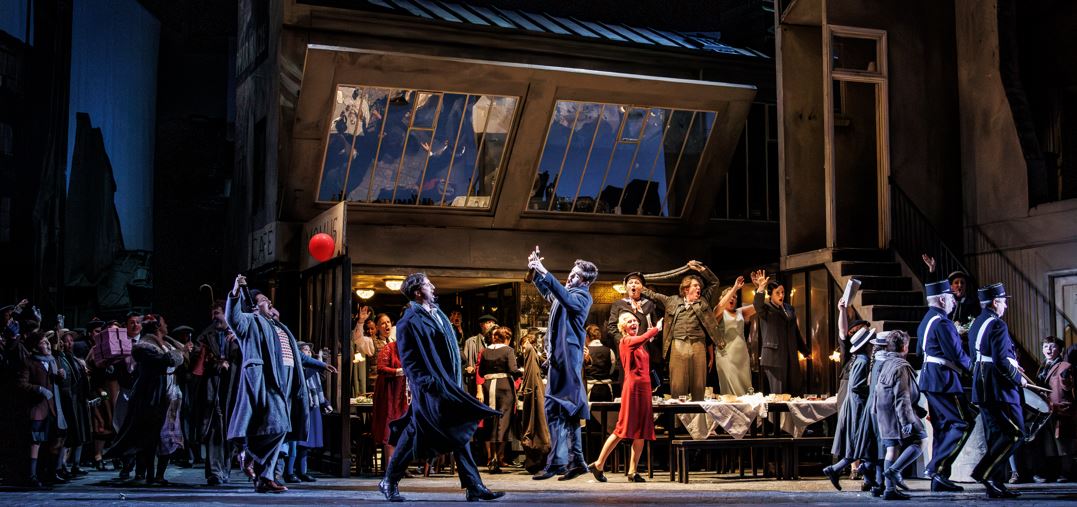
What struck me is the cohesiveness of this vision, to the point I thought some past reviews unfair because they were taking an element of the production out of context and evaluating it as if it had been a different production with a different vision. For example, to counterbalance the more realistic portrayal of poverty, Miller consciously injects the gallows humour of the 1960s cult film Withnail and I. After all, “you cannot laugh and be afraid at the same time – of anything” (Stephen Colbert). This only works in the context of Miller’s entire vision for this production. You couldn’t do this to a Zeffirelli production.
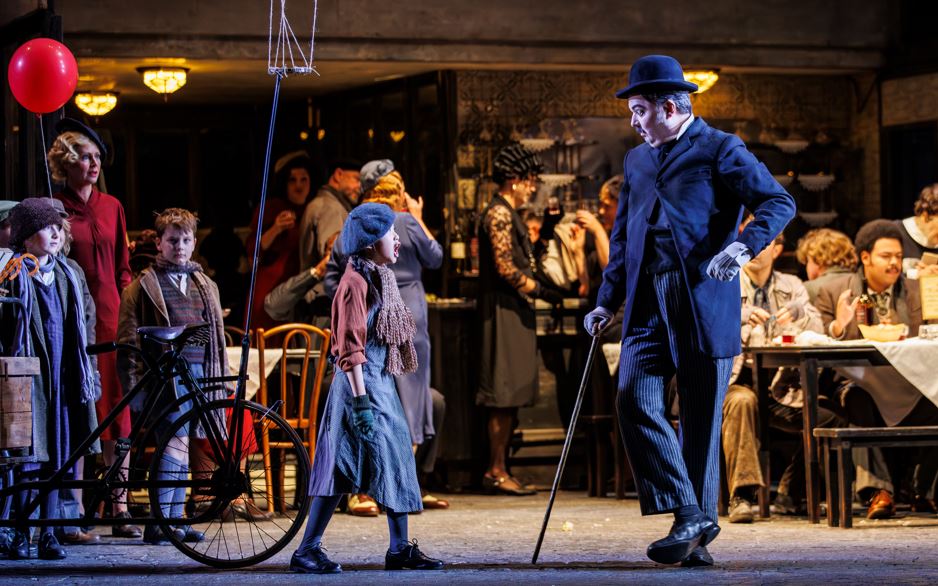
To make the poverty and fleeting respites from it feel more real, the Act Two street and café festival scene (with Musetta’s waltz) is designed to make the audience feel like they are on stage, not spectating. For the gallows humour to resonate with contemporary audiences, the translation is more contemporary and terse than usual, and the floweriness is eliminated. To make the audience see and smell the Christmas festivities in their mind’s eye, small artistic liberties are taken such as the mention of mince pies (which the French don’t eat!).
Not everything is without compromise. The contemporary language compromises some of the original beauty in the arias and duets, but Puccini’s music in combination with the particularly condensed structure of La Bohème (almost devoid of recitative or long choruses) is able to compensate. I’ve often argued that ENO should stop performing in English, but in this case, the translation works with Miller’s vision, even if it diminishes the lyrical beauty of the original Italian.
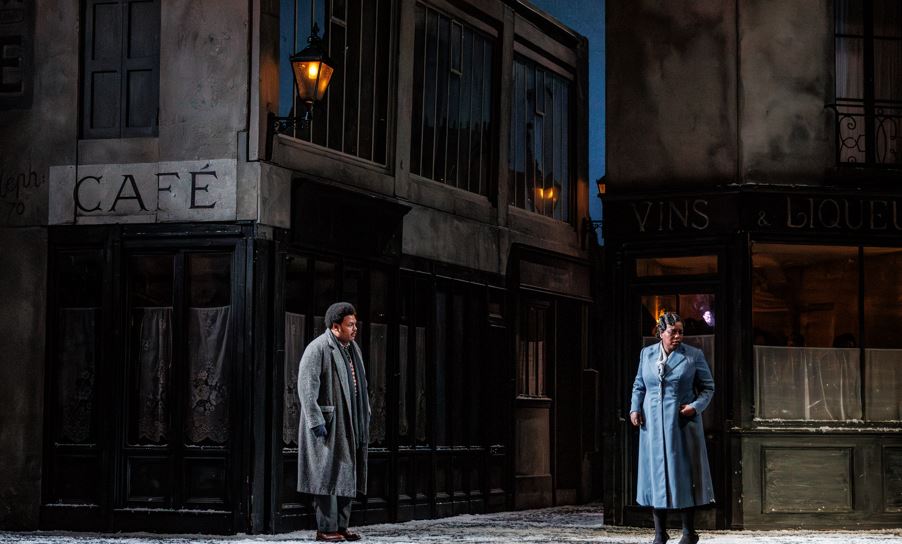
The attic is well-furnished, reflecting the students’ limited budget without relying on cliché. Later, the windows serve as a canvas for different shades of blue, artfully recapitulating the opera’s romantic and tragic arcs. The bustling Parisian café culture in Act Two is portrayed vividly, and just when we’re caught up in the gorgeous set, the emotional isolation of Mimi is emphasized as the set changes and she stands outside, realizing she and Rodolfo must part.
Under Clelia Cafiero’s baton, the orchestra is as fine as ever, though perhaps just a little too loud on entering the first and second acts. In the lush passages, the build-up of emotion and impassioned playing is everything you would want; in the fair scenes, the muted trumpets sound just like the toy soldiers they are meant to. What was deliciously unexpected was the nod of empathy towards Puccini’s history of always being loved more by the people than the intellectual establishment — at least while he was alive. There are many moments where the music almost swings freely, as if it might in musical theatre, making it more accessible.
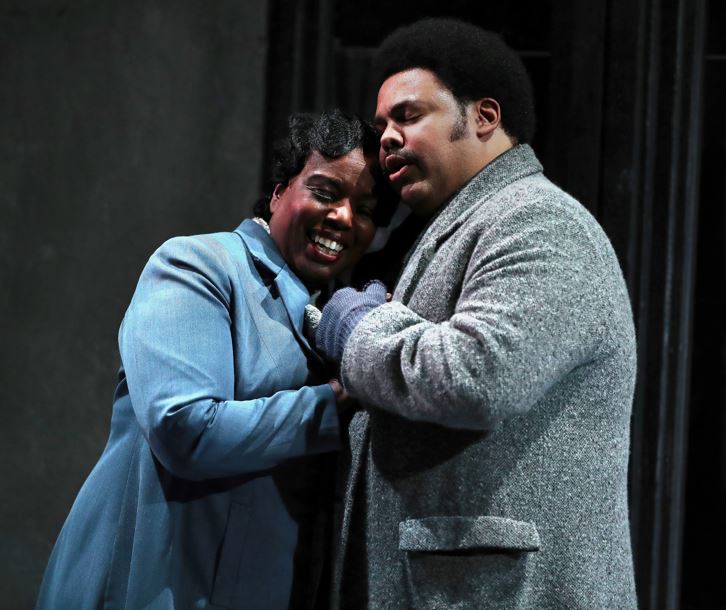
However, the casting in this revival detracts from the production’s potential. While all the leads have lovely voices, technical control, and musicality, they lack the chemistry and emotional intensity needed for Puccini’s heart-wrenching love story. I compared it to the original 2009 production with Alfie Boe and Melody Moore, whose “O Soave Fanciulla“, which was filled with moving passion and tenderness, and the sense of urgency which we know with hindsight is because Mimi doesn’t have much time left.
By contrast, in the current fifth run, Joshua Blue’s Rodolfo’s voice is warm, with good technical and phrasing control, and his arias like “Your tiny hand is frozen” sound beautiful, but the problem is with his stage presence, which is awkward. Nadine Benjamin’s Mimi was able to project both tenderness and strength and is also tremendously musical with good technique and phrase control, and when needed, richness and power — but never conveys the depths of desperation or intense love necessary for Puccini’s doomed love story. At first, their slightly awkward, jokey chemistry felt intentional, as if to delay the growth of passion for a more dramatic climax. Unfortunately, this awkwardness persisted throughout, and the necessary magic was never fully realized. Curiously, Benjamin was most believable opposite
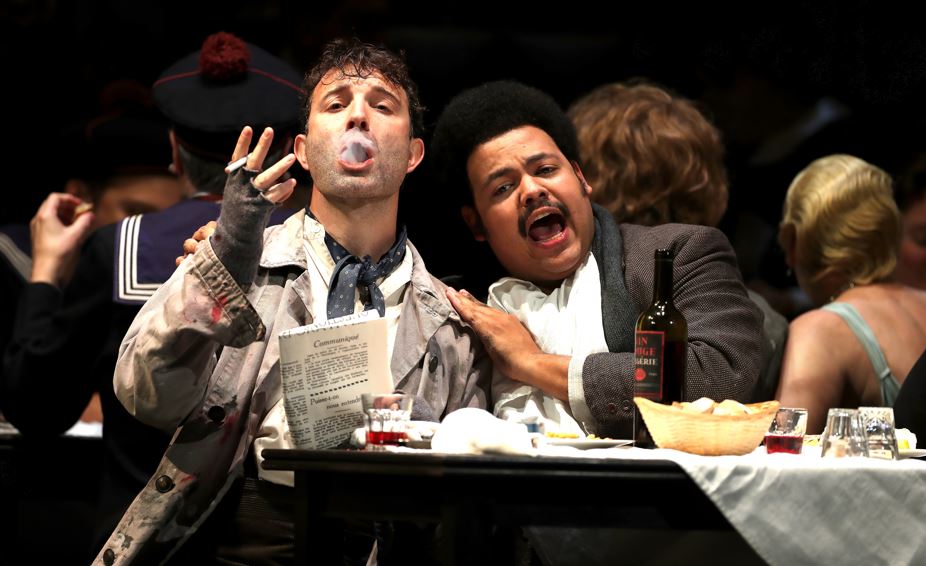
Charles Rice’s Marcello when seeking his counsel — we really do feel her passion, fear, and isolation there. Rice was one of the stars of the production, with his rich resonant baritone voice able to switch from boisterous humour to emotional intensity in his on-off relationship with Musetta and in his concern for Mimi. Dingle Yandell’s Colline was the fourth of the group of attic friends and his rich dexterous bass brought gravity and humour and convinced with his touching selflessness at one point.
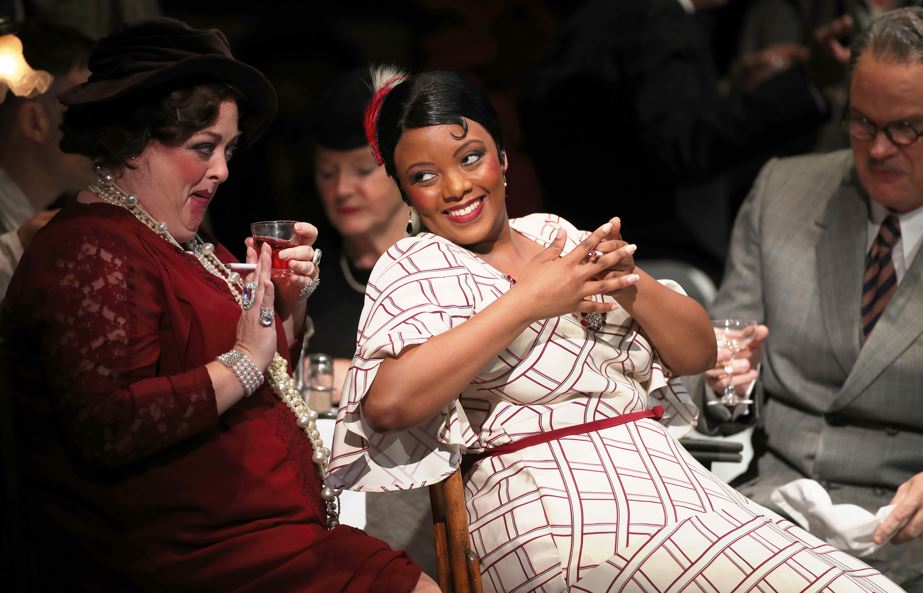
Vuvu Mpofu is a bright soprano whose voice fits the coquettish character of Musetta. She can act — we are left shocked and upset for Marcello when she pretends she loves him, and just as he’s possibly thinking about getting back with her, she callously flicks his seated shoulders (standing behind him) casting him aside for her new gentleman friend. But I would have liked her to be a bit more coquettish, and I was never quite convinced when she was singing about how all the men adored her beauty that even she believed it.
All in all, the 2009 production was a masterpiece, and while this 2024 revival is still worth seeing for Miller’s vision, the romantic magic and tear-jerking love story don’t fully succeed with the current cast.
Susan Furnell, September 2024
Photography by Lloyd Winters


 Mark Aspen
Trackbacks & Pingbacks