
Humble Boy
All the Buzz
Humble Boy
by Charlotte Jones
Teddington Theatre Club at the Coward Studio, Hampton Hill Theatre until 5th October
Review by Steve Mackrell

Ayckbourn on steroids. That’s the first and overwhelming impression that comes to mind after taking a large dose of Humble Boy, written by Charlotte Jones, and first performed at the National Theatre in 2001.
Presented by Teddington Theatre Club, in the intimate space of the studio in Hampton Hill Theatre, the play sparkles with sharp and witty comedy. We are soon introduced to a variety of familiar characters pottering around a pleasant contemporary garden somewhere in middle England. Into the mix is placed a matriarchal mother, her troubled son, a boorish self-made businessman, his daughter and even, classic Ayckbourn, an eccentric gardener.

A death in the Humble family has brought about a family reunion which provides the background for exhuming old ghosts and uncovering various layers of secrets and past events. Then there’s the metaphor of the bees – bee-keeping being the beloved hobby of Flora’s recently deceased husband – but now his bees have been released by Flora leaving an empty hive. Into this situation Flora’s son, Felix, returns home from Cambridge and the growing tensions between mother and son are slowly revealed.
The mother, the controlling and matriarchal Queen Bee, Flora Humble, is played by Dionne King, who displays an acid sharpness and brings a believability to a character who is self-assured and driven by a need for power over the people around her. This is a fine performance capturing the essence of the character without ever over-playing. Her acerbic comments such as “the last word is my prerogative” and “I’m not angry, just incandescent with rage” cuts through the Coward studio like a knife through butter. All this balanced with some fine comedy timing such as the moments where she reflects on her “Lamborghini” of a nose job.
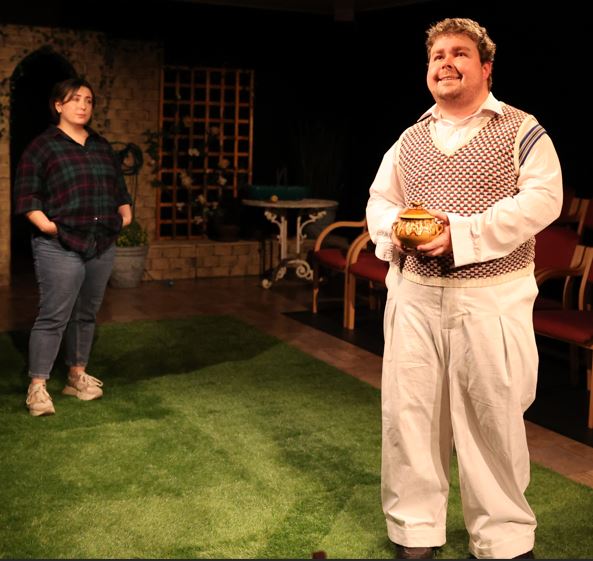
Playing the central character of Felix Humble, Flora’s son, is Alex Farley, who has a large responsibility for holding the play together by projecting his fears and feelings, thus gaining the empathy of the audience for his troubled predicaments. Felix is a complex character, with a brilliant scientific mind, a theoretical astrophysicist immersed in a world of string theory and black holes with hopes of “discovering the theory of everything.” Hence, a gulf in understanding exists between mother and son which adds to their uncomfortable relationship, causing Felix, blinking rapidly, reduced to a stutter when confronted by his mother. Being deeply disturbed by the death of his father, Felix has become introspective, depressed and even suicidal – perhaps a nod towards a much-troubled Hamlet. Farley’s interpretation of this complex character is handled sensitively and portrays a believable representation of his inner anxieties and emotions. Most importantly, his performance is thoughtful, capturing our imagination and evoking audience sympathy for his characterisation. Especially powerful are his reflections about contemplating suicide, and recalling watching the Apollo moon landing with his father at 4am in the morning,
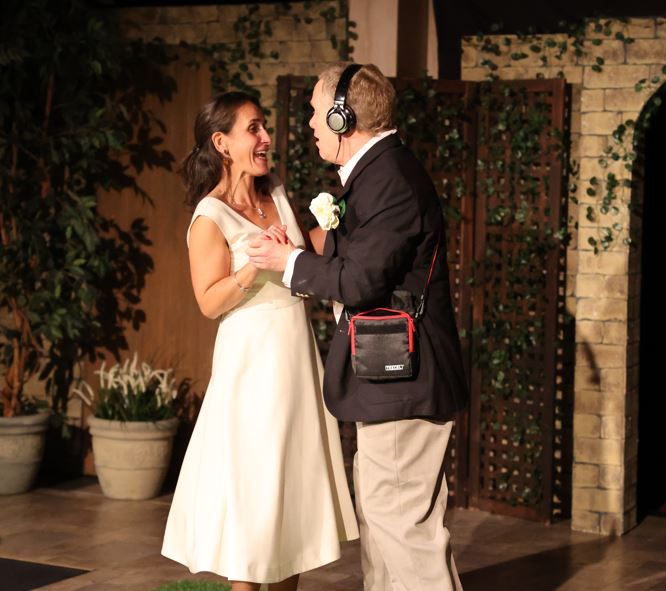
Mother and son are supported by a fine ensemble, foremost of which is the larger-than-life character of George Pye, played by Peter Hill, who has the intention of marrying Flora, much to the consternation of Felix. Pye, a self-made man running a coach company, is obsessed with the music of Glenn Miller, and is the complete opposite of Flora’s “decent upright” deceased husband. Peter Hill is magnificent in successfully conveying this loud-mouthed character who is obnoxious, flashy and brash. Pye is very much the comedic element in the play, especially in his drunken scenes, and delivers some well-timed comedy lines such as his thoughtless put-down of his daughter, “she’s not a looker, but has character.”
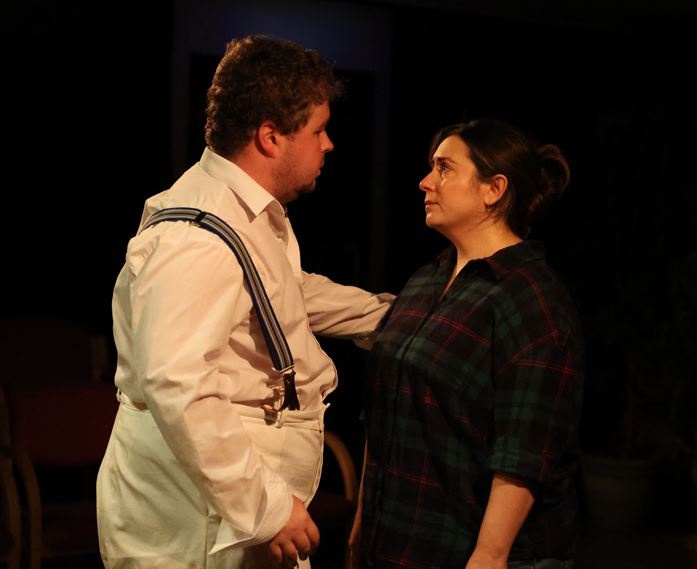
Pye’s daughter Rosie is played convincingly by Madeleine Gordon, whose character transpires to have been a former serious girl-friend of Felix, and her scenes with Felix are sensitive and touching. Jane Marcus plays the part of Mercy, Flora’s long suffering and put-upon friend, who’s very much under the control of Flora and seemingly acting as her spy. Jane Marcus’ understated performance hits just the right note for her subservience to those around her. The rather farcical scene where she orchestrates the lunch by serving the gazpacho with some surprise ingredients is perfectly timed.
Then there’s the rather odd role of Jim, the gardener, played quietly in the background by Alan Hooker, an interesting older character who appears incidental to the happenings in the Humble’s household but becomes the only person that Felix can really confide in. His closing scene with Flora where he discusses the flowers in the garden with their Latin names is remarkably touching and powerful.
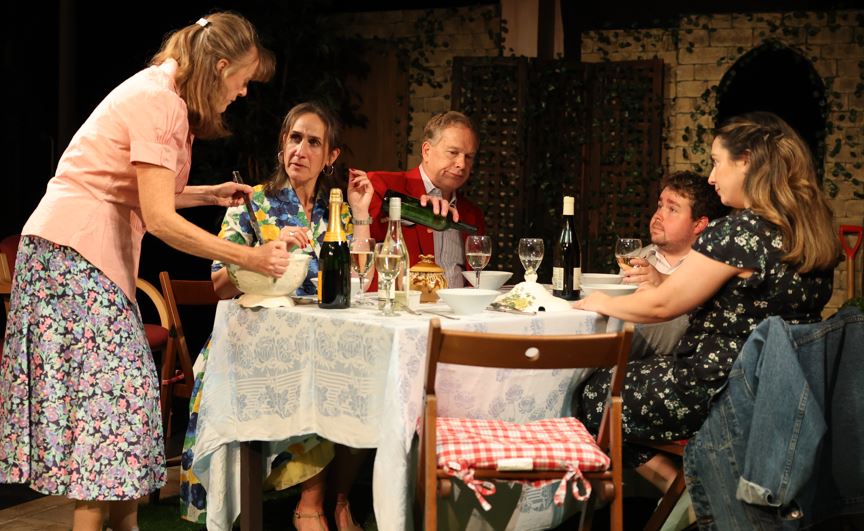
Overall, a very satisfying play and director Ben Clare teases out the subtleties of the various characters without ever falling back on portraying stereotypes. For example, Peter Hill’s characterisation of the abrupt George Pye, which can be tempting to over-play, is restrained in its portrayal of a brash individual, clearly out of his comfort zone in aspiring to belong to the genteel world of the Humbles. The comic timing is well judged and Ben Clare’s assured direction, and carefully placed sound effects, carefully ratchets up the tensions and reveals the growing friction between the characters.
Humble Boy, as with a number of other recent TTC productions presented in the informal setting of the studio, have been first rate and have included some inspired choices of plays, showcasing a variety of lesser-known gems of contemporary theatre. Once again, an excellent and engrossing production – powerful, funny and emotional.
Steve Mackrell, October 2024
Photography by Steve Sitton


 Mark Aspen
Trackbacks & Pingbacks