
Il Tabarro and Rita
Canaletto and Custard
Il Tabarro
by Giacomo Puccini, libretto by Giuseppe Adami
Rita
by Gaetano Donizetti, libretto by Gustave Vaëz
Instant Opera at Normansfield Theatre, Teddington until 13th October
Review by Salieri
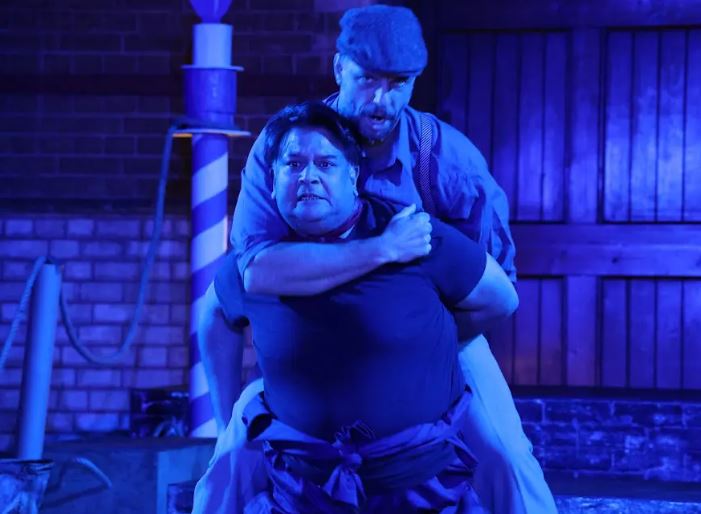
This production of these two seldom performed operas, completely different from each other, provided a fascinating evening’s entertainment. Il Tabarro by Puccini, first produced in 1918 is a typical melodrama with the customary corpse at its ending, whilst Donizetti’s Rita is a wonderfully funny romp, with a sprightly and entertaining score.
The stage at Normansfield is not very wide nor deep, which means that productions with large casts are not easy to present. With a cast of three, Rita has the advantage, but the first piece, Il Tabarro, with a cast of twelve, missed out. At the opening, and into the central part of Il Tabarro, movement of the actors was very haphazard, exits and entrances were not definite, and it was not easy to know who everyone was and where they were going.

Rita, though, was brilliantly staged. There are actually three principals in the opera, and the rest of the entire company of actors turned into the customers who frequent the Pensione da Rita on many occasions and joined into the fun (but rightly not putting in their own dialogue) with the three participants, constantly moving all over the stage. There was some wonderful business with P.C. Bortolo (Douglas Somers Lee) and amongst the customers, I took particular note of Rose Rands as Midinette, who put a little extra cream on her performance. The three performers, soprano Callie Gaston (Rita), tenor William Diggle (Beppe) and established baritone Simon Wilson (Gasparo) played splendidly together. Their obvious talent for comedy, their strong singing voices which blended perfectly, and the pace were all first-rate. Donizetti’s music is infectious, and although the music was sung in Italian, the dialogue was in English. Stage Director Valeria Perboni has created an extremely well-thought out magnificent production

To return to Il Tabarro is difficult, since the presentation was untidy: many of the supporting cast had no real character with the notable exception of velvety mezzo Anna Loveday (Frugola), who did make us all sit up with a well-rounded performance. The others had no real material with which to create characters. Thus we concentrated on the three main roles, soprano Emily Sloan (Giorgetta), Italian baritone Emil Vicenzi (Michelle) and tenor Joshua Baxter (Luigi), all of whom had considerable presence and gave tremendous vocal performances.
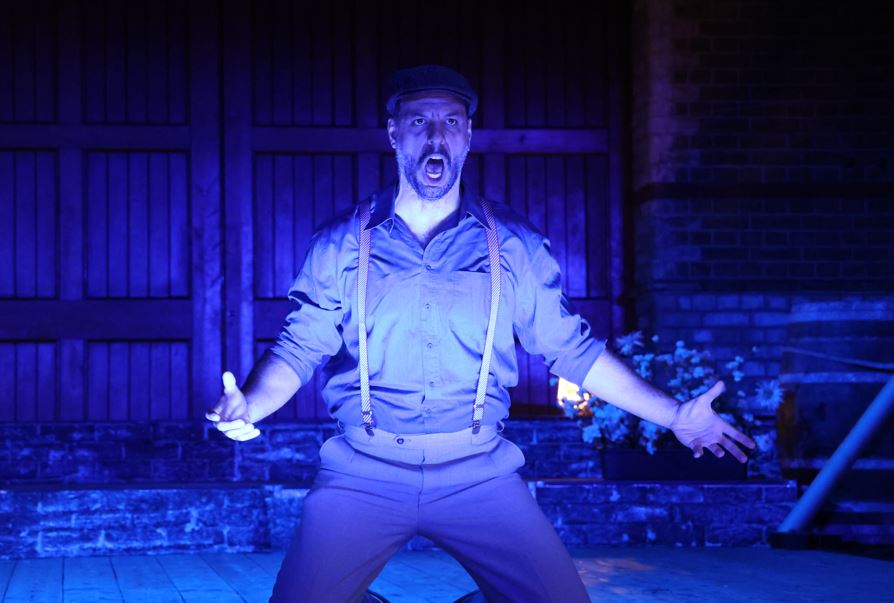
However, we come here to a problem with the venue. Frankly, it was overwhelmed. Puccini’s music needs space to be fully appreciated and the Normansfield stage could not really handle it. Thus the main action towards the finale became a series of arias which almost turned the production into a concert performance until the final strangulation of Luigi.
However, more could to advantage have been done to sharpen the production, as much of the content was too static. It needed to move and propel us to the final climax so that we are as horrified as Giorgetta was when she discovered the body. It’s all there in the excellent summary provided in the programme, but it didn’t really happen. The cast did all they could and musically no-one faltered, but it goes to show that the director has to be responsible for the end product, and I was not convinced that enough had gone into the planning.
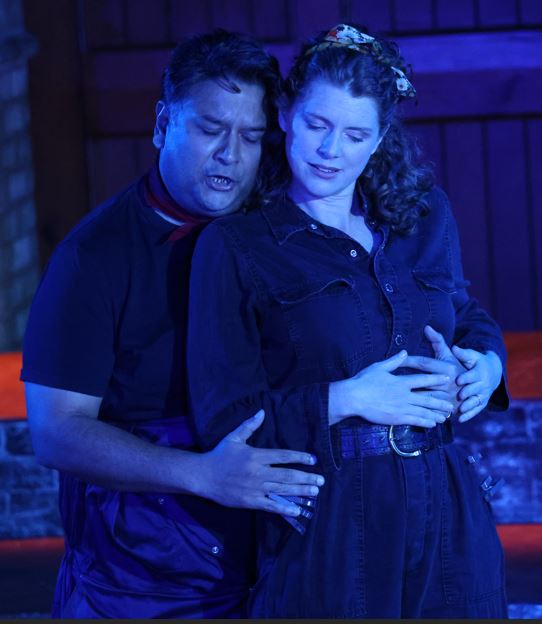
The set of Il Tabarro had been changed from the composer’s original location, to a canal side warehouse in Venice, September 1966. That was perfectly acceptable in theory, but there did not seem to be anything particularly Venetian about it. The lighting was perfectly adequate, becoming gradually more subdued as the opera became itself darker. The set of Rita was absolutely right and Simon Pike had lit it beautifully, giving just the right atmosphere of the piazza it was set in.
The orchestra had, logically, to be reduced in size for the performances at a small venue, and the absence of an orchestra pit meant that the audience were alongside, and the conductor Lewis Gaston was literally “in the way” of most of them, masking stage centre. There was, in fact, no way round this, and we became used to it as the performance proceeded, but undoubtedly the musicians of the Instant Opera Orchestra did full justice to the score of both operas.
All in all, this double bill was a worthy endeavour.
Salieri, October 2024
Photography courtesy of Instant Opera
Il Tabarro
Rita

 Mark Aspen
Trackbacks & Pingbacks