
Shakespeare in Love
Bard’s Heart
Shakespeare in Love
by Marc Norman and Tom Stoppard, adapted for the stage by Lee Hall
Putney Theatre Company at the Putney Arts Theatre until 16th November
Review by Polly Davies
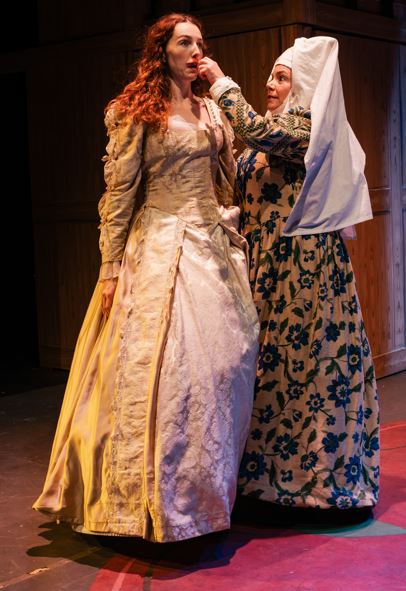
They say that London is a town made up of villages, and the crowd that filled the theatre on the opening night of Shakespeare in Love really did feel like a community coming together to support this ambitious production. And they were not disappointed. This is a rollicking comedy, beautifully played and very entertaining. It easily fulfils directors’ Jodi Rilot and Barney Hart Dyke’s intention to provide a fun evening away from the onset of winter with its dull days and dark nights.
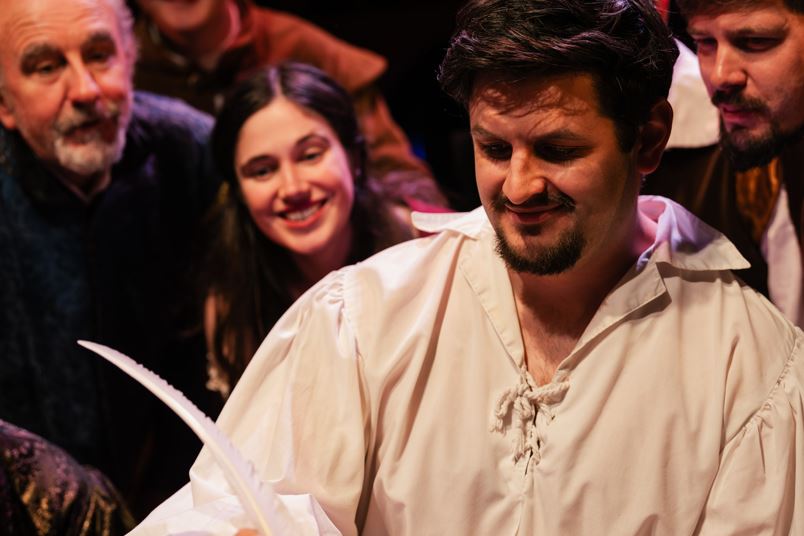
An adaptation of the Marc Norman and Tom Stoppard screenplay for the BAFTA and Golden Globe winning film, the play follows young William Shakespeare at a time when he is just beginning to make his way on the London stage and specifically imagines how he might have come to write Romeo and Juliet. As the play opens, helped by his friend Christopher Marlow, he is developing the plot for a soon to be presented play “Romeo and Ethel”. The theatrical promoters Henslowe and Burbage are vying for the script to put on at either the Rose Theatre (Henslowe) or the Curtain (Burbage). In the process Shakespeare falls for the beautiful Viola de Lesseps, who is defying convention by entering the hallowed ground of a male actor only stage by disguising herself as a man. Meanwhile her father is plotting to marry her off to the Earl of Wessex if they can get the approval of Queen Elizabeth I.

The wooden set, designed successfully to evoke memories of the Globe, proved the perfect vehicle for all the “scenes off ” which peppered the plot, including a romp in the bedroom and a delightful shadow puppet theatre Nearly half of the 26 strong cast, many new to this theatre, had roles as both characters and ensemble actors. The way they managed the many costume changes was impressive and this did mean that there was a large and impressive ensemble. For a far proportion of the time the stage was packed full of actors, all beautifully costumed by Simon Crump and Roanne Hathaway. With the accompanying Elizabethan music it was easy to be transported back to the period. Special mention must be made for the short but delightful singing of a guard. The play has it all, well directed sword fights, sexy love scenes, comic interludes, including Alexa Adam’s witty comic cameo as a taxi boatman. And, of course there is lighting designer Martin Jessup’s stunningly well-lit death scene.
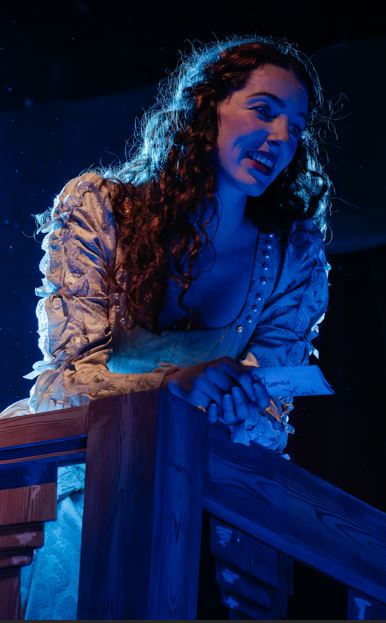
Callum Locker’s funny, poetic, and unashamedly adulterous Shakespeare dictated the fast pace of the play, ably supported by Dylan Nosworthy’s droll Kit Marlow, and Lucy Oglesby’s feminist but enraptured Shakespeare groupie Viola (and Cait Hart Dyke’s vicariously implicated Nurse).
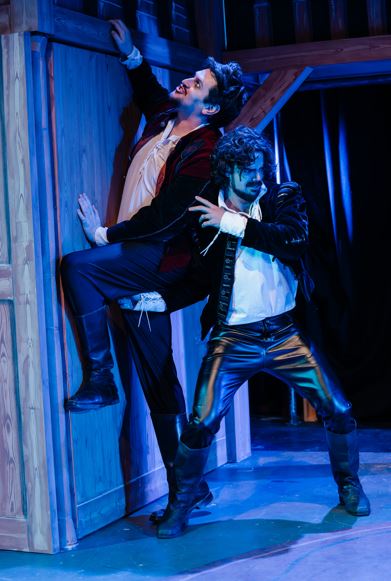
The play was a credible exploration of how little change has happened in some aspects of the theatrical world during the four hundred or so years between the writing of Romeo and Juliet and today. It is still a struggle between commercial success and artistry. Roger Blitz’s impecunious Henslowe’s desire for a popular comedy – must have pirates, – contrasted well with David Miller’s swaggering Burbage who just wanted something finished as they both sought to own the play and improve their fortunes.
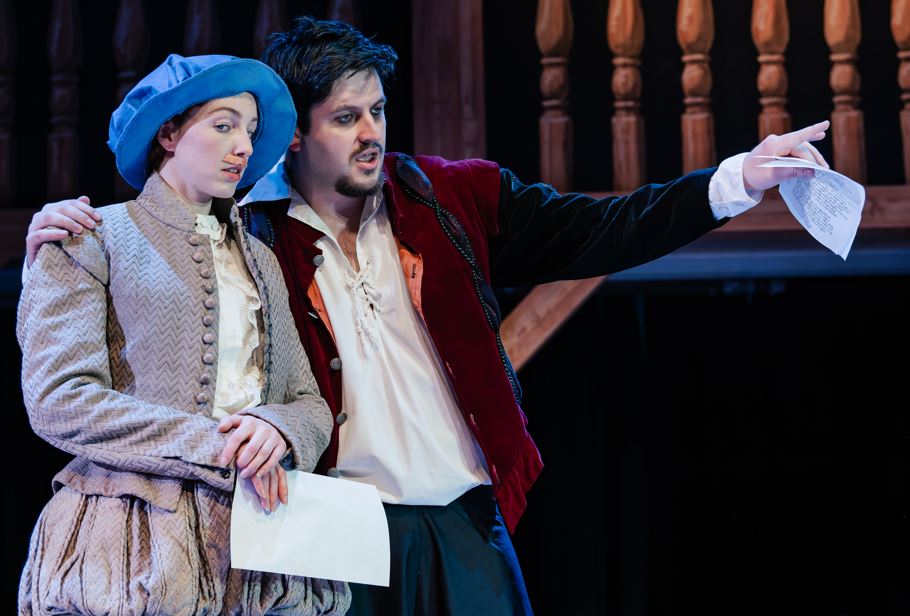
The many possible pitfalls between the idea of a play and its successful opening haven’t changed. Will the script be finished, are the actors right for their parts, will the audience turn up? Ian Wainwright’s commanding Ned Alleyn will bring up memories of many a film star strutting the stage. Unsuccessful contestants in the latest TV talent shows will emphasise with Ellen O’Farrell’s portrayal of the blood thirsty but thwarted would- be actor John Webster. Matt Rimmington may well bring a tear to the eye of so many ex-childhood actors as happy Sam realises that his breaking voice means his career playing the young female lead is over.
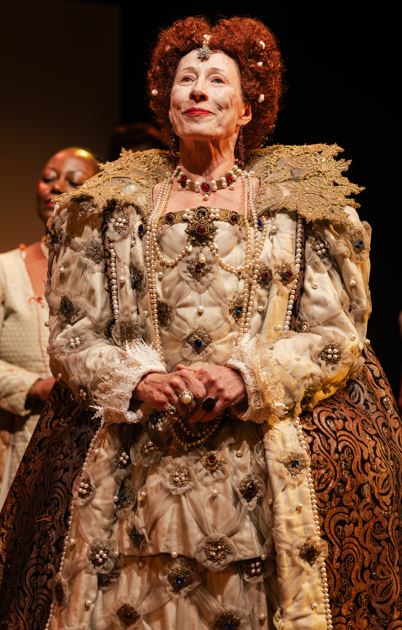
And the environment the theatre exist in hasn’t changed much either. It is Penny Weatherall’s totally convincing all-powerful Queen Elizabeth I whose approval to the marriage between Viola and Wessex was essential. And it was her desire that “any play must include a dog” that gives us the totally absurd, but utterly believable, dog. It and its handler puppeteer Katrina Spreyer could easily have stolen the show.
Polly Davies, November 2024
Photography by Steve Lippitt

 Mark Aspen
Trackbacks & Pingbacks