
Messiah
Unto Us
Messiah
by George Frederic Handel, libretto by Charles Jennens from The Bible and the Prayer Book Psalter
Wild Arts at the Smith Square Hall, Westminster, 7th December, then on tour until 19th December
Review by Mark Aspen

Now, here is a Messiah that speaks. Handel’s most popular work, and traditional seasonal staple, has a habit of being a spectacle that shouts or a recital that whispers. But when Handel, in a frenetic three weeks and three days in the summer of 1741, wrote this towering oratorio, the quarter of a million notes that burst from his pen were a statement of his own faith in the divine, spoken to his fellow human beings.

The concept of this production, and its simple staging by established director Tom Morris, is to speak directly to the audience, and by extension to those outside the concert hall. The singers and musicians are intimately part of the audience, some of whom are seated around the low stage, and the performers come out into the body of the hall to tell the audience their message. After all, the very opening words are “Speak ye comfortably …”, with an emphasis on “fort” , bringing out the obsolescent sense of the word, to draw strength.
Musical director Orlando Jopling, the Artistic Director of Wild Arts, conducts from the harpsicord. There are simply a dozen musicians, some with period instruments, notably the pair of natural trumpets (valveless instruments), which are played from various stations in the hall. Strikingly, they deliver fanfares from the organ loft, angels declaring the Second Coming. The orchestration is virtually that of Handel’s manuscript. The basso continuo is grouped stage left and opposite the players of the two violins and a viola stand throughout. That they are on their feet, again provides an immediacy with the audience. Moreover, they can talk as solo voices. They too speak to the audience.

There are just eight singers. The usual four soloists are doubled, but all the soloists also comprise the chorus. They work hard, but the result is greatly rewarding. In an oratorio where a chorus of eighty or even eight hundred would not raise eyebrows, the economy of a chorus only eight is really valuable. They are no longer an anonymous crowd, but are individuals, with their own distinctive voice within the group and not lost in the mass. They speak, but no longer speak at us, rather they speak with us. “Unto us a child is born …”.
Morris’s staging has all the performers in everyday clothes. So, as they speak with us, they become us. The emotions become real and not acted. And, with the closeness of the performers, it is clear that they inhabit the interlinked roles they depict in song.
Charles Jennens, Handel’s librettist, complied the text of the oratorio from the words of the King James Version of The Bible and the Psalter from Coverdale’s Prayer Book, near contemporaneous works that are often linked together with Shakespeare as the finest examples of the power and poetry of the English language.
The resultant structure though is such that the Messiah, Christ, does not feature immediately or personally in the work, only by reflection in the emotions and spiritual involvement of the ordinary person. Hence, why the chorus is such a strong feature.
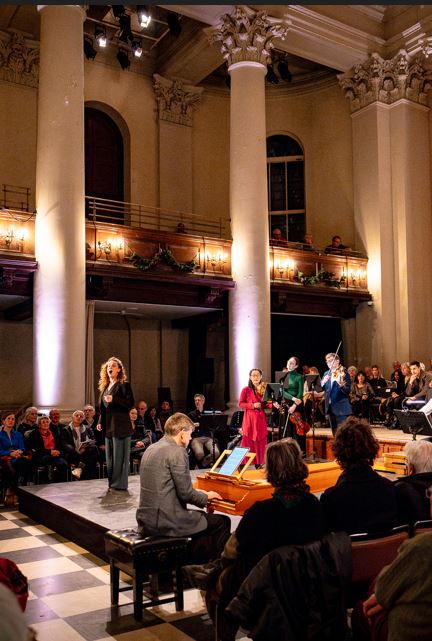
All eight soloists, however, make a remarkable impact. Each voice adds something different and, with the comparative intimacy of the smaller concert hall it gives the opportunity to appreciate the timbre of each voice. Smith Square Hall, famously known as “Queen Anne’s Footstool” when it was built in 1728 by Thomas Archer as St John’s, Smith Square, a church with a subsequent eventful history. Its appropriately Baroque style of architecture includes massive Corinthian columns in the auditorium, which provide a symbolic setting for Messiah, its affirmations of faith reaching to the heavens. Its acoustics tend to cradle the voices and bring out their characteristics, although the effects vary across the audience.

Two mezzo-sopranos sing the parts scored for alto. Catherine Blackhouse demonstrates a velvety quality of voice right from her first piece, “But who may abide the day of his coming…”. Later in the description of Christ’s passion, her delivery of “He was despised … a man of sorrows and acquainted with grief” her anguished expression is deeply moving. Martha Jones has a lighter touch, but still with touching emotion depth. She is a widely versatile performer, ranging from a demure Fanny Price in Mansfield Park, to a primitive Friday in Robinson Crusoé, to a dangerously sensual Nerone in The Coronation of Poppea, and it is here in the Baroque that she is at her best.
Edward Hawkins, who made a benevolent Alidoro in ETO’s Cinderellalast year, is fast becoming the go-to bass. His voice has a magisterial power in “The people that walked in darkness have seen a great light”, taking on a contemplative richness in its corollary, “they who dwell in the shadow of death, upon them the light has shined”.
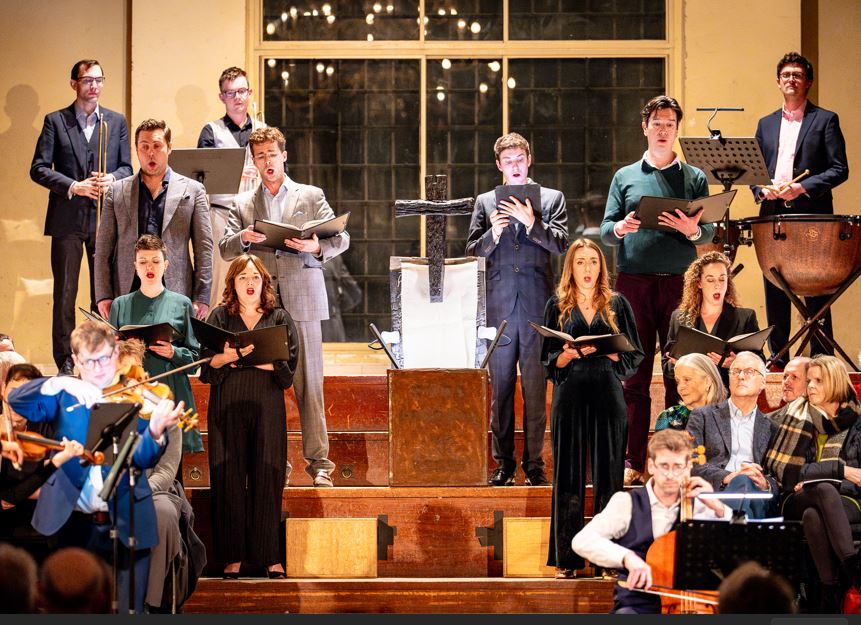
Baritone Timothy Nelson also takes up solo parts scored for bass. He engages directly with the audience and has evocative passages, such as the striking, “I will shake the heavens and the earth”. He has a repertoire of up-beat characterisations, which feed into his approach. (Wild Arts’ Eugene Onegin next year will turn a corner for him.)
The tenor solos are performed by Guy Elliott and Sam Marston, who share the key introductory Scene. Elliott beckons all with those opening words, “Comfort ye, my people”, and Marston with the carillon, “Ev’ry valley shall be exalted …” . It is tenors who also deliver the key message of Part Two, of Christ’s redemption of sin, and God’s victory over evil.

Little is actually said of the story of Christ’s life, except the nativity is recounted through the eyes of the shepherds. Lucy Hall sings “There were shepherds abiding in the field…”, her lyrical soprano speaking like a clear bell. In the only duet in this version of Messiah, she and Backhouse sing “He shall feed His flock like a shepherd”. It is beautifully done, they speak directly to each other of the gently gathering up of lambs in His arms. (Hall is good at this, one remembers her charming Lila in that bijou operatic gem, The Firework Maker’s Daughter.)
There is a lot about sheep in Messiah. They are a metaphor of us all. Maybe that is why the chorus piece, “All we like sheep, have gone astray” has always struck me as humorous. It underline the folly of mankind, of us humans. Add in the jaunty accompaniment of the musicians, and the singers savour this piece, and they do physically scatter.

“How beautiful are the feet of them that preach the gospel of peace” is here sung as a solo piece with a wonderfully delicate touch by lyrical soprano Natasha Page, who played a heart-rending Pamina in Wild Arts’ The Magic Flute last year. However, her intense interpretation of that beautiful air, “I know that my redeemer liveth” has a remarkable touch. She holds the final note exquisitely extended and without faltering, symbolic of the evermore that is eluded to in this passage.
Messiah is perhaps best known for its choruses, and the Wild Arts performers bring out the meaning and emotion of each of these large set-pieces. “For unto us a Child is born” has a real expression of joy, and towards the end of the oratorio, “Since by man came death …” has an eerie feel that tingles the back of the neck. Of course everyone is waiting for the well-known Hallelujah chorus, that triumphant proclamation from Revelation. Here though, we hear the individual voices adding into the commonwealth of faith. Often overlooked though is the final chorus “Worthy is the Lamb that was slain”, leading into the Amen chorus. With the preceding bass air “The trumpet shall sound, and the dead shall be rais’d”, sung by Hawkins, and that fanfare from the pair of natural trumpets, it really packs a punch.
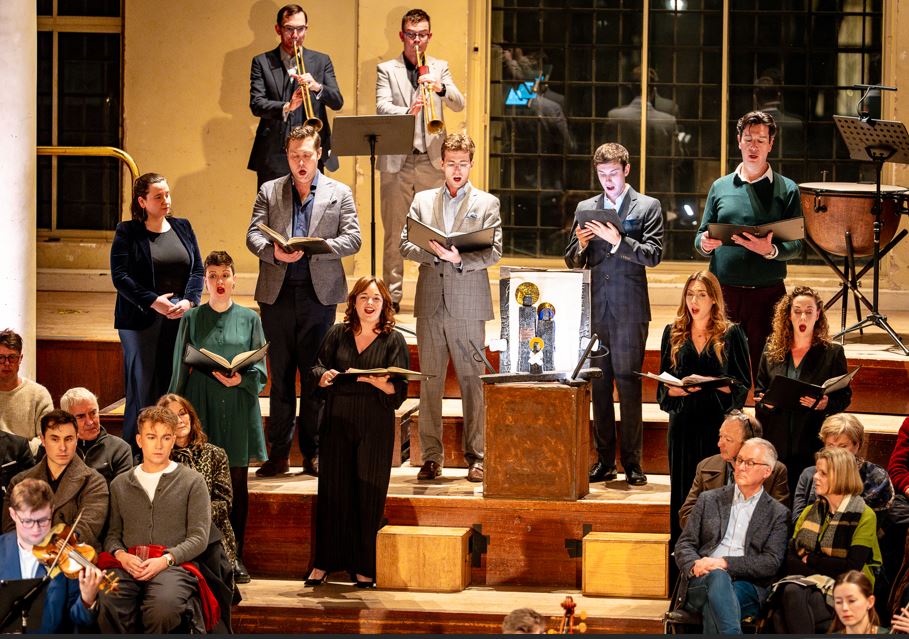
Messiah is big, and this production is big, in spite of being reduced from three hours to two. Its musical arrangement works well, but it is uncredited, although presumably the work of the talented Orlando Jopling. His musical ensemble understands Baroque music and obviously enjoy its vivacity, from its urgent presto rhythms to the contemplative slow movements.
The passage whose absence from this arrangement is felt is “O death, where is thy sting?” in the run-run to the Amen chorus, where it would seem to be a prerequisite.
Messiah is a Christmas staple, yet the Christmas story is only referred to tangentially. The first of its three Parts starts by prophesising the birth of Christ, and after His birth looks forward to the redemption of mankind. Part Two tells of Christ’s sacrifice and looks forward to the triumph of good over evil, and the third Part predicts the defeat of death and looks forward to the second coming. So it would seem to be about an optimistic future.
The performance was introduced by Edward Hawkins, who modestly described their production as an improvisation, and explained it was about uncertainty and doubt. He asked us to “imagine a confused and broken world”. The ironic chuckles said that no-one would find that hard to imagine. (The frightful events in the Middle East had that day opened to another front in Syria.) He hoped it would be changed for the better.
Handel and Jennens had no uncertainty about their faith and no doubt that, in the fullness of time, the world would be changed for the better.
However, there is no doubt about the future of Wild Arts’ Messiah. After its tour (to the far north and far south of England, from its home in the east of the country where England meets the sea and the sky), it will certainly be back next year and into the future. It is a triumph!
Mark Aspen, December 2024
Photography by Steve Gregson


 Mark Aspen
Trackbacks & Pingbacks