
It’s A Wonderful Life
Spirited Christmas
It’s A Wonderful Life
by Mary Elliot Nelson
Putney Theatre Company at the Putney Arts Theatre until 21st December
Review by Steve Mackrell

Taking an iconic black and white Hollywood film from nearly eighty years ago, and adapting it as a stage play, represents a difficult and daunting challenge. Also, for Putney Arts Theatre to select such a stage adaptation as their Christmas production, is perhaps a brave and bold decision, especially since It’s A Wonderful Life differs from most other traditional seasonal fare on offer. But despite any initial concerns, the format of the production works, and indeed, works exceptionally well.
The stage adaptation, written by Mary Elliot Nelson, manages to capture successfully the spirit, sentiment and charm of the original 1946 film, as directed by Frank Capra and famously starring James Stewart in the leading role. The film was based on an earlier 1943 short story The Greatest Gift, which in turn was loosely based on Dicken’s Christmas Carol.
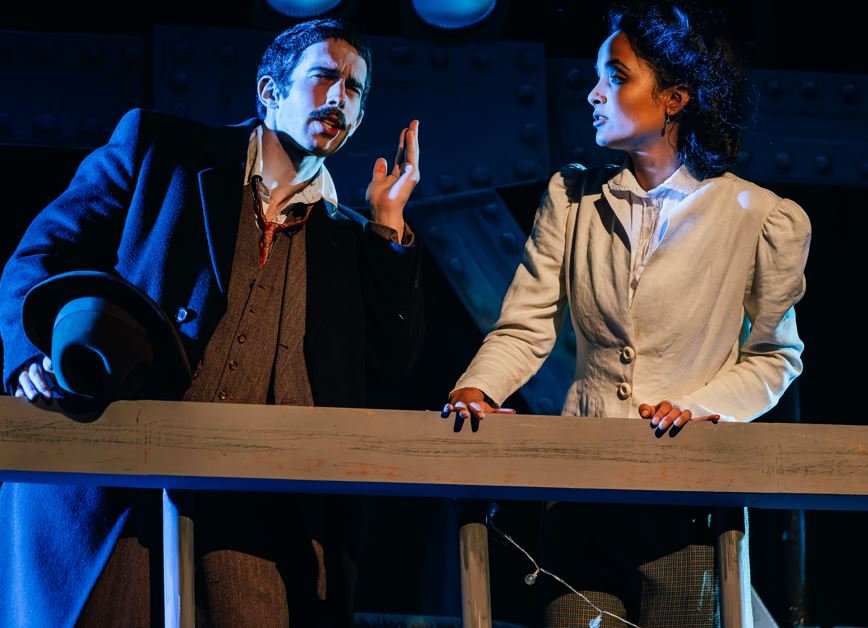
This new version of what is essentially a supernatural drama, has been enhanced by introducing some musical numbers, but otherwise keeps faith with the original story, both in its American setting (a town called New Bedford in New York State) and in its time period (Christmas Eve, 1946). For those not familiar with the film, the story follows a small-town financier, George Bailey, who despite being a good and compassionate man finds himself, on Christmas Eve, both depressed and suicidal. Enter then from heaven, his guardian angel, a trainee yet to earn her wings, who sets out to remind George of all the good qualities he has and how poorer life on Earth would be without his positive contributions.
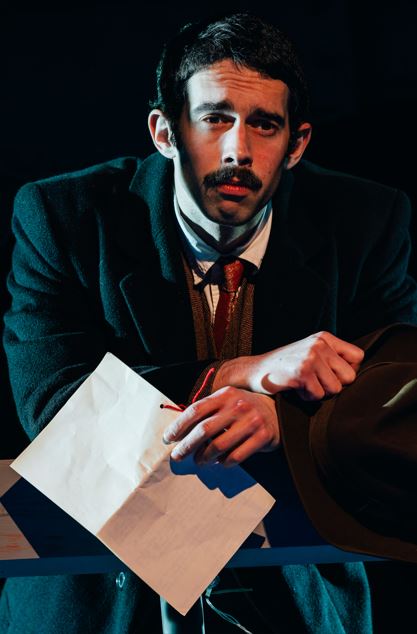
Director Lois Savill has kept to the original concept of the adaptation by keeping to just four actors, three of whom play multiple roles, as specified in the script, although some versions have used additional actors to avoid audience confusion. Certainly, using only three actors playing a host of different characters in a fast moving and complex narrative, can indeed create problems for the audience in following the plot – on the other hand, for the actor, it creates an exciting challenge for interpreting so many varying characters. No such problem however for the protagonist, George Bailey, played by Matthew Hoisch who, being cast in just the one role, was able to develop his character and to gain the empathy of the audience.
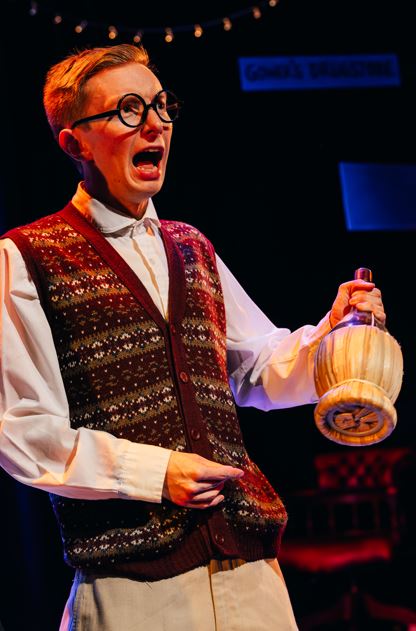
As for the three actors playing multiple roles, they had to work exceptionally hard to help the audience distinguish between their various multi-characters. The variety of different roles also meant there was little time to fully flesh-out the characters and hence they tended to become portrayed as one-dimensional caricatures. Perhaps Ben Wheeler’s various characters were the most flamboyant including his larger-than-life portrayals of Uncle Billy and the eccentric Italian Mr Martini.

Robert Wallis had an equally wide-ranging selection of characters including George Bailey’s successful brother Harry, the dour street cop and the money-grabbing profiteer Mr Potter.

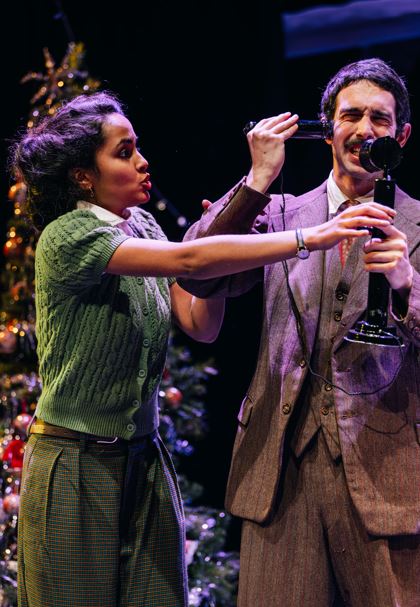
Playing all the female characters was Nicole Pavlou who had to manage countless quick entrances and exits. At times, when changing characters, her costume changes were minimal which didn’t help the audience’s ability to navigate around her various roles. The characters in her repertoire were the guardian angel, Clarissa Oddbody, George Bailey’s wife Mary, plus of course, all the other female roles in the play. A difficult task to accomplish – and perhaps a wider range of vocal intonation would have helped but, that said, her early scenes as Mary falling in love with George were remarkably well-observed, and later, her scene as the angel on the bridge urging George to rethink his life, was powerfully persuasive.
Without doubt this was an excellent group of energetic actors and exceptionally well-disciplined by director Lois Savill. A good pace was maintained throughout, and the stage was constantly full of movement. The second act began with a rousing rendering of Jingle Bells, performed by Harry Pavlou and an excellent “Andrew’s Sisters” type trio of Lyndall Brown, Nicole Pavlou and Lois Savill. Effective sound design also helped with the dark mood of the play and especially atmospheric was the haunting and discordant piano playing of Hark! The Herald Angels Sing.
The set was minimalist, with a bare stage helping the fluid movement of the ensemble, and props were quickly wheeled on and off stage to signify scene changes. A snowy street scene covered the back wall to help convey the feeling of the small upstate New York township, above which towered the iron girders of an American style railroad bridge. The uncluttered set also helped in maintaining the pace of the production and complemented the intimacy created by the four actors.
Finally, cynics could perhaps dismiss all this as just a cosy sentimental story of salvation – a mere whimsical feel-good fantasy about redemption – but the story is much more than that. It is both dark and thought provoking, it’s about dreams and aspirations and about success and failure. So, is it suitable for Christmas? Well, yes, but probably not for children. There was a Christmas tree and yes, at the end the cast did sing Auld Lang Syne but – this is strictly a show for grown-ups. Nevertheless, still very much a show for Christmas as it tells an uplifting, moving and timeless story making it a perfect vehicle for the season of good will. In short, It’s A Wonderful Life is a magical adaptation which remains true to the spirit of the original film classic.
Steve Mackrell, December 2024
Photography Stephen Lippitt

 Mark Aspen