
13 Days
Thin Ice of the Cold War
13 Days
by Angela Gibbins
Teddington Theatre Club at the Coward Studio, Hampton Hill Theatre until 25th January
Review by Mark Aspen
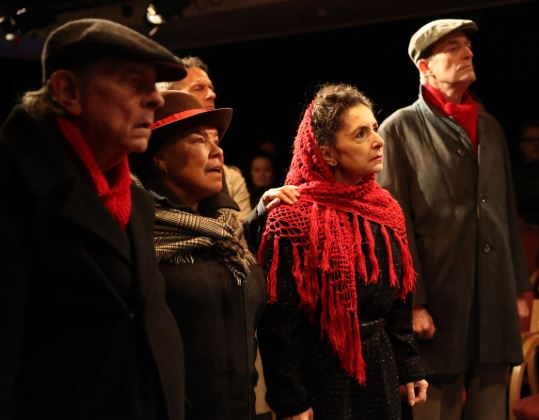
Towards the end of October 1989, I was in Budapest and was able to witness the dying days of communism in Hungary. It was a particularly febrile period that marked the end of the Soviet occupation, and feelings were especially high in those few days when the people of Budapest were recalling the tragic events of thirty-three years earlier.
The city fluttered with flags which had large holes in the middle, where scissors had hastily cut out the hammer and sickle from the Hungarian flag. I remember men and women climbing the lampposts in Karl Marx Platz with pots of black paint to rename the street signs Imre Nagy Square.
Imre Nagy had become the folk hero of the Hungarian Revolution, an uprising which began on 23rd October 1956. By 4th November, it had been crushed by Soviet tanks.
These thirteen days are those that inspired local writer Angela Gibbins’ dense drama. Taking over a decade its gestation and the product of painstaking historical research, 13 Days requires concentration from an audience, but concentration that proves very rewarding.

The protagonists are an assorted array of politicians, diplomats and UN dignitaries … and the ordinary people of Budapest, those with the most to lose and to suffer. They are imprisoned behind an Iron Curtain and excluded from the wider world by the Cold War. Hungary, and many more erstwhile sovereign countries, are vassal states of the Soviet Union, which has imposed politically ideological demands of industry and agriculture that its engineers and farmers know are impossible to achieve. World War Three is a distinct possibility. Sounds familiar today?
The play is in the capable hands of Clare Cooper, who has carved out a niche market in a series of analytical plays about the Second World War and its aftermath, an ingenious but chilling production of Arthur Miller’s Incident At Vichy in 2023; her meticulous version of David Haig’s Pressure in 2024; and now in 2025 the premiere of 13 Days. Clare Cooper has a knack for creating a Tardis, filling a bijou studio space with nineteen actors without it looking cluttered, and for punctuating the action to maintain interest in an intensive piece of theatre.
The design by Fiona Auty and Jacqui Grebot has an economical essence, a few flags and a versatile bench, which can become at will a funereal bier, a statue’s plinth, or various furniture items. The set is extended by the lighting by Alan O’Connor and Chris Dawe, which include a video backdrop of authentic footage of events of the period. The footage adds the reality of a tumultuous period, marked by destruction, loss and deprivation, even over such a short period. It shows the violent interjections into everyday life, by the Soviet military behemoth with heavy armaments and tanks; by the notorious treachery of the Hungarian secret police, the AVH, torturing individuals and machine-gunning peaceful crowds; and by the brutality of ordinary people driven to seek revenge.
Almost half the cast double as Budapest citizens to create an ensemble of everyday life pushed to the limits. The plethora of named parts are largely extended cameos, who centre on the prime movers of the drama. However, every actor is totally engaged with the character (or characters) they portray. It is an exemplary depiction of the human cost of conflict at all levels, and in all aspects, emotionally, physically, mentally and financially.
In setting the scene of the historical facts, there is inevitably a lot of backstory to be established, and with many historical figures as characters or named in the dialogue, there is much cramming to be done by an audience. A distillation down to the key facts may have lightened this burden. Nevertheless, the attention required pays dividends.
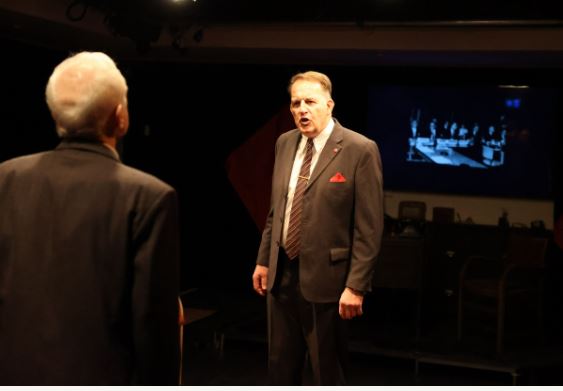
Some of the backstory is provided by Bang Jensen, the Deputy Secretary of the UN Commission, played with upright authority by Nigel Andrews. His brave searching exposition of the facts of the Uprising and the subsequent Soviet incursions is revealing, as he holds his own against the belligerent bullying objections by the Soviet representative, a solidly fearsome Geraint Thomason.
The three historically important Hungarian politicians, Imre Nagy, Janos Kadar and Enro Gero skate on politically thin ice. At stake is their country, their future, their families … and their lives. Each has his own agenda to fulfil, whilst balancing the interests of the groups involved, yet managing his own political and personal destiny. They are characters with many dimensions, but only one is at heart an honourable man.

Of these three pragmatists, it is Imre Nagy who emerges as a man of principle (and historically he was to pay for his principles with his life). Nagy had lost his position as Prime Minister because of his attempts to mitigate the Stalinist excess of the imposed Soviet ideology, but was reinstated when, on 23rd October 1956, student unrest triggered the Uprising. The powers that be at the time were hoping he might be able to appease the fractious public. Chris Dearle’s portrayal of Nagy is of a gentle man, trying to come to terms with possibility of reconciling the demand of the rebels, the tight hold of the internal Hungarian communist party, and the hovering threat from Khrushchev’s Soviet Union. One of Nagy’s first moves is to confront the mob that had gathered in front of the parliament building and successfully to calm them. On the play’s opening night, it felt that Dearle was holding back on this big Mark Antony moment and he could have given it more wellie. Generally, however, Dearle excels in this role, showing the character’s resolution versus hesitation, ideology versus pragmatism, and caution versus action, juggling all these possibilities. He has obviously studied his character, right down to Nagy’s round spectacles and walrus moustache.
Ernő Gerő was co-First Secretary at this time and a Stalinist hardliner. Of the three top politicians, he is the most transparent. Under the veneer of being part of Nagy’s government, it is he who, often literally, is calling the shots. Robin Legard plays Gerő as a refractory tough nut following the hard-line, a riveting picture of someone one should steer well clear of.
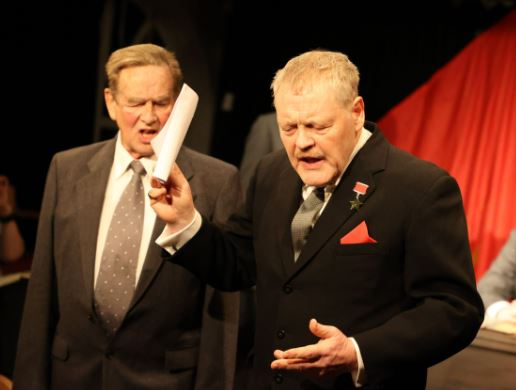
The third of these politicians, co-First Secretary János Kádár, is a slippery character, two-faced and propelled by solipsism. All the cards are hidden up his sleeve in David Robbins portrayal, as a man superficially urbane, yet capable of the most heinous things, all done with a smile. His Kádár was quite capable of making up to the widow of Laszlo Rajk, in whose show trail and execution he had been the prime mover, then ostensibly seeming to be part of the revolutionary government, before sliding off to Moscow to see Khrushchev.
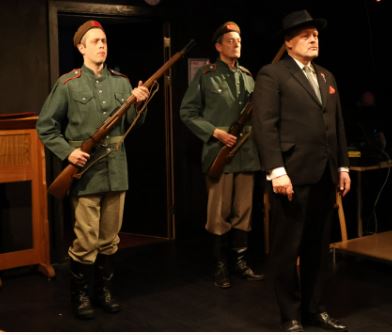
These three purveyors of Realpolitik have, as their nemesis, General Mikoyan, an unflinching hard-man with the Soviet army at his beck and call. (Here, he may be a conflation of several historical characters, including Khrushchev’s right-hand man Anastas Mikoyan, the diplomat and Politburo member.) Marcus Ezekiel is outstanding in this role as, with great stage presence, he portrays a man of steel, with always the thinly-veiled threat of military intervention. Yet one sees cracks in his personality where some humanity hides. But is his feigned empathy just a ploy to trap these unwary politicians? He is not averse to having an armed soldier standing behind Nagy as he is forced to modify a document. When Nagy threatens to withdraw Hungary from the Warsaw Pact, Mikoyan sends in fifty tanks.
There are some thoughtful touches in the costumes. Maggie Bassett and Anne Chatterton have an eye for authenticity, Nagy’s specs and Mikoyan’s Order of the October Revolution, ironic indeed (although anachronistic). Mikoyan’s suit doesn’t quite fit, think Mrs Khrushchev. A fountain pen sits in Nagy’s breast pocket.

Prominent amongst the civil servants in Nagy’s office is his son-in-law, Ferenc Jánosi. Alex Pearce, in this role, has quite large part, including joining the dots in the narrative. Pearce plays Jánosi as a busy man, full of nervous energy, a general factotum supplying the detail to Nagy (and to us). He propels thing along with a constant worried frown.
Also in the office is Laszlo Rajk’s young widow, Julia, now a fervent activist. We see her at the beginning of the play with Nagy, at her husband’s funeral, and with her fatherless son Lacika (played with poignancy by Alex Leafe). Laura Hannawin gives Julia Rajk a fervency born of grief, in a touching depiction of loss.

It is in that evocation of the human cost of this conflict that this production has depth. The interactions of the two friends, Luca and Ilona in their small conspiratorial interchanges over a planned supper of a dead pigeon, works well in the intimate space of the studio. Luciano Dodero and Enid Gayle fill these minutiae with a real poignancy.
Clare Cooper has allowed us a retreat into the ravaged lives of the ordinary citizens of Budapest in interludes of sub-balletic movement in the funeral, the rioting, the AVH massacres, and in their quotidian interactions of hope or despair. These accompany a mesmerising ethereal soundtrack by Derek Baum and Martin Dale, a respite from sound effects of gunfire.
And the rest of the world at this time, the radio broadcasts of the news are parenthesised with the announcer’s worrying over his lunchtime sandwich, and the more important points that the Uprising disrupts the European football and the forthcoming Olympics. Stalwart local actor Dave Dadswell makes the point well in his insouciant voiceover broadcasts. The inimitable Roger Smith has a pointed cameo as the British Representative to the UN, stating that there are bigger fish to fry in Suez. The West seems almost relived that the Suez crisis has diverted attention from an awkward confrontation with the Soviets.
But have we learnt lessons? There are messages that resonate into the twenty-first century. Mikoyan’s labelling of the Soviet incursions into Hungary as “special operations” is echoed today by Putin. And debate is shut down by calling critics “fascists”. The Soviet response to the Hungarian Uprising shows how extra-sovereign hegemonies can use their imposed spurious legalistic process to frustrate the will of the people, a tactic used by the pro-EU opponents to try to prevent Brexit.
We ignore history at our peril, and 13 Days makes an almost forgotten piece of history come alive with power and pertinency.
Mark Aspen, January 2025
Photography by Steve Sitton


 Mark Aspen
Trackbacks & Pingbacks