
Posh
No Sleep till Oxford
Posh
by Laura Wade
Questors Production at the Judi Dench Playhouse, Ealing until 1st February
Review by Andrew Lawston
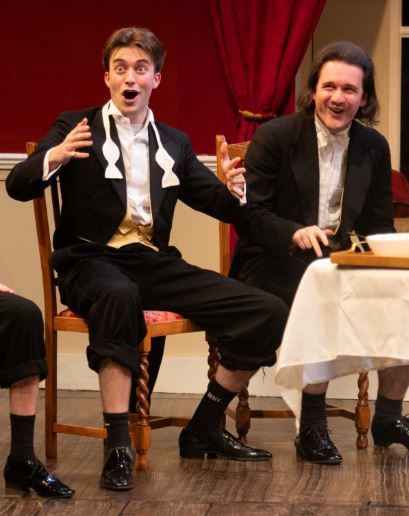
The Questors’ Judi Dench Playhouse is transformed this evening into the private dining room of a rural gastropub, complete with chandeliers, a glowering portrait of Winston Churchill, and a large table set for a banquet.
Into this highly detailed set swaggers a collection of confident young men, in a uniform of tail-coats and highly-polished shoes, all intent on having the night of their lives. These are the ten members of The Riot Club, an exclusive Oxford University dining club, which is closely identified with the Bullingdon Club from which several of the last generation’s prominent politicians emerged. Laura Wade has always been careful not to emphasise these similarities, particularly given the fact that Posh was first performed before 2010’s general election, and the aim seems to be a general examination of privilege and the British class system, rather than a more specific satire which would already feel dated.
Posh has been updated at least once, to take into account developments in politics over the last fifteen years, but its themes remain timeless. Privileged, arrogant young men behaving disgracefully, believing themselves to be beyond reproach and immune from consequences. A tightly-constructed two acts of chaos ensue.

The play opens with The Riot Club on thin ice, as ambitious member Guy Bellingfield calls on his godfather Jeremy for advice on how to pull off a successful dinner. Willo Johnston invests Jeremy – a member of the House of Lords and former Riot Club member – with suitable gravitas as he comments upon the fact that the club has been suspended for two terms following some unfavourable coverage in the national press. Bellingfield is anxious to get the club back on track and harbours ambitions to be the next president. Guy Jack, in an energetic opening performance that remains his character’s high point, introduces the play’s themes succinctly – alluding to the importance of the club for his CV (“not the written one!”), and the connections that he hopes to forge through its leadership.

As the action moves to The Bull’s Head and the play proper begins to unfold, The Riot Club’s temporary suspension remains a key plot point. We learn that thanks to negative publicity, the club must now book under a false name (the Young Entrepreneurs’ Club), and far away from Oxford itself. There is a broad agreement that they must keep their antics under control to avoid further media backlash. Several of the members visibly seethe with resentment at these restrictions, but all heap scorn Toby “Tubes” Maitland, who wears the Wig of Shame after being the cause of the club’s misfortunes. Pascal Orzabal gives a spirited physical performance as Toby, a role which has perhaps the greatest range in the play as he moves from dejection, through the humiliating ritual of “dreggsing”, and briefly appears to incarnate Lord Riot himself, founder of The Riot Club.

Resentment becomes a recurring theme among the diners, as they complain about the changing world, with one of their number late because they were asked to do a numeracy test while applying for an internship, and several complain about the National Trust allowing visitors into their parents’ stately homes. There’s even an undercurrent of tension that the Greek student Dimitri (Omar Aga in a brilliantly restrained performance) is one of their number, despite him offering to whisk them off on a jaunt in his family’s private jet.
This simmering undercurrent helps fuel the play’s tension. It seems inevitable that events will escalate and get out of hand, and Wade’s script keeps offering potential catalysts which are either defused, or which add to the bubbling rage that fuels some of the characters. Guy’s ten-bird roast turns out to be short of a guinea-fowl, and the members are contemptuous of club president James Leighton Masters’s (Dominic Reed giving one of the most nuanced performances as the occasional voice of conscience in the group) timid complaint to the waitress Rachel. The half-finished carcass of the nine-bird roast lingers on stage for the rest of the play like Chekov’s gun.
Meanwhile, the landlord, Chris, grows ever more exasperated and angry with his private dining group. James Rushbrooke’s performance is impressive as he alternates between bluster and wheedling, as he tries to keep the group under some kind of control.
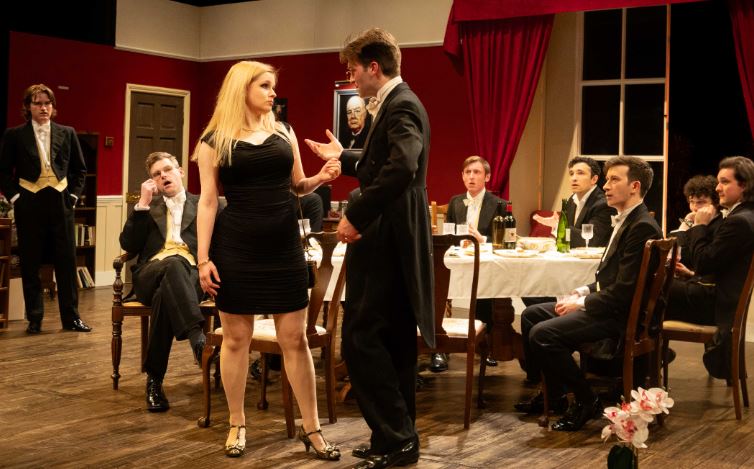
When the hapless George (a charming performance by Bailey Finch-Robson), charged with procuring cocaine for the party, is forced to admit via an interminable anecdote that he was mugged by a homeless man he mistook for a drug dealer, the incident is forgotten quickly.
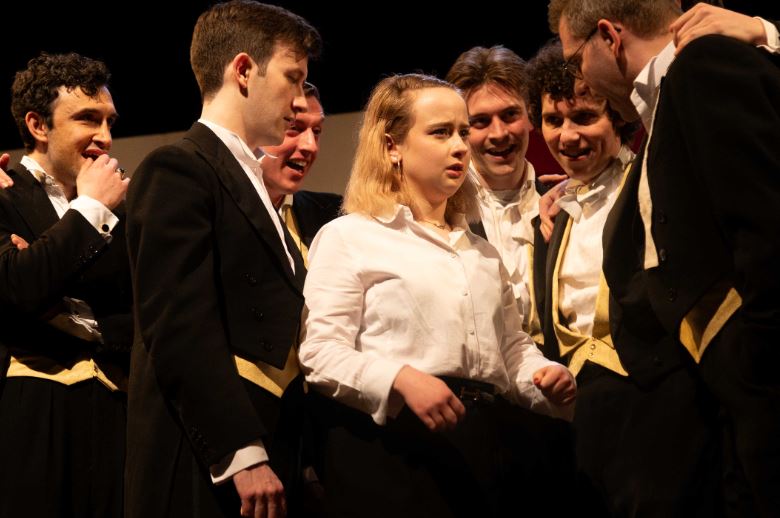
When it emerges that Charlie, the escort booked by Harry Villiers (played with great gusto by Harry Miller), is first barred from the restaurant by the landlord Chris, and then after she is sneaked in states that she is not willing to perform the acts demanded of her, the tension begins to increase. Tilly Benson-Reid brings great energy to their brief appearance as Charlie, and their open scorn at the boys’ antics is joyous. Her attitude seems to be shared by Rachel, the waitress and Chris’s daughter. Ruby Barry has some magnificent moments of deadpan comedy as she maintains a brittle professional facade around the group.
Miles and Ed (Daniel Thompson and Alex Hunter) are new to The Riot Club, and it is fascinating watching them both being drawn closer in as the play progresses, and the members become united against what they perceive as a changing world.
When the party inevitably boils over into chaos, it feels unsurprising that Andrew Rakowski’s seething Alistair should be the instigator. And it’s painful to see damage inflicted on Bron Blake and Roger Brace’s marvellous set!

Posh’s strength lies in its characterisation. The members of The Riot Club are repellent as a group, but individually some are charming, some are intelligent, and some are witty. Most of them have at least one moment where they show a human side – whether it’s Alistair stopping Toby’s “dreggsing”, George declaring that he doesn’t like doing drugs anyway, or Harry Roebuck’s Hugo quietly objecting to the treatment of the escort, Charlie. All of the actors have their moment to shine and all embody their characters magnificently.
Gary R. Reid’s direction is also frenetic, and the pace never lets up in this extremely wordy play – he also makes sure his cast are on their feet as much as possible considering the setting is a dinner party. As a result, two and three quarter hours fly by, funny, shocking, and alarming by turns.
Andrew Lawston, January 2025
Photography by Carla Evans

 Mark Aspen
Trackbacks & Pingbacks