
Summer 1954
Tabled Manners
Summer 1954
by Terrance Rattigan
Theatre Royal Bath Productions and Living Theatre at Richmond Theatre until 1st February, then on tour until 15th February
Review by Eugene Broad

A flawless double-bill of twee slices of life from days gone past, and nearing the end of its tour, Summer 1954 is a masterfully cooked bittersweet slice of life in all aspects, which shouldn’t be missed.
Terence Rattigan (1911-1977) was the master of the well-constructed play, a skill he used to create meticulous masterpieces depicting characters whose controlled emotions are used to imbue the work with arching poignancy. But time marches on and, with the rise of Osborne and Wesker, the “angry young men” at the end of the fifties, his work began to be seen as of another era, the emotions repressed, the characters steadfast, the stiffness of their upper-lips challenged only by the stiffness of a well-starched white collar.
Yet time marches on, rhythms change and, as we have moved into the 21st Century, Rattigan’s work has begun, perhaps unsurprisingly with the rise of period dramas in popular media featuring staid English settings (e.g., Downton Abbey, Call the Midwife, Bridgerton), to be increasingly appreciated by audiences. It has been featured in the National Theatre’s repertoire and championed by, especially, The Theatre Royal, Bath, co-producers of Summer 1954, which brings together Table Number Seven (from his Separate Tables) with the better known one-act play The Browning Version. Both present a slice of life, one in a boarding hotel and one in a boarding school, in the summer of 1954, each where a different man is forced to confront his own personal inadequacy.
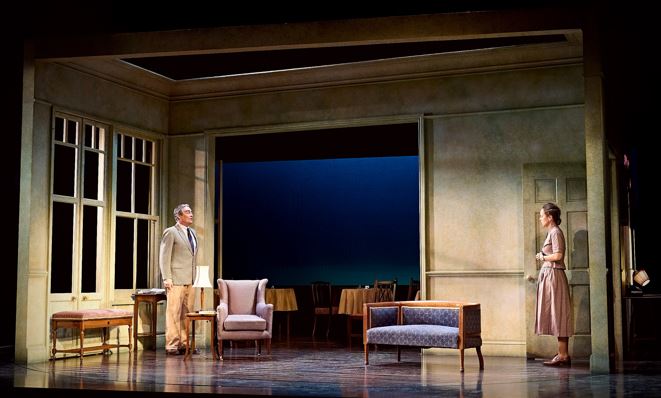
Bournemouth is, and was, the candle-flame attracting the retired. In Table Number Seven, The Beauregard is a private hotel, offering full board and lodgings. As was reasonably common in the 1950s, many of the guests are long-termers, who have resided there for months or years — many of them seeming to have been from affluent backgrounds, but for one reason or another have ended up there — think an elderly spinster or widow, living out her days in comfort with no need to cook or clean for herself, or an older bachelor unwilling or unable to find a spouse. In Table Number Seven, a small yet intimate social circle has emerged out of these sorts of characters.

Here, they take centre stage as our aged bachelor, Major Pollock (who it turns out is more a Walter Mitty than a Colonel Mustard, and is portrayed by Nathaniel Parker), is discovered by domineering matriarch Mrs Railton-Bell (the esteemed Dame Siân Phillips), to have recently pleaded guilty in the local magistrates to importuning young men along the Bournemouth esplanade. A host of other well-heeled long-term residents are summoned to an emergency meeting by Mrs Railton-Bell where her nervous and browbeaten daughter (Alexandra Dowling), an affable but bookish retired schoolmaster (Simon Coates), a no-nonsense but eccentric spinster (Richenda Carey), a conciliatory but spineless minor aristocrat (Pamela Miles), and a young professional couple (Angela Jones and Jeremy Neumark Jones), all debate Major Pollock’s future. The wickedly overbearing Mrs Railton-Bell chides, charms, and cajoles her housemates with sparkling charisma and displays of crystalline wit, calling for Major Pollock’s instant ejection from the hotel. With varying degrees of acceptance, reluctance, and in some cases — indifference — Mrs Railton-Bell ultimately succeeds and goes as an emissary to inform the hotel manager, Miss Cooper (Lolita Chakrabarti). Yet, Mrs Railton-Bell has underestimated the magisterial, and at times almost regal, Miss Cooper, who gently and with sensitivity gives (now, just Mr) Pollock the empathetic understanding and help he needs. An emboldened Mr Pollock comes to terms not just with his own sexuality, but through Miss Cooper’s quiet strength and grace, helps him to accept and move past his own fears of interpersonal interaction allowing him to hide no longer behind his own psychological facades.

Meanwhile, in The Browning Version, a middle-aged Classics teacher (Nathaniel Parker) must retire early with heart issues, after faithful and dogged service to his school, but ultimately being reviled as soulless and cold amongst the staff and pupils alike. Gifted a copy of his favourite work (Aeschylus’ Agamemnon, which we are told he had translated into rhyming couplets in his youth) by a pupil (Bertie Hawes), Crocker-Harris is overcome with emotion, which spirals into full existential crisis — completely unsupported by his noxious manipulative harpy of a wife (Lolita Chakrabarti), who if anything is only too happy to twist the knife further. It is, ironically, an ultimately harmless but hedonistic fellow teacher who is reluctantly cuckolding him (Jeremy Neumark Jones), who helps Crocker-Harris find some self-respect and move past the inadequacies of his teaching career, and the inadequacies of his marriage.
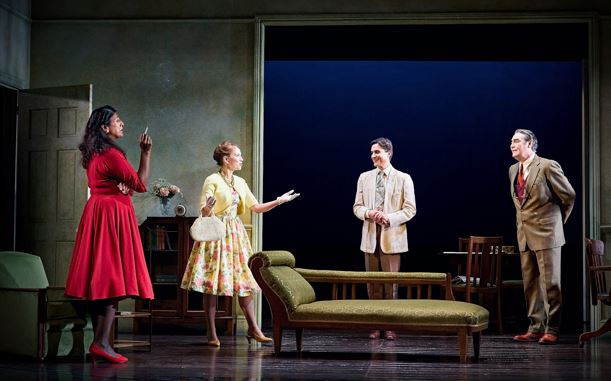
It goes without saying that both the direction from James Dacre and acting from the entire cast is a masterful weave of momentous occasions within life’s tapestries. The cast manage to portray a wholesome lightness without being sappy or overly-sentimental. They have excellent chemistry and bounce off each other well with perfect timing, be that acerbic backhanded conversation, or letting the silence sit as a character stews in their predicament. Most importantly, their interactions feel natural and fluid, never stilted or forced; simply, the viewer is perfectly transported into a window — less than 24 hours — of someone’s life, in a way that doesn’t feel unrealistic or wrong. That’s also a testament, of course, to the incredible pacing and writing of Rattigan, but to deliver it with that authenticity and ease can solely be down to a virtuosic cast and a director with a clear vision that comes together seamlessly.
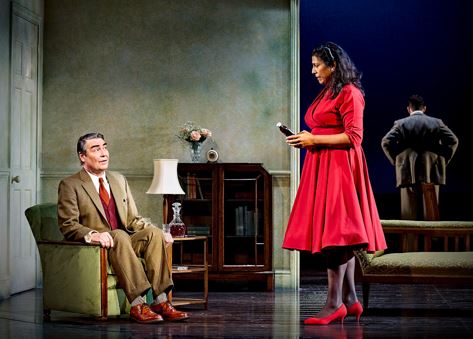
Particular mention must go to Nathaniel Parker who has major roles in both plays, and delivered them both with effortless sincerity. Likewise, Lolita Chakrabarti has a chance to show off a delicious emotional range across the two plays, really getting to be both heroine and villain. An additional mention must go to Dame Siân Phillips, who despite having entered her 90s, performs with an energy and electricity that can only come with a lifetime of treading the boards.

But it wasn’t just the direction, cast and script which delivers— virtually everything about the production is as masterful as stagecraft can get. The revolving set is almost a character in itself, offering an extra dimension of kinetic energy to the production (Mike Britton). Period appropriate props, costumes and decorations — including a 1950s classic perambulator — must have been meticulously sourced. Multiple subtle decisions with hairstyles, colours, affectations, clothing and accessories indicate a great deal of consideration by the backstage team, as well as the cast. The lighting (Charles Balfour) gradually moves in warmth and angle to replicate the cycle of a day. The sound design (Bella Kear) is subtle but omnipresent, from the ticking of a clock, to the distant waves and squawk of seagulls. Equally subtle was the ambient background music, strategically deployed to help escalate uneasy moments and tension, almost imperceptible but quite clearly there; it felt reminiscent of influences like Johan Johansson or Ludwig Goransson, so it was little surprise the music was scored by the Icelander Valgeir Sigurdsson, compatriot of the late Johansson. All put together, and the feel was almost cinematic in nature — especially Table Number Seven, which at times it felt less like stage play and more like the silver screen.
Approaching the end of its tour, and only in Richmond for a few more days, this bittersweet double-bill is one not to miss. It’s not every day such a well-constructed and considered production like this comes around.
Eugene Broad, January 2025
Photography by Manuel Harlan


 Mark Aspen
Trackbacks & Pingbacks