
The Capulets and the Montagues
Bel-Canto Bomb-Burst
The Capulets and the Montagues
by Vincenzo Bellini, libretto by Felice Romani
English Touring Opera at the Hackney Empire, 22nd February and on tour until 26th April
Review by Mark Aspen

The intrepid photojournalist Letizia Battaglia kept a live record of the atrocities of the violently uncompromising Sicilian Mafia during the 1970’s in her “archive of blood”. It is these raw photographs that inspired director Eloise Lally’s production of Bellini’s I Capuleti e i Montecchi, entirely unlike the soft flowery balcony pictures that we associate with Shakespeare’s Romeo and Juliet.
Both Bellini and the Bard draw their sources ultimately from a 1524 novella by Luigi da Porto and both flesh out the same skeleton, but in different ways. Bellini (with a nod towards an 1818 Italian play by Luigi Scevola) has no Nurse, for there is no comedy here, and all the early hostilities that inflame the rivalry between the Capulets and the Montagues have already happened.
The action of the opera is set solely within the base of the wider Capulet clan, under the leadership of the hardened Capellio. In designer Lily Arnold’s late 1960’s setting this is initially in the café-diner that forms the front for the Capuleti’s cocaine smuggling racket. This is stated to be in New York City, but in truth could be in any world city with Italian diaspora, or indeed in Italy itself. The sepia set gives a well-used and slightly faded look, and the period and setting is detailed in the counter, bar stools and coffee machine, and in the spindly furniture of the seating area.

During the sinfonia introduction, the clan members arrive one by one, while the pecking order becomes clear. Capellio is top dog, the godfather of the clan, to whom all others defer. His use of a walking-stick is not due to old age, but from a past violently inflicted injury. Still, it a handy weapon, if needs be, to supplement the ever ready handgun. Lorenzo, ostensibly the café owner, is the medic and general advisor to the group. The waitress is Giulietta, the daughter of Capellio, whom he treats as a chattel to be traded to enhance his felonious power. Giulietta is the only female role in the opera, and it is her around whom all the plot revolves.

Giulietta is treated like a prize exhibit, to be wolf-whistled by the Capuleti men, but she is betrothed to Tebaldo, Capellio’s lieutenant and chief fixer. Tebaldo is a hard man, who will yield to no-one, and tenor Brenton Spiteri fires up the role with an intense bellicosity, yet suffuses it with a feeling that Tebaldo has a truly passionate love for Giulietta, although clumsily expressed. Tebaldo is the antithesis of Shakespeare’s effete Paris. Here is a man who can on one hand state that “this sword is earmarked for revenge of your blood” in his cavatina È serbata a questo acciaro; and on the other hand, soon afterwards can express his love for Giulietta with a devoted L’amo, ah! l’amo … l’amo tanto. And here is a man who is not one-dimensional. Spiteri effortlessly extends his fine spinto tenor between the taut anger of the avenger and the ardent adoration of the would-be lover.
Capellio is as immutable and immovable as a rock-face, but he has immured himself in this self-defeating attitude. Timothy Nelson, in this role, exhibits in his body-language Capellio’s stiff resistance to his own feelings in his stubborn insistence that Giulietta will marry Tebaldo, and at the earliest opportunity, like now, come what may. And what comes is mayhem. The strength of Nelson’s sturdy baritone, which was last heard “shaking the heavens and the earth” in The Messiah last Christmas, has commanding effect. Then again, there is just one point in the whole opera where a small crack appears in Capellio’s façade, as Giulietta, whom he believes to be dying, craves his forgiveness, a crack immediately to be plastered over. (Although Nelson does give Capellio some flower-arranging skills, when they prepare for the immediate wedding.)
Tension ramps up throughout the whole of the first half. Romeo has contacted the Capuleti, by telephone, as an unnamed Montecchi representative, offering to end their feud. Heat is turned up, however, when he suggests that peace be guaranteed by the marriage of Romeo and Giulietta, which causes uproar. The idea that Romeo would be a second son for Capellio, inflames things further. All the gang members of the Capuleti call for war, as the tension boils over. The chorus of guerra! guerra! guerra! engulfs all in sound, even with the small ensemble.

The all-male ensemble, four in the Capuleti mob, three in the Montecchi, have quite a presence as they colour-in the action. (Bellini and his librettist, and good friend, Romani had related them directly to the historical rival political factions Guelph and Ghibelline in mediaeval Italy.) In the second scene, tensions mount even higher culminating in physical violence when Romeo and the Montecchi storm the Capuleti diner just as the celebrations prior to the wedding of Giulietta and Tebaldo get underway. Fight director Kaitlin Howard and movement choreographer Carmine de Amicis have worked in great detail together in creating a wide brawl, with guns, knives and fists (plus walking-stick) to great effect. It is executed in slow-motion which is timed perfectly with Bellini’s music. What could be a cinematic slo-mo cliché, is quite a tour de force. And surely never before has an opera’s first half culminated in the throwing of a live Molotov cocktail.
At the opening of Act Two, after an interval for the audience to recover its heartbeat as much as the cast, the picture is very different. A plangent cello solo allows time to take in the scene. It is before dawn and Peter Harrison’s lighting design sets the mood and enhances the setting. Lily Arnold’s set has been turned around to show the exterior rear of the diner. A large charred hole gapes in the wall, pipes dangle from their fixings. All is muted and misty, its darkness punctured by harsh edged lights. The whole mise en scène is reminiscent of a painting of the American Realism school, maybe by George Bellows or Edward Hopper.

The only empathetic male character is Lorenzo, the Capuleti’s medico e famigliare, clearly a trusted retainer of the family. He can however see the foolhardiness of the feud and councils restraint to Capellio, advice that is summarily dismissed. He acts without the Capuleti’s knowledge as a go-between with the Montecchi, having sub-rosa conversations with Romeo to try to defuse things. He is particularly protective of Giulietta and is aghast that Capellio should use her as a “sacrifice to the altar” of Tebaldo. Masimba Ushe portrays a reassuringly concerned Lorenzo, his rich soft bass voicing conveys reassurance, but has an edge that gives it an urgency that is underlined by his constantly furrowed brow.
Ultimately, it is Lorenzo who engineers the get-out for the lovers, familiar from Shakespeare, which goes so disastrous wrong, here outside the charred monument to violence, on a catafalque in the Capuleti’s mausoleum.
Undoubtedly though the jewel in this crowning production is the outstanding pairing of the lirico mezzo of Samantha Price’s Romeo and the coloratura soprano of Jessica Cale’s Giulietta, who create a cornucopia of bel canto Bellini at its best.
We first see Romeo parleying for peace with the Capuleti from the unlikely base of a telephone booth. This does however underline how far apart they are in their positioning (and gives Romeo plenty of opportunity to vent his frustrations on the telephone receiver). There is quite a remarkable contrast between his earnest plea for reconciliation in his cavatina, se Romeo t’uccise un figlio (if Romeo killed a son), and his machismo cabaletta, la tremenda ultrice spade (the overpowering avenger’s sword) when his approaches are so strongly rejected.
Meanwhile Cale acts Giulietta’s bobby socks off though the whole of this scene, but then when alone and presented with her wedding dress, her Oh! Quante volte, asking how many times must she weep and beg heaven for Romeo, we go to another level. Her lightly decorated aria, with its smooth sighing legato, is exquisite.
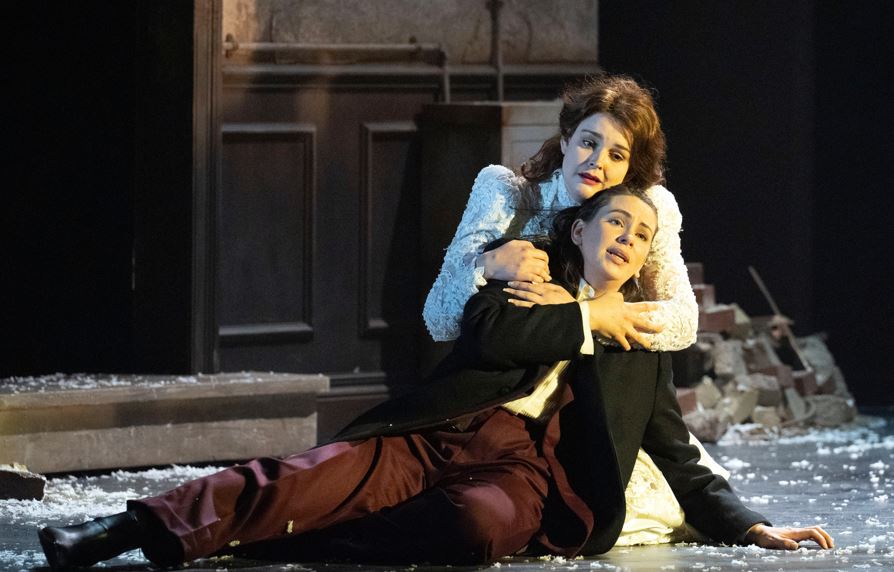
Then, after Lorenzo smuggles in Romeo to join her, and Romeo pleads that there is nothing left for them but to flee together, their virtuoso duet, fuggire, a noi non resta is extraordinary. Price and Cale’s two voices perfectly marry in an idyllic whole.
Giulietta though is torn between her passion and love towards Romeo, and honour and duty towards her family. So there is to be no elopement. Romeo’s reaction in his cantabile, Ah crudel, d’onor ragioni, tearing his heart out as he says how cruel she is that for reasons of honour she will not elope, although powerfully sung with soaring heart-felt passion, he does come across as a bit self-centred with lines like “you don’t love me like I love you”, a man of action going all wimpy. Later, in the event though, actions speak louder than words.
Bellini’s score is very narratorial and beautifully expressive. Conductor Alphonse Cemin takes the ETO Orchestra on a journey that starts with a light touch, and builds in strength and intensity. The score, unusually, gives many opportunities for individual instruments to be foregrounded. Solo harp arpeggios introduce the second scene before the wedding dress is brought in and the there are many tableau moments when time stands still as Bellini paints the mood. A meditative horn solo leads into oh! quante volte. A lovely cello introduction opens the second Act, and an extended clarinet solo proceeds the funereal scene action later in that act.
The second Act, post the destruction of the Capuleti mob’s hideout, has a sombre mood that is infused with a threatening ambiance, yet is very poetic in its form. Its drama is of heroic proportions.

The fading cello finds Giulietta wandered alone amongst the wreckage, stunned at what has happened. Lorenzo offers her the cold comfort of the sleeping potion, which she gingerly takes. When Capellio arrives and sees her, he senses something is wrong, but the recalcitrant patriarch insists the marriage go ahead in spite of (or because of) what has happened. Cale again excels with her decorated cabaletta Ah non poss’io partire, in a deeply touching and tender performance as Giulietta begs for her father’s forgiveness.
After she has gone, and the distraught Romeo comes looking for her, but in due course comes face to face with Tebaldo, also searching for Giulietta. The suddenness of their encounter elicited gasps from the house on press night. Here are two macho men, incandescent with anger, grief and the lust for vengeance. It is a classic gunfight face-off. A powerful duet rides on the ensuing violent action as, in Spiteri’s a un sol mio grido , Tebaldo threatens that his single cry will bring a thousand men, while Romeo warns he will wish the alps and the sea were between them, in another show of Price’s vocal fireworks.
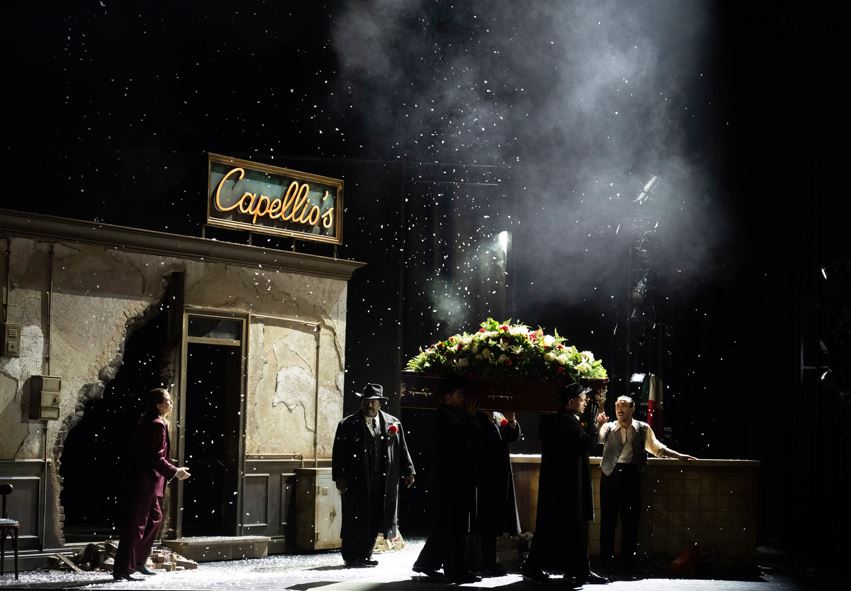
However, their combat comes abruptly to an end as Giulietta’s body is carried in, decked in flowers, on an open bier on the shoulders of the Capuleti men. Lally crafts a coup de théâtre as it begins to snow; the setting, the music, the lighting and the movement all complement each other to create a scene of overwhelming sombreness.
After Romeo has made his final fatal mistake, and Giulietta wakes and her initial hopes turn to emotional devastation, their final cabaletta, in each other’s arms is heartbreaking. Lally though has given the ending a final dramatic twist, which takes Bellini’s plot more towards Shakespeare’s.
In lesser hands, the compression of so much violent acts and convolutions of fate would result in overblown melodrama, but this consummate version of The Capulets and the Montagues, with Bellini’s score beautifully performed and Romani’s libretto so imaginatively interpreted, an inspired design and an outstanding cast, it is a raw retelling of a well-known story with a visceral impact, a production with punch.
Mark Aspen, February 2025
Photography by Richard Hubert Smith

 Mark Aspen
Trackbacks & Pingbacks