
The Merchant of Venice 1936
Do WE Not Bleed?
The Merchant of Venice 1936
by William Shakespeare, adapted by Brigid Larmour and Tracy-Ann Oberman
Trafalgar Theatre Productions, the Royal Shakespeare Company et al at Richmond Theatre until 12th April, then on tour
Review by Gill Martin
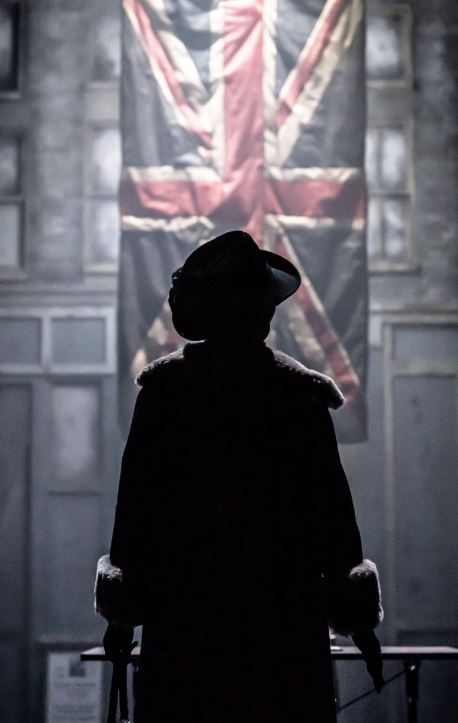
With the world in the grip of race hate, anti-Semitism and economic convulsions, the setting of The Merchant of Venice in the mean East London streets of Oswald Moseley’s marching fascist Black Shirts 1936 is horribly timely.
Shakespeare’s classic erupts onto the stage after two West End sell-outs to hold audiences at Richmond Theatre gasping for breath with its power.
This is theatre at its best. Challenging. Gripping. Thought provoking. And with acting of the highest calibre.
And, still reeling from the impact of this production, I’d admit feeling uncomfortable at the unremitting torrent of venom and antipathy levelled at Jews in innuendo, insults and blatant acts throughout the two acts.
Mob rule and violence are the backdrop. The set is grim, the façade of a dark brick terrace of houses, upturned tables, chairs and hat-stand.

Members of the cast appear in party mode from the aisles, reassuring the audience not to panic, inviting them to join in the dinner party that starts with Jewish prayers in flickering candlelight. Black and white posters display hate messages: Britain First; Jews Out; Even Hitler was not anti-Semitic until he saw a Jew.
This is an historic portrayal of Shakespeare’s Shylock, the Jewish money lender, now, for the first time, played by a British woman. Tracy-Ann Oberman is the star and also associate director and co-adaptor. She dominates in this electrifying play.

Oberman has based her Shylock on her great-grandmother, Annie, who fled Belarus and made a new life in the East End; only to become the target of anti-Semitic hatred once again.
The historical context of this production, where the script is heavily cut and characters and scenes swapped around, is important. Oswald Mosley’s British Union of Fascists appealed to a cross-section of English society from First World War veterans, to the unemployed of the Great Depression and to aristocrats. Mosley was married to beautiful socialite Diana Mitford, their wedding attended by Hitler as guest of honour.

In this production those same toffs are portrayed by Antonio (Joseph Millson) in the cocktail-sipping company of chums with clipped vowels, clipped moustaches and striped blazers.
Suave Antonio, Brylcreemed hair as sleek as an otter, becomes a Blackshirt, his friends willing participants in their prejudice and the stunning, stylish Portia (Georgia Fellows) equal in her poisonous snobbery.
Shylock is a protective single mother running her pawnbroking business from her house in Cable Street, earmarked for a paramilitary march against the Jewish community. She does a deadly deal with Antonio when he seek a loan, securing a bond that if not honoured must result in a forfeit— a pound of flesh. His flesh.
Oberman is both powerful and yet vulnerable, a loving mother one moment, a vengeful creditor the next. Villain or victim?

Venom infects most of the characters: Shylock’s turncoat servant Mary (Evie Hargreaves) and Gratiano (Xavier Starr) appal. While Mary mocks her previous employer, Gratiano shocks with behaviour worthy of a Bullingdon Club member by draping himself in a Union Jack and pissing on the doorstep of a Jewish house.
The campaign of intimidation mounts as windows are smashed, graffiti smeared and we see projections of real life history with Blackshirts saluting.
Strong set design (Liz Cooke), lighting (Rory Beaton) and sound (Sarah Weltman) all dial up the tension; while Gavin Fowler as Bassanio, Mikhail Sen as Lorenzo and the Maharajah, and Grainee Dromgoole as Shylock’s schoolgirl daughter Jessica all deserve credit for their performances.

We are treated to those famous lines from the steely matriarch Shylock: “If you prick us do we not bleed? If you poison us do we not die? And if you wrong us shall we not revenge?” delivered by the peerless Oberman.
And in a tense courtroom scene there’s the unforgettable plea from Portia, disguised as a lawyer, urging Shylock to show mercy to Antonio with “The quality of mercy is not strained. It droppeth as the gentle rain from heaven…”
While the script is silky smooth the play rather judders to a halt with Shylock’s desperate forced conversion to Christianity and then a breaking of the fourth wall as she at last finds support from her East End neighbours who stand in support of the Jewish community during the Battle of Cable Street and resist the fascist marchers.
“They shall not pass” is the cry. Cheers and prolonged applause greet this passionate plea for tolerance and solidarity.
Gill Martin, April 2025
Photography by Marc Brenner


 Mark Aspen