
Tis a Pitty Shee’s a Whore
Brotherly Love?
Tis a Pitty Shee’s a Whore
by John Ford
Richmond Shakespeare Society at the Mary Wallace Theatre, Twickenham until 26th April
Review by Gill Martin
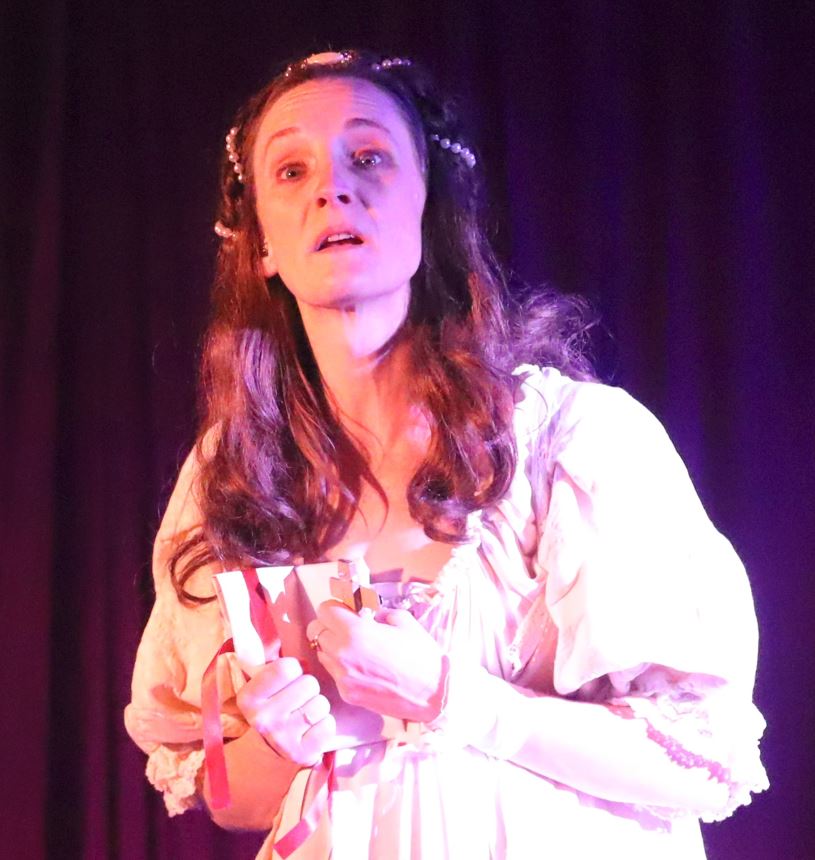
The question: “Shall then, for that I am her brother born, /My joys be ever banished from her bed?”
The answer to Giovanni’s conundrum screams unequivocally YES.
But that would leave John Ford’s Jacobean play ‘Tis a Pitty Shee’s A Whore unwritten and we would never be drawn into the dark and tragic story of Giovanni’s forbidden love for Annabella, a blood-soaked tale of incest and treachery.
Throw murder, adultery and betrayal into the theatrical mix and you have an explosive revenge tragedy that has engaged and shocked audiences over centuries. Now it was our turn in tranquil Twickenham on the Thames Embankment’s Mary Wallace Theatre to endure or enjoy an evening of shock-horror dastardly deeds played out in rather too realistic fashion at full pace by the cast from Richmond Shakespeare Society.
Ford’s verse and story-weaving bears comparison to fellow Renaissance dramatist William Shakespeare but ‘Tis a Pitty Shee’s A Whore is rarely performed, no doubt in part for it’s uncomfortable content. Isn’t there a Scottish saying along the lines of: “Try anything once except incest and folk dancing”? We were spared the bagpipes and folk-dancing, but not the incest.

White-ruffed black-booted young Giovanni (Will Hunter) and his vulnerable elder sister Annabella (Emma Gridley) are consumed by their feelings for each other, despite the risk they take in devoutly Catholic Padua, Italy.
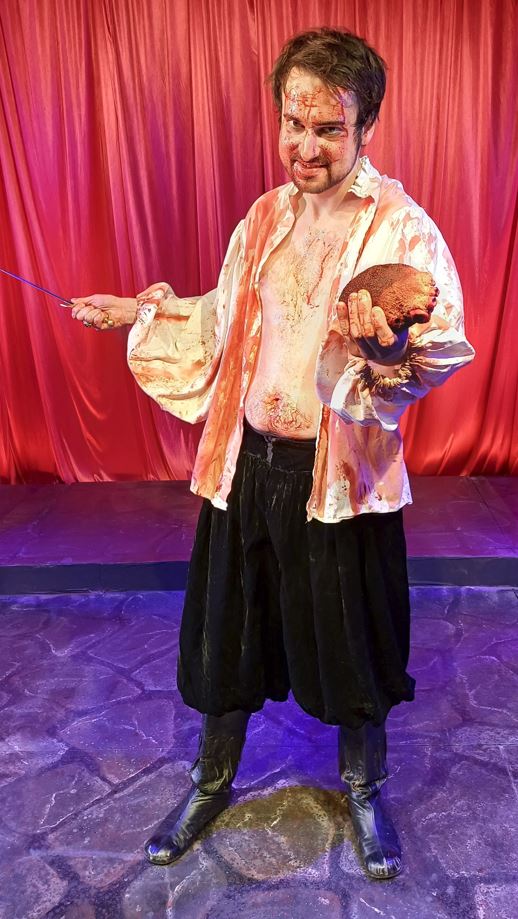
Naked passion versus conscience played out against a hypocritical and corrupt society does not make for easy viewing. Nor do the death throes of so many of the players: poisoned, stabbed, sentenced to death, suffering a heart attack. There’s a lot of blood on stage and the odd organ wrenched from its victim. Eyes were gouged out, spiked wine spat out and fatal knife wounds ineffectually stemmed.
Another unsettling factor is Ford’s refusal to condemn the incestuous love or lust between the ill-starred lovers. This is no Romeo and Juliet.
We can feel pity at least for Annabella, whom Gridley plays as a frail woman in the thrall of her domineering brother whose all-consuming lust for her will not be denied. He woos her with the words: “Come, Annabella, no more sister now,/ But love, a name more gracious.” . . . Words that prove disastrously irresistible.
Giovanni has wilfully ignored the Biblical hellfire warnings levelled by the understated Friar Bonaventura (James Phillips) when he confesses incestuous desire for his sister that torments him. “O, Giovanni, hast thou left the schools of Knowledge to converse with lust and death? For death waits on thy lust”, warns the friar.
It is a tribute to both Hunter and Gridley that their first on stage kiss is shocking. Incest surely is the last taboo.
Their doughty mother Floria (Fran Billington) is in blissful ignorance of her children’s behaviour. Beautifully and sensitively portrayed as sage and sensible, all Floria desires is a decent marriage for her daughter.
Annabella is pursued by a succession of unsuitable suitors introduced by her softly-spoken companion Putana (Pauline Orchard), whose name is a strong Italian swearword. The suitors after her hand: Grimaldi, a soldier (Scott Tilley); Saranzo (Rob Wallis); and Bergetto (Paul Smith) are well cast and impeccably costumed in 17th Century attire of brocade, velvet, tabards and breeches, feathers, tassels and pearls. Hats off to costume and wardrobe creatives John Gilbert and Junis Olmscheid.
Successful suitor Soranzo, all red beard and tousled hair, employs Spanish servant Vasques (magnificently played as an arch-villain by Eric Petrossian). Any Spaniard would have incited antipathy among audiences of the time, around 1630, following four attempted invasions of England by Spanish Armadas between 1588 and 1601. And anti-Catholic antagonism was whipped up by the Catholic-inspired Gunpowder Plot to blow up Houses of Parliament in 1605. Ford portrays the imposing Cardinal (Jeremy Gill) as a figure of corruption for granting sanctuary to a self-confessed murderer. He also sentences the unfortunate Putana to a fiery execution.
But he does get the best closing lines, “He and his sister chose the path to hell. / ‘Tis a pitty shee’s a whore.”
A strong, simple set, excellent lighting and deft direction by Rodney Figaro of a nineteen-strong cast all deserve mention. There are so many characters, interwoven plots, wheeling and dealing demand full audience attention. And the violence is visceral.
Ford’s open treatment of incest has made it one of the most controversial works and rarely seen on our stage. Maybe Netflix could shock a new generation by re-working a play first performed five centuries ago.
Gill Martin, April 2025
Photography courtesy of RSS

 Mark Aspen
Trackbacks & Pingbacks