
Joseph K and the Cost of Living
Well Drawn and Quartered
Joseph K and the Cost of Living
by Emily White after Franz Kafka
Richmond Shakespeare Society at the Mary Wallace Theatre, Twickenham until 7th June
Review by Steve Mackrell
Taking a modern but relatively unknown stage adaptation of Kafka’s famous novel, The Trial, represents a brave programming choice by the Richmond Shakespeare Society for its latest production at the Mary Wallace Theatre. Welsh writer Emily White’s adaptation of The Trial, curiously retitled Joseph K and the Cost of Living, was recently commissioned by the National Theatre Wales and premiered in Swansea in 2023.
The journey from novel to stage can be fraught with difficulty, including such problems as compressing complex narratives into a shorter storyline, conveying different characters in both motive and depth, and turning book text into speech to create a visual two-hour theatrical experience. These hurdles were not entirely cleared by Emily White’s script, although in mitigation, the play is referenced as “after” Franz Kafka, suggesting the writing was inspired by the novel, rather than providing a faithful representation.
Without doubt, the novel of The Trial, written by Kafka in 1914, is both complex and philosophical and is far from being a straightforward story. In brief, on the morning of his thirtieth birthday, Josef K, an unassuming bank worker, is unexpectedly arrested on his way to work by some unknown agency for some unspecified crime and subsequently prosecuted by some remote authority. Confused? Well, that’s the simple part of the story, thereafter we meet a host of different characters, in all, an ensemble of eleven actors playing thirty roles.
Clearly, the novel’s themes are deep and varied. They explore the control of society by a totalitarian state, creating a dystopian vision of problematic social and political issues. Hence, translating this to the stage represents a huge challenge but, in production terms, director Maxina Cornwell has successfully created a vivid and frightening world of confusion and fear. The direction is razor sharp and the acting scarily convincing as we become immersed in a world of social, cultural and philosophical challenges. We witness the growing chaos around the characters, with references to war, famine and even Brexit and, getting back to the play’s title, a slight nod to the relentless rise in the cost of living, all themes which are both topical and urgent. But quite why “the cost of living” became part of the play’s title remained unclear.
This is an extremely engrossing piece of physical theatre, full of constant movement and dynamic sound which hits you full in the face. The stunning opening scene, perhaps five minutes long and without dialogue, sees the stage flooded with constant action and loud music riffs – a choreography of commuters crowded together travelling to work and then busily engrossed in manic office routines. The adaptation also places us in contemporary times and into the world of mobile phones, social media, google and even riot police holding back a crowd of protesters shouting, “enough is enough”, a sentiment I briefly shared.
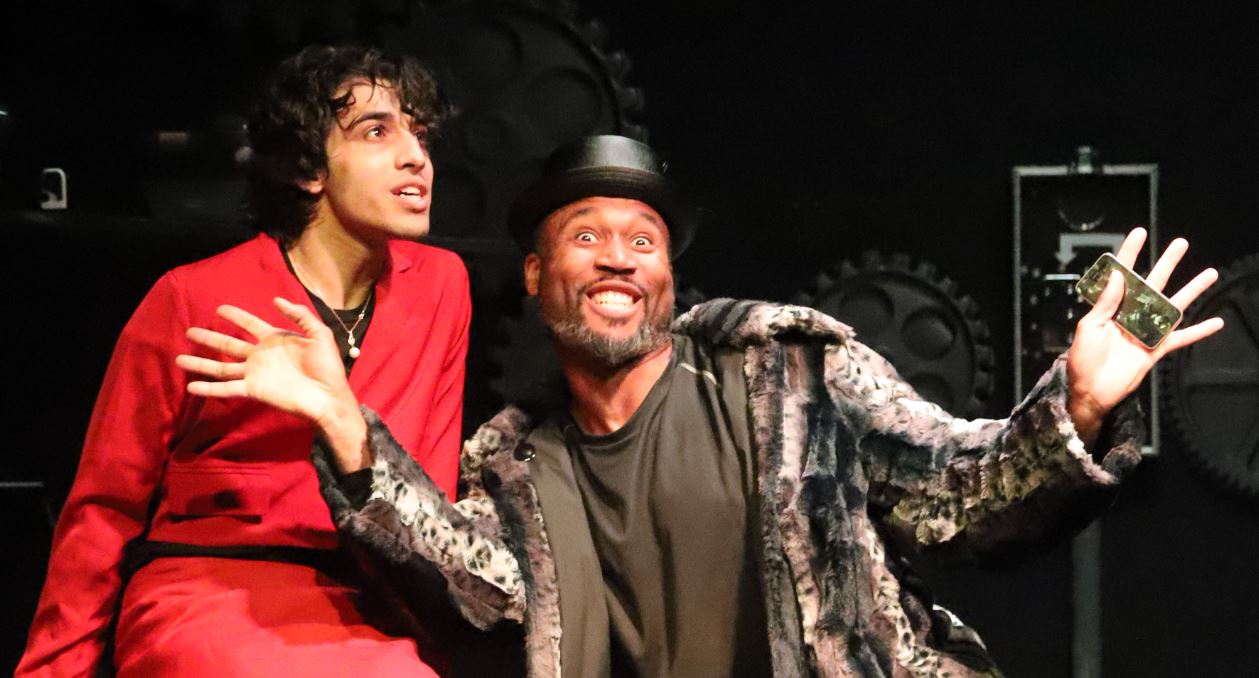
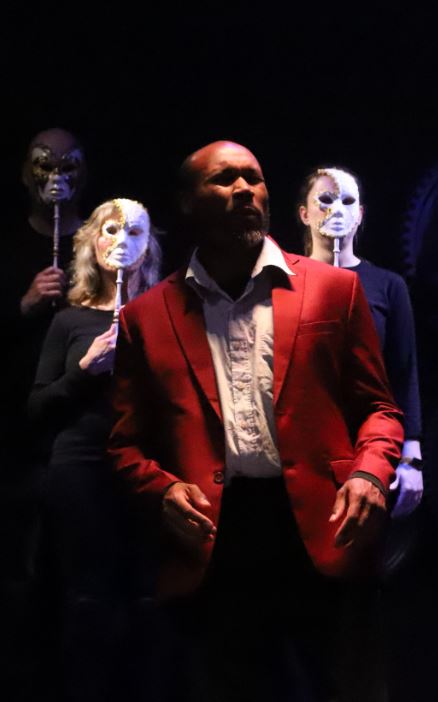
However, the key device which sets the play apart from the novel, is the division of Kafka’s protagonist Josef K into four different and successive characters, denoted simply by the names K1, a white male (Dominic Upton), K2, a male trans-gendering to female (Krishan Miller-Pullen), K3, a white female (Anastasia Babich) and K4, a black male (Elewisa Kuusi). But why four? Not made at all clear, but cutting the hero into four separate characters seemed only to complicate not illuminate. However, to help the audience navigate, identification was usefully aided by the wearing of jackets emblazoned with a large red capital letter K.
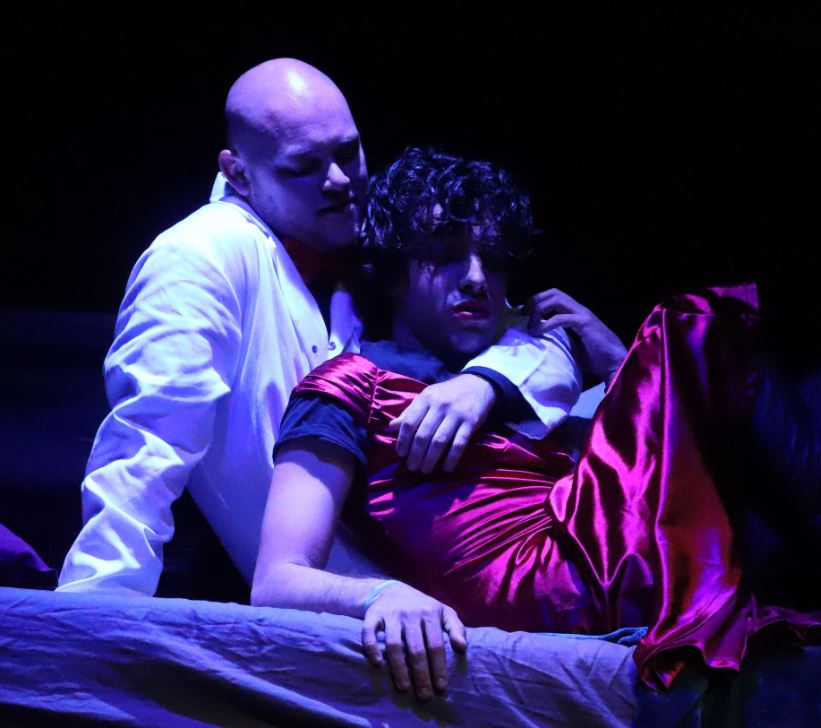
Of the four successive Josephs, Dominic Upton’s K1 was particularly impressive and was both emotionally and physically intense. His later role in a gay scene with K2 was both sensitive and believable while Krishan Miller-Pullen’s K2 was elegant and feline as a transgendered female, made stunning by a vivid red skirt and skyscraper high heels.
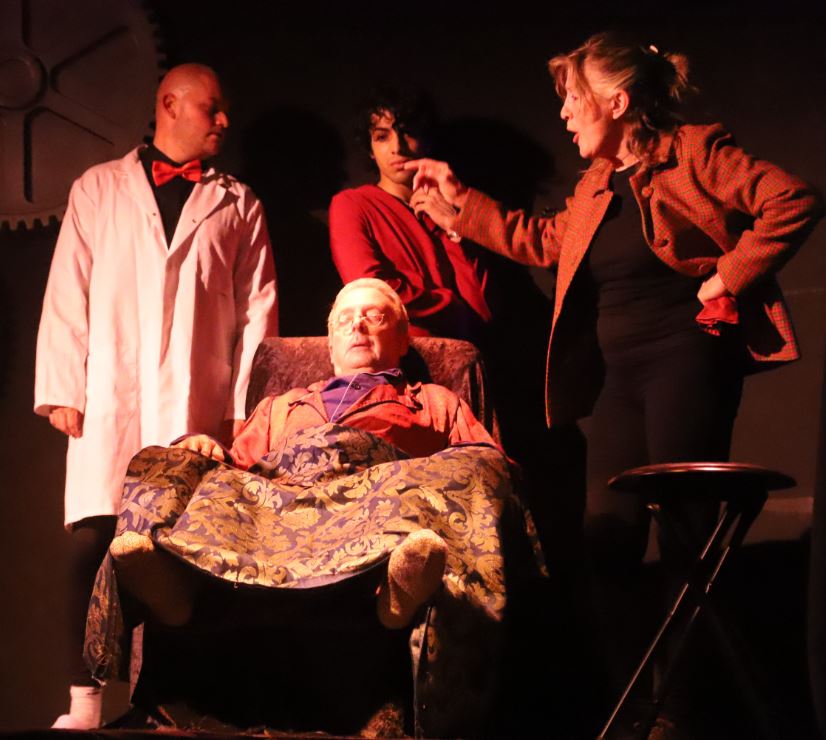
Other standout performances included John Mortley’s corrupt lawyer Huld, bedridden with a heart attack, and Susan Reoch as Block, his wearily submissive client. Elewisa Kuusi, as well as making a commendable K4, also excelled in the ebullient role of Titorelli, the portrait painter for the courtrooms.
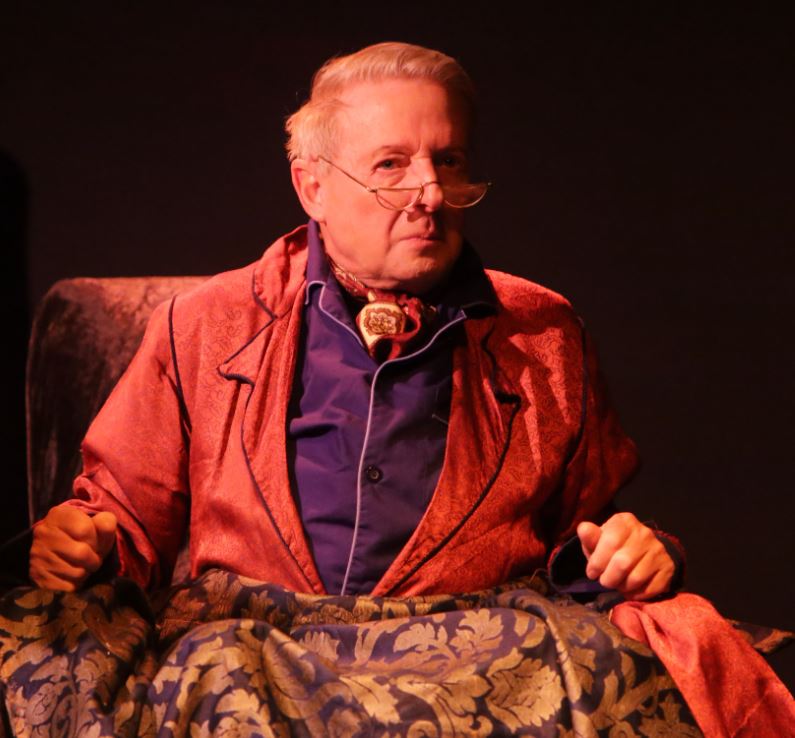
Especially enjoyable scenes included K1’s raucous birthday party complete with a surprise female stripper, the cathedral scene with Mark Cavendish playing the earnest Chaplain, the intimate tango that opens Act 2, the courtroom scene where cue cards are held up for audience participation, and a stunning finale where the four K’s directly address the audience with shouts of “someone’s been telling lies.” Indeed, welcome to the world of misinformation and, as one character says in Orwellian undertones, “data is knowledge and knowledge is power.”

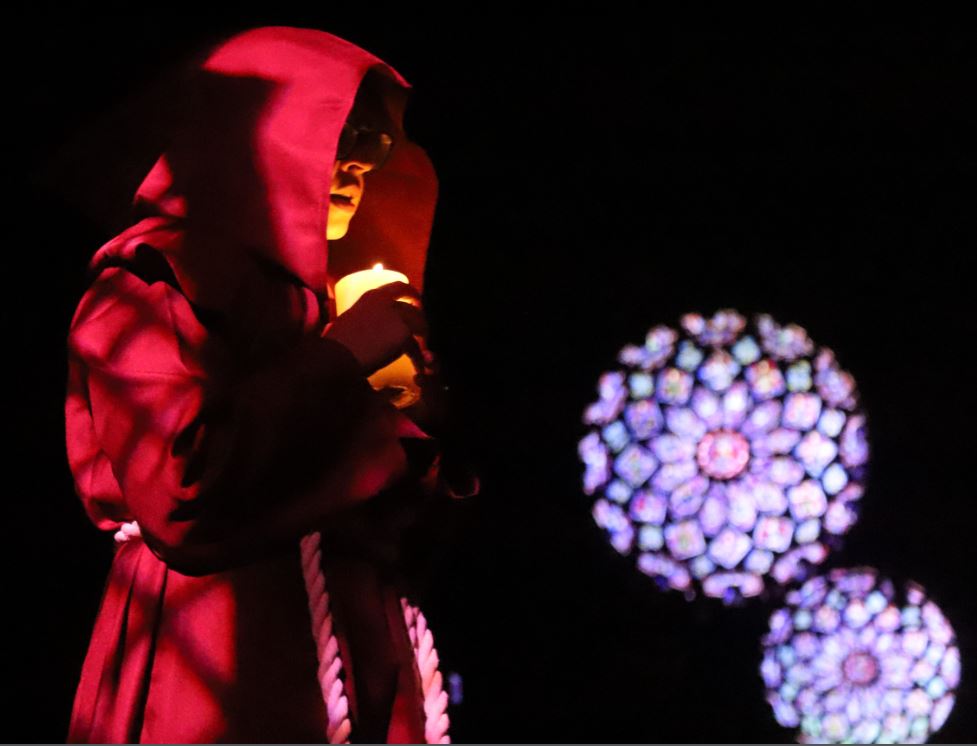
The set, by Junis Olmscheid, was simple and stripped back to basic podiums bathed in blue. The back wall was decorated with a series of intertwining cogs which, later in the production, become a canvas for projected images such as cathedral windows and, amazingly, a live feed during the courtroom scene of two of the main actors. Other larger moving images were also projected on the back wall including speeding commuter trains and an erupting volcano to accompany a successful sexual union. Indeed, the show was full of visual wizardry, loud techno sounds, blackouts and strobe lighting, all confidently mastered by Technical Director Marc Pearce, using techniques which must be on the cusp of AI technology.
This is a quirky play, suffering only from a rather bland script which fails to inspire and fully grip the imagination. However, this downside is more than offset by the excellent production values and by a spectacularly energetic ensemble. This is a progressive and adventurous production by RSS with much to commend it. Without doubt, an innovative and physical production, and definitely worth the watching.
Steve Mackrell, June 2025
Photography by Simone Best


Trackbacks & Pingbacks