
Tis a Pitty Shee’s a Whore
Cutting Edge Drama
Tis a Pitty Shee’s a Whore
by John Ford
Richmond Shakespeare Society at the Mary Wallace Theatre, Twickenham until 26th April
Review by Ralph Stanhope
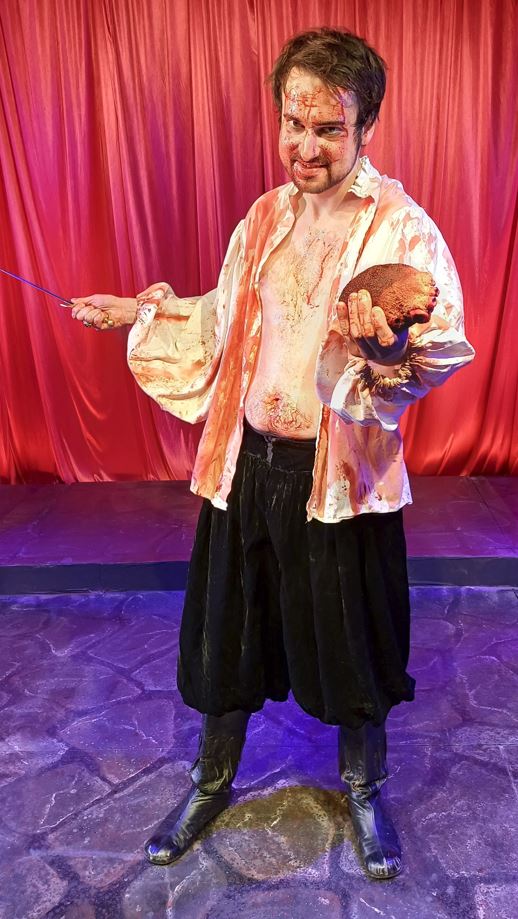
Jacobean Theatre does not feature over-much in amateur theatre, so it is refreshing to see Richmond Shakespeare Society’s latest production of John Ford’s masterpiece at the Mary Wallace Theatre, and the result is an evening of absolute power and magnificence.
Written around 1626 (when it was first performed), Ford presented a dark drama about sexual passion leading to despair, incest and revenge , but with the poignancy of love, although not as we believe it today. It is not for the faint-hearted and this production hurls itself at us right from the opening. Indeed when the curtain rises, we join a conversation between Giovanni and the Friar when we immediately discover the physical relationship between brother Giovanni and sister Annabella which rises to supreme tragedy, reaches its apogee in the final denouement.
My immediate accolade must go to director Rodney Figaro, who does a splendid job with a fine cast who gradually steer us through the drama to its horrific climax with extreme skill. There are a number of characters who make a considerable impact; as indeed, as we may well have guessed, the casualties increase

The brother and sister, played by Will Hunter and Emma Gridley are the central characters; however they are not Romeos and Juliets. Parma is a darker place than Verona. Indeed, we never really warm to Giovanni; Hunter’s performance is an aggressive one right from the start, and each time we see him he becomes increasingly out of control until the final scene when virtual madness has taken over! This is a performance that could go OTT, but Hunter keeps us just within the bounds.
We cannot have both lovers on such a plane, but Emma Gridley is just as compelling in Annabella’s obvious inside passion and, when she learns she is with his child, her tragedy is clearer to her than to her lover’s. Her final moments are poignant and most moving: we cannot have a Juliet-type death, no potions. Giovanni has to kill her: sadly she has to just disappear. I’ve seldom seen a greater twosome.
There are other equally fine performances: foremost is the mercenary Spaniard, Vasques. This role must gradually develop until the Iago-like personality becomes clear. Eric Petrossian gives a sinister performance. I watched him carefully, his face seldom really changed, so you knew this was a dangerous man, a carefully-studied brilliance.
Ford gave us some comedy in the ridiculous Bergetto and Poggio. Some relief is surely necessary. A good double-act from Paul Smith and Roderick Ellis, who keep the comedy scenes under control, concentrating on their own ridiculousness until nemesis descends on Bergetto. Indeed Smith’s death scene is splendidly done, reminding me of Mercutio’s great line, “A plague on both your houses”.

Fran Billington plays Floria, mother to Giovanni and Annabella. Now Ford wrote this part as male (Florio), but I thought the female characterisation improved the situation throughout. Fran is very good at playing benevolent parental roles. She too dies – a part of Ford’s original moment, which is much too sudden: here it works.
The part of Soranzo, who is the inevitable unsuccessful suitor to Annabella, has to portray this somewhat unfortunate character – we know he won’t last out the play! But Rob Wallis more than got away with it via a strong and powerful performance, beautifully spoken, a character who is out of his depth throughout, and perishes as a result. Likewise, Hippolita an ex-Soranzo Mistress, strongly presented by Rebecca Fallon in two fine speeches, who meets her end before he does. Ford did not appear to continue her character.
I was not sure about the set, since it took up too much room on an already small stage, but by the second Act, I realised that a more open stage would not really have worked and the lighting melded into the set. The costumes are – thank goodness – in the real period of the 1620’s, as opposed to – well, anywhere! Jacobean Theatre requires Jacobean costumes: end of story.
One comes out of a play such as this positively reeling, as I did. I noted that the audience at the performance that I attended was almost silent until the actual play had concluded. Then came the considerable applause. The production deserved this, but the play does as well: Jacobean drama must be encouraged – there is much more waiting in the wings.
Ralph Stanhope, April 2025
Photography by Simone Best

 Mark Aspen