
Laburnum Grove
Hot off the Press?
Laburnum Grove
byJ B Priestley
Q2 at The National Archives, Kew until 17thMay
Review by Gill Martin
You could argue that the star of Q2’s production of J.B. Priestley’s Laburnum Grove is the venue. But that would be unfair to the Players. If your haven’t been to the National Archives at Kew before, you’ve missed a treat. Few theatres can match its approach past playing fountains and tranquil waters on which a pair of swans glided, with four cygnets snuggling between the pen’s folded wings.

The play takes us from these delightful surroundings in south west London to equally leafy Laburnum Grove, Shooters Green. This address epitomises smug, middle-class suburbia in north London where ‘nothing ever happens’.
Until now.
Suburban respectability is shattered by some dodgy dealings as George Radfern (Malcolm McAlister) tries to rid himself of sponging relatives by revealing a shocking part of his business life. But is he really the master forger of Laburnum Grove he declares himself to be? Or is he pulling the financial wool over their greedy eyes?
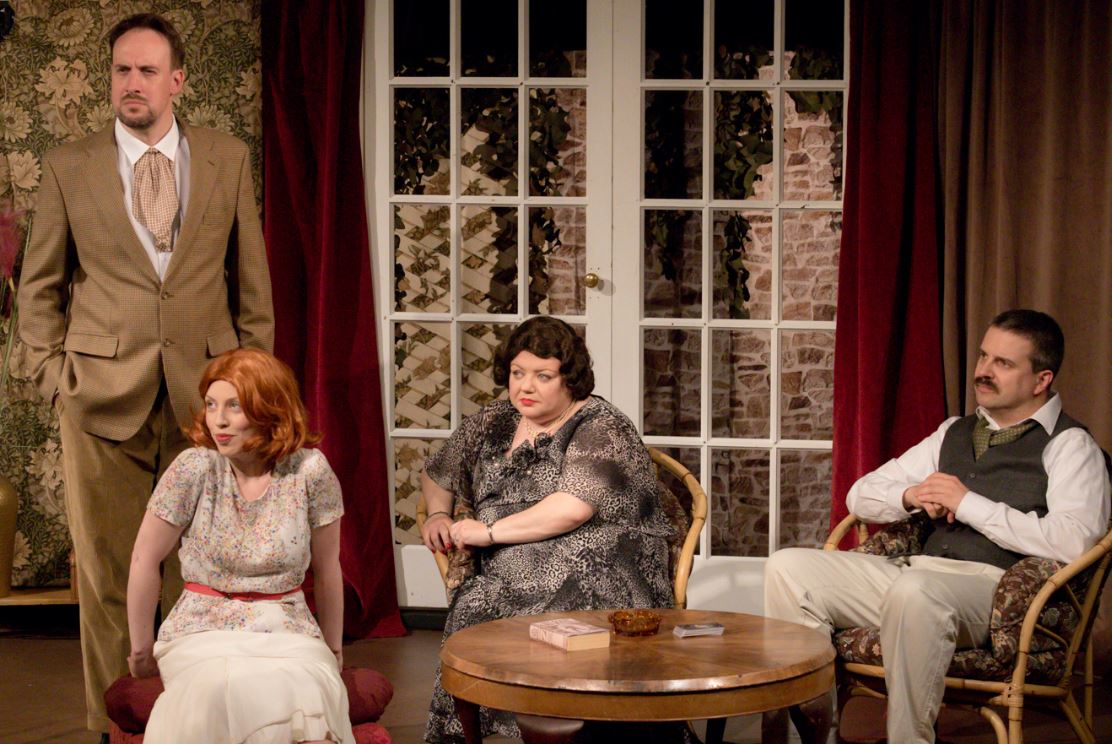
This gentle comedy becomes edgy as family dynamic shifts and we ponder if George is a master money man or just a genial joker.
To his neighbours in Shooters Green, he appears the decent middle-class hard-working householder, smartly dressed for work in the wholesale paper trade by day, then spending weekends and restful evenings tending tomatoes in his greenhouse while listening to the wireless. What a perfect cover for printing fake currency and bonds.
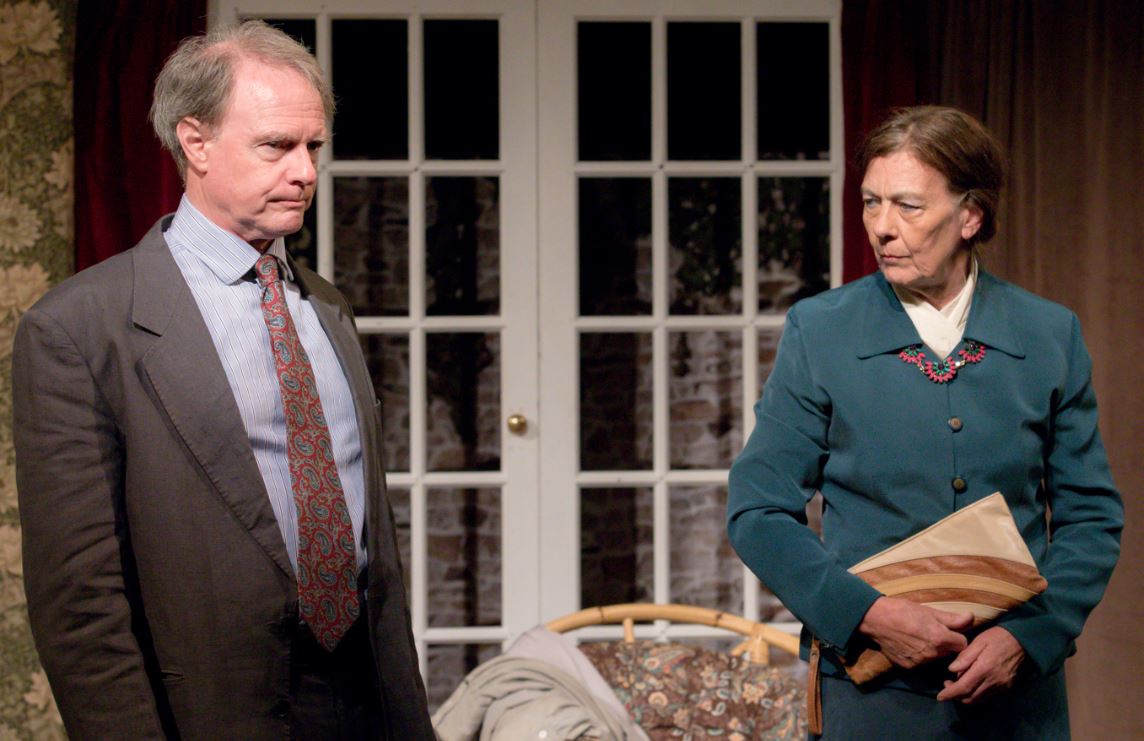
Genial George appears to have survived the economic depression between the two World Wars. He inhabits a cosy semi whose dining room speaks of genteel living: William Morris wallpaper, tinkling fine china tea-cups, suppers of ham and tongue and salad. Full marks to set design and construction by Bob Gingell and Harriet Muir.
Unremarkable George has provided a secure home for his family, fiery red-headed daughter Elsie (Anna Piggott) and home-maker wife Dorothy (Andrea Wilkins). Yet he is criticised for leading such a safe, boring existence.
Elsie, 20, is about to become engaged to Harold Russ (Dominic Parford), a calculating car dealer who sees his prospective father-in-law as an easy touch for funding a business venture.
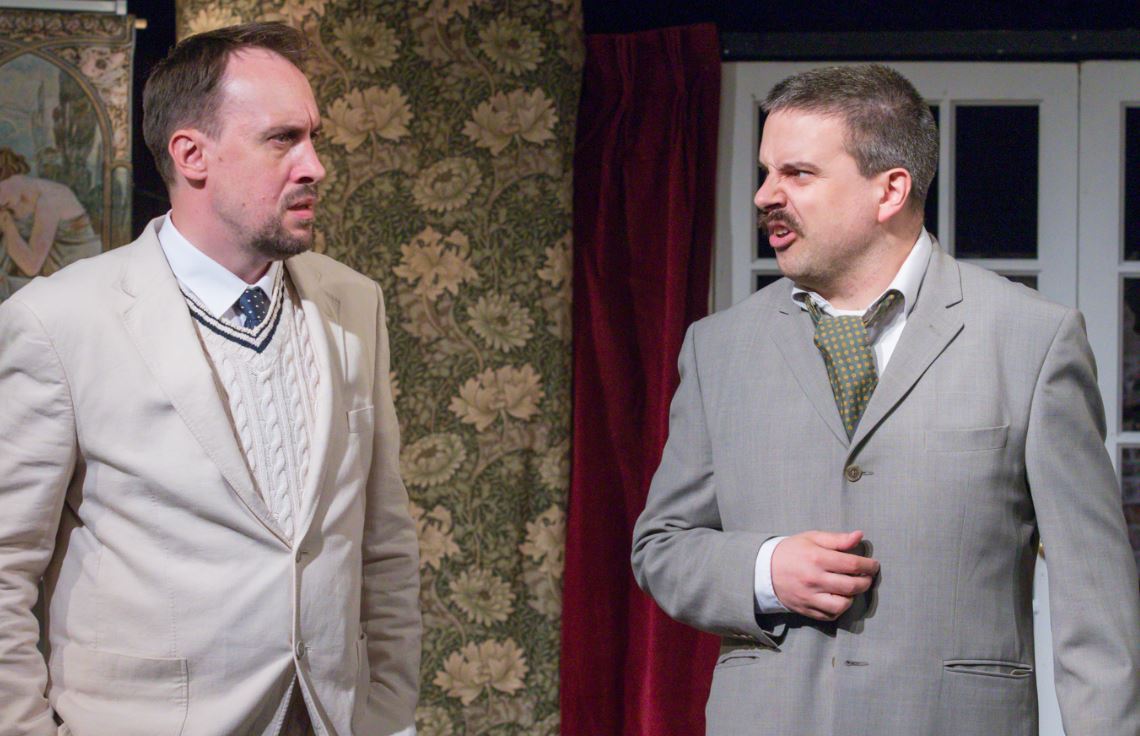
Dorothy’s sister Lucy Baxley (Mandy Gasson) is freeloading at the Radfern’s with her ghastly banana-chomping husband Bernard (Paul Huggins). This grasping brother-in-law is also trying to tap George for more money.
For my money, Mandy is the stand-out act of the show, effortlessly delivering her lines, every expression right on cue in her role as long-suffering wife to the entitled Bernard, who pines for his days in Singapore where servants were at his beck and call. She’s also dabbles in fortune telling. Or even misfortune telling.
She, like all the cast, is impeccably attired in period wardrobe thanks to costume design by Harriet Muir. All, that is, apart from Sergeant Morris (George Lowdell) in a police uniform that swamps him.

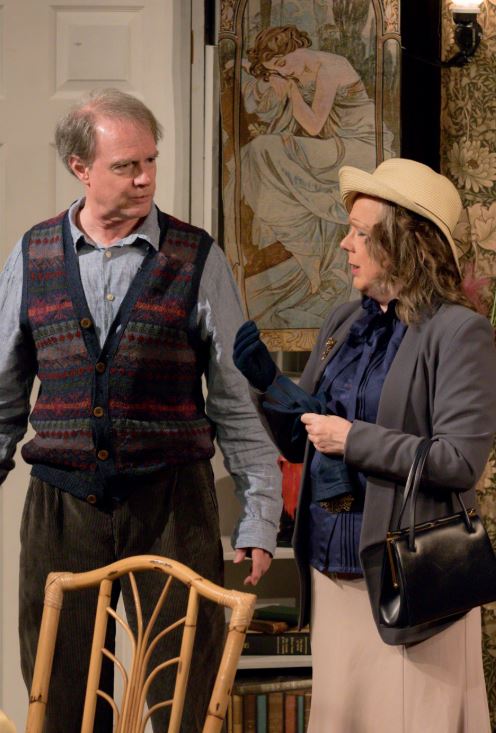
Smart detective Inspector Stack (Harriet Muir again) is suitably austere and no-nonsense, while doddery neighbour Joe Fletten (Chris Hodges) is kitted out in Fair Isle woollies. Is he the innocent friend frequently popping around for advice about greenhouses or an unlikely partner in crime?
Another clever touch: the play opens to We’re in the Money, a song by Ginger Rogers from The Gold Diggers movie.
‘Oh, we’re in the money
Come on my honey
Let’s lend it, spend it, send it rolling around’, so the song goes.
John Boynton Priestley’s drama was first staged between the World Wars in 1933. It was a hit in the West End and then opened in Broadway. Film versions were screened in 1936 and 1950. It wears its 92 years lightly, especially now the world is rocked by Trump’s will-he-won’t-he tariff war. George might argue that forgery is a logical response when global trade is suffering because ‘there isn’t enough money in circulation.’
J.B., whose most well-known work is An Inspector Calls, described Laburnum Grove as an ‘immoral comedy.’ Director Terry Oakes agrees. ‘Certainly none of the main characters can lay claim to any of the moral high ground in Shooters Green’, he writes in the programme notes. ‘…you may be unsure whether to think George Redfern as the hero or villain of the play.’
The jury is still out.
Gill Martin, May 2025
Photography by Ben Gingell


 Mark Aspen
Trackbacks & Pingbacks