
In Praise of Love
Mutual Secrets
In Praise of Love
by Terence Rattigan
OT Productions at the Orange Tree Theatre, Richmond until 5th July
Review by Harry Zimmerman

Richmond’s Orange Tree Theatre has demonstrated an enthusiasm for Terence Rattigan revivals over recent seasons. Previous productions have included While the Sun Shines and French Without Tears. Their latest offering, In Praise of Love, a less frequently performed work , is directed by Amelia Sears, and represents a different challenge, one to which the team rises with aplomb, brio and attack.
In Praise of Love is a late play in Rattigan’s canon and is ostensibly inspired by his friend Rex Harrison’s decision in the late 1950s to not inform his wife Kay Kendall of her own terminal cancer diagnosis. Rattigan himself had already been diagnosed with leukaemia when he wrote the play, and the spectre of death is an ever-present leitmotiv, haunting the script and underpinning the actions and reactions of the characters.
The play takes us into the archetypal middle class London home of Sebastian and Lydia Cruttwell, with many scattered books, a chess set and a very well-used drinks table.
It is 1973; a year which straddles the still active memories of the Second World War and the swirling uncertainties of Cold War escalation. The palpable sense of dislocation and uncertainty as a result of the shifting tectonic plates of global realpolitik, domestic political change and recent wartime experiences pervades the Cruttwell’s world.
“The real English vice is our refusal to admit to our feelings”
Sebastian is an acerbic, arrogant literary critic, totally convinced of the correctness of his opinions on everything ranging from politics, the economy, relationships and literature.
Lydia is an Estonian, active in her country’s wartime resistance movement, whose marriage to Sebastian transported her from the trauma of life in central Europe, suffering under both Nazi and Communist occupation, into the very different milieu of post-war literary London.
Both are former wartime intelligence operatives, and, as such, are masters of concealment and obfuscation, hiding truths from friends, family and, especially, each other
Lydia is spinning several plates simultaneously, indulging and cosseting the fractious and abrasive Sebastian, trying to manage the relationship between her husband and son Joey, which is threatening to disintegrate, and rekindling her relationship with American Mark Walters, a hugely successful author of bestselling mass-market fiction, who has returned to London. Mark has always carried a torch for Lydia, whilst also maintaining a genuine friendship with Sebastian.
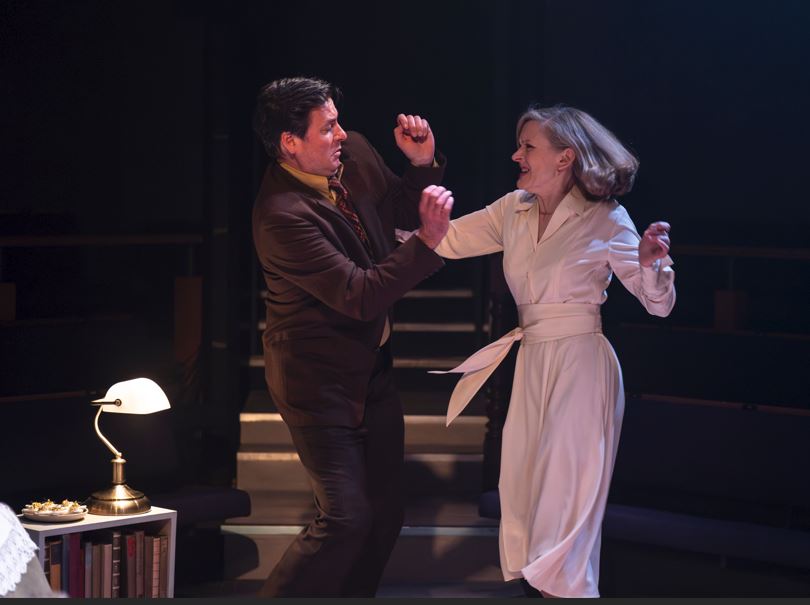
These emotional and practical complications are eclipsed by the devastating news that Lydia has an incurable, terminal illness. Both Lydia and Sebastian know the truth, but are desperate to keep it from each other, to spare each other the pain of such knowledge, with the subject never explicitly discussed between them. Indeed, in a bid to keep from Lydia how serious her illness is, Sebastian hides his real feelings, treating her as dismissively and carelessly as he has always done.
Thus, the scene is set for a series of escalating deception, legerdemain, duplicity and circumvention of the truth. Both characters build a carapace of disinformation to avoid facing the dreadful finality of reality.

Throughout, it becomes ever clearer that Sebastian and Lydia share a deep love and respect for each other, a bond that goes much deeper than the acidic bon-mots and caustic throwaway observations that they habitually hurl at each other.
The truth, and the depth and honesty of their feelings for each other, can only be revealed in the discussions they both have separately with Mark, who provides the much-needed empathetic sounding board for their emotional outbursts and revelations.
Sebastian and Lydia’s respective revelations to Mark provide moments of intense emotional power. For instance, Sebastian’s moving evocation of Lydia’s miraculous escape from Nazi atrocities is compelling and spell binding and serves to explain his earlier instinctive actions of concern and gentle protection following Lydia’s physical collapse.
In a production of this type, relying as it does upon individual communication and interaction, and the essential believability of the motive forces underpinning each character’s emotional response to intense scenarios and escalating tensions, the ensemble playing needs to be of the highest quality. In this instance, we are richly and satisfyingly served.
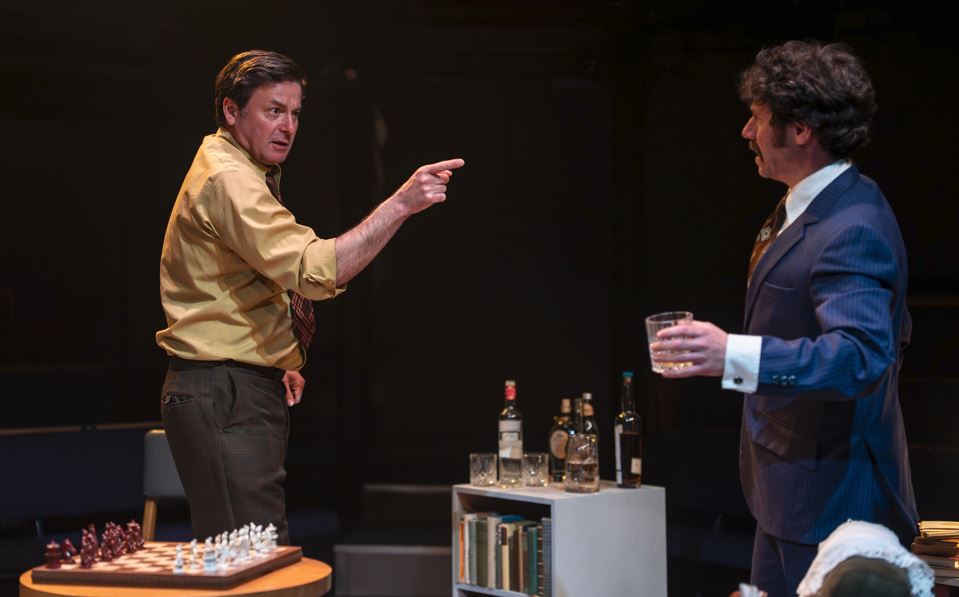
Dominic Rowan gives us an apparently confident Sebastian, lazy, arrogant, impractical and occasionally corrosive with outmoded concepts of structural domestic harmony. Yet, he is never completely unlikeable, and delivers many laughs, even if they are grounded in much of his pomposity and irascibility; a self-proclaimed Marxist who cannot pour his own drinks or remember the name of his cleaner. His work is paramount to him, and his ostensible belief in his superior intellect and knowledge is convincingly broken down as the narrative progresses.
Claire Price is superb as Lydia, giving her a dignified yet steely core. With impeccable timing, Price reveals moments of tenacity, tenderness and perceptiveness, whilst also eliciting sympathy when adopting the role of the put-upon wife who is taken for granted. Her performance is a subtly nuanced, yet quietly powerful one.
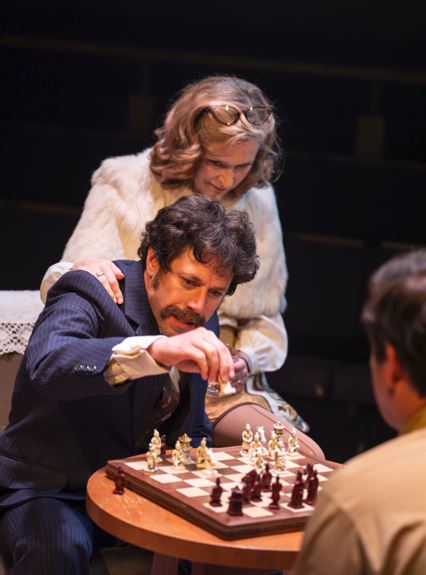
Daniel Ableson gives us a Mark Walters who is a well-rounded, amiable and grounded figure, fully aware of his pivotal position as a balanced listener and support function for both Sebastian and Lydia. It is Mark who forces the issue in enabling them both finally to confront the truth.
Joe Edgar, as the Cruttwell’s son Joey, delivers an assured performance, portraying with honesty and candour his love for his mother, and exasperation with his father, whilst never quite fully giving up on his relationship with him. Portraying Joey as fundamentally decent and thoughtful, Edgar never falls into a caricature of an angry young man, even though he has plenty to be angry about!

In Praise of Love is a deeply moving drama which, although dealing with sombre issues, is punctuated with a humour and vitality that leavens the overall seriousness of the central narrative thrust. The maintenance of this balance between tragedy and laughter is one of the key successes of this production.
Whilst on the surface the play takes the form of a growing edifice of deception and equivocation, it swiftly and subtly builds into a situation of almost unbearable pathos as layer after layer of pretence, concealment and dissimulation is peeled away from Sebastian and Lydia’s relationship to reveal the full measure of each’s unspoken love for the other, and the pain of inevitable loss.
Satisfyingly, we reach a resolution which is prefigured by Lydia’s earlier observation that “In the end, it is only people that matter”.
Tickets will be at a premium for this production…and rightly so.
Harry Zimmerman, June 2025
Photography by Ellie Kurttz

 Mark Aspen