
La Traviata
Passion Fruit
La Traviata
by Giuseppe Verdi, libretto by Francesco Maria Piave
The Grange Festival at The Grange Northington, Alresford until 6th July
Review by Mark Aspen

It is quite some while since opera lovers have had the treat of a new production of La Traviata, and the Grange Festival offers a new look at Verdi’s best known work, and it is a gem that probes the psyches of the opera’s main protagonists with intriguing insight and intuition.
Director Maxine Braham has set out to explore the louche world of mid nineteenth century French high society, wisely keeping it in the period and place where it inextricably lives, whilst putting the psychological and emotional impetus of each character under the microscope.
The production introduces, even during the overture, a visual leitmotiv of a small child, clearly Violetta’s younger self, who becomes a recurring presence. The opening scene, in her grand Parisian salon, has fashionable portraits of Violetta as classical or Biblical figures. Here are windows into Violetta’s soul, a secret longing for her lost innocence and a desire for virtuous affirmation. Or is it guilt at that very loss of innocence and virtue?
One feels that Verdi was in love with his tragic heroine Violetta Valéry, the courtesan who is la traviata, the woman who has gone astray. Verdi’s second wife, the operatic diva Giuseppina Strepponi, had developed a certain notoriety before she married Verdi for the number of her wealthy escorts. (Indeed, Alexandre Dumas’ La Dame aux Camélias, the play on which the opera is based, was inspired by the enigmatic Marie Duplessis, the real-life courtesan, with whom Dumas had had a passionate affair.) La Traviata contains some of Verdi’s most passionate and moving musical creations, so one might conjecture that Verdi wove something of his own experiences into what is often called opera’s greatest love-story.
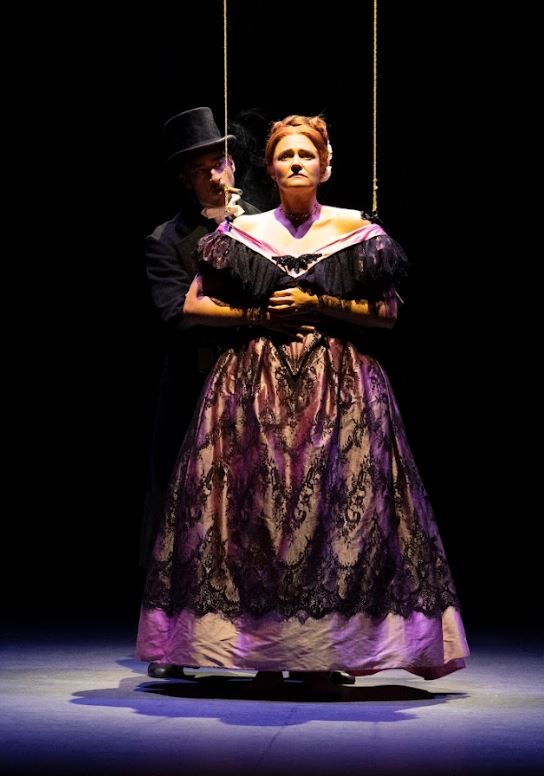
Certainly La Traviata is inextricably entwined around Violetta, and Maxine Braham’s exposition takes a viewpoint largely from Violetta’s perspective.
Lyric soprano Samantha Clarke excels in the role of Violetta Valéry, and takes the full sweep of the emotional spectrum that Violetta traverses, in naturally affecting acting and multi-faceted bel canto singing. From the assured Violetta, riding high as society’s most sought-after hostess, the vivid coloratura of the hedonistic view of her life being “always free” in a spirited sempre libera; through to the legato lines of the dying Violetta’s addio del passato, her bereft “farewell to the past”, are captured in virtuosity. The route between the two is a roller-coaster of passion, in the sense of the true love that she shares with Alfredo, expressed in the two love duets, un dì, felice and Parigi o cara, which mirror Violetta’s solo arias at the beginning and end of the action, and deliver poetic balance. Clarke renders Parigi o caro, her forlorn hope to go “from Paris, my beloved”, with heart-rending pathos. Alfredo’s un dì, felice ignites the flame of love, which when alone she realises that strangely his words are etched on her heart, and Clarke’s impassioned è strano! è strano! in core scolpiti has a real depth of conviction.

Delightfully, è strano is accompanied by a fly-drop of rose petals, underlining Violetta’s immersion in this fresh feeling of romantic love. It is one of many comments on the action by an accomplished design team. Jamie Vartan’s set includes Violetta’s sumptuous salon, that scintillates with glitz, glitter and glamour, where even the mauve upholstery matches her gowns; the pastel coastal retreat, a villa that is the love-nest of Violetta and Alfredo; the palatial Parisian party venue of Flora Bervoix, a friend and confidante of Violetta; and the subdued setting of the tubercular Violetta’s house where she spends her last hours as consumption claims her. Particularly effective are the brindisi scene, which makes use of the double revolve, in a panorama of convivial busyness; and the use of an-onstage theatre box in the colourful entertainment interludes at Flora’s soirée. The progression of the story across these settings is greatly enhanced by the ambience created by the lighting from the acclaimed lighting designer Johanna Town. And the costumes are many and gorgeous.

The energy of the piece is upheld by movement and dance. Maxine Braham is also an acclaimed and established choreographer and she has created arresting dance sequence, which are executed with style (and the support of choreographic assistant Monica Dominguez). There is visual delight of waltzing in the salon, and the set pieces at Flora’s party with gypsies and matadors (and my, are they enjoying themselves). And then there are the Mardi Gras revellers, who introduce an incongruent juxtaposition in the hospice-like hush of Violetta’s final moments.
Looking down the other end of the telescope from Violetta’s viewpoint, Braham also focusses in on the interactions and reactions to the heroine of the other characters. She does not have them come to comfort Violetta after she is openly humiliated at Flora’s party, in spite of their assertion, fra cari amici qui sei soltanto, “you are here among dear friends”.

Instead they ironically sit in an amphitheatrical semi-circle, around her, as entertainment, and observe her thorough opera-glasses, a specimen. None is present during her terminal illness in the final Act. Their cynicism and hypocrisy underlines their shallowness.
The big set-piece blockbuster of La Traviata, the brindisi, the wide ensemble drinking song, all about enjoyment, wine, eroticism, wine, extravagance, and wine, starts the show. The whole company, on the whirl of the revolve, put enormous fun-loving gusto into this. But why does Verdi play his ace card right at the start? Because it is emotionally downhill for Violetta from here. After the euphoric switchback ride of falling in love, there is rejection, humiliation and abandonment. Then in her last moment, a spark of hope extinguished by stark reality. From the brindisi, there is a stripping back of joy, from demi-monde to devotion, and dejection to demise.

The role of Alfredo Germont is a difficult one, steering as it must a middle course. Alfredo can be seen as superficial as his initial infatuation fades and fickleness takes its place; or he can come across as a petulant adolescent with a crush, blind to the fuller picture, going into a jealous strop, until, whoops, he’s got himself into a perilous duel with a hard-nosed aristocrat. Fortunately, Maltese tenor Nico Darmanin pitches it just right in a balanced portrayal. His Alfredo, besotted as he is is, is truly concerned about her, and his io son felice, I’m so happy, is genuinely expressed. Yet, when in Act Two, they are living together
in the countryside near the sea, he seems oblivious to her feelings, and that they are living on borrowed time … and her money. Darmanin expresses this well in his Io vivo quasi in ciel, he sings, I live like someone in heaven, sung with light abandon.
Alfredo’s father Giorgio Germont is another character with a long emotional journey, and there is always the danger of portraying him as too sympathetic too early, leaving the acting nowhere to go. There is no such problem here, as Dario Solari’s Germont senior comes into Violetta’s country house like a bulldozer, his polite aggression forcing her to retreat in her own home. He has come to insist that Violetta must leave Alfredo, in order to protect his engaged daughter, pura siccome un angelo, pure as an angel. He is a man whose is intent on keeping his family name from any impropriety. Solari’s baritone has a richness that suggest authority and he has real stage presence.
But the father’s actions do not secure the good name of the Germont family, for Alfredo, stung and hurt after Violetta’s sudden separation from him, seeks her out back in Paris. There his friend Gastone, played with insouciant sparkle by tenor Sam Marston, who introduced him to society at the start, now procures him an invitation to Flora’s soirée. Bad move, for one of the aristocratic guests is Baron Douphol, Violetta’s new “protector” and a man to be reckoned with. Baritone Peter Edge plays Douphol as a hard man, not the usual old duffer, his wits sharp and his temper quick. Edge sings with a staccato bite, which gives an air of menace. This scene is imbued with a palpably threatening air, notwithstanding the gaiety of its opening, and when the party guests move to the gaming tables, the tension mounts. In spite of the mollifying interventions by the genial Marchese d’Obigny, in the soothing bass-baritone of Leo Sellick, and the concerned hostess Flora, the sweet-voiced American mezzo Annie Reilly, it is not going to end well. The ill-judged cockiness of Alfredo at his gambling success against the Baron, fires his pique at his beloved Violetta and his bitter rejection of her. His unforgivably uncouth insult of throwing his substantial winnings at her is accentuated in another fly-drop, here of banknotes. It is condemned even by his own father, who arrives too late to intervene.

The heartbroken response of Violetta, non puoi comprendere, is movingly sung by Samantha Clarke, her devastated reaction, that he cannot understand all the love in her heart. It is an aria that stands out for the sheer depth of its expressiveness.
All the musical elements of La Traviata are deeply expressive, and conductor Richard Farnes brings the rich emotions out from a Bournemouth Symphony Orchestra on top form. The score and action are a perfect fit and Farnes accurately takes the music along every turn in its emotional road. A vigorous chorus, omnipresent in the salon scenes, of two dozen (including some of the named parts) under chorus master William Vann, brings colour and muscle to the piece.
In the final Act, Verdi has, with great artistry, accentuated its poignancy, right from the entr’acte’s plaintive oboe and pizzicato strings (plucking at the heartstrings?), and the starkly intrusive contrast of the Mardi Gras celebrations. Dr Grenvil, in the solemnly sympathetic bass of Peter Lidbetter, offers hope, against the blatantly transparent truth of Violetta’s imminent end.
The servants feature with brief intensity, and the cameo role of the faithful maid Annina is beautifully portrayed by the Portuguese soprano Isabel Garcia Araujo, as a constant presence, even to the bitter end. It is worth noting that Violetta’s manservant is called Giuseppe (Verdi serving Violetta?), regrettably a tiny part for tenor Samuel Kibble.
La Travitata has a strong message of redemption, and Alfredo and his father arrive just in time for a form of reconciliation between all three. Germont has explained to his son the true nature of her sacrifice, and he himself is chastened by the knowledge that his own pride has led to Violetta’s and his son’s downfall. Violetta’s dying grace is to forgive them.
But how this Traviata stands out is the sharp focus on that sacrifice, in a thoughtful dramatic device. When Germont first meets with Violetta in her coastal villa and she acquiesces to his insistence that she and his son should part, for the sake of his family, there is a moment after her tearful aria così alla misera, accepting what she must give up. Germont, ostensibly inadvertently, raises her arms in a gesture of crucifixion, whilst praising her courage and noble heart, coraggio e il nobile cor. And now, in her dying moments, Violetta washes Alfredo’s feet.

When Violetta sold off her possessions to fund the country villa love nest, there was one painting that she could not part with, that of herself as Mary Magdalen. Was she here assuming the part of Mary Madalen in Luke’s Gospel, washing Christ’s feet, He to forgive her previous life and she to devote herself to him? But she does not dry his feet with her hair.
In the opening of the scene at the coastal villa, the child pulls across the beautifully painted backcloth of the lovely countryside and sea, perhaps the return to a more innocent time.
Or is it that the imagery is that of Christ on Maundy Thursday washing the disciples’ feet? Is Violetta washing away the wrongs that Alfredo has done to her, before she offers herself as a sacrifice to exculpate Alfredo, Germont senior, and all her “friends” of their sins?
Maxine Braham and her company have given us much to think about in an incisive probing exploration of an old favourite. And nothing is lost in so doing. Here music, song and presentation excel in creating an enquiring, enjoyable and enviable work of art.
Mark Aspen, June 2025
Photography by Richard Hubert Smith


 Mark Aspen