
Eugene Onegin
Green Ayes
Eugene Onegin
by Pyotr Ilych Tchaikovsky, libretto with Konstantin Shilovsky, after the narrative poem by Alexander Pushkin
Wild Arts, Summer Opera Festival at The Layer Marney Tower, Essex until 21st June, then on tour until 18th September
Review by Mark Aspen

There is something direct, open and uncomplicated about Eugene Onegin, especially in its early scenes, that makes a setting in the wide and open countryside of Layer Marley particularly pertinent and attractive. Sunshine and flowers of a hot June late afternoon chime with the opera’s bucolic first scenes, and act as a contrast in the later scenes which take part in the cloying atmosphere of the fashionable salons of St Petersburg.
The approach is to keep things simple and to let Tchaikovsky’s music and libretto breathe, and this indeed puts new breath into an old favourite. Wild Arts is fortunate in having a talented company, and at the helm: director Dominic Dromgoole, previously artistic director at Shakespeare’s Globe amongst other prestigious theatres; musical director Orlando Jopling, founder of Wild Arts, and with a conducting career that includes The Royal Ballet and Opera, as the combined company is now known; and movement director Siân Williams, whose choreography has encompassed Broadway to Glastonbury via The Royal Shakespeare Company.
Being, in is own words, “sick to death of ‘versions’”, Dromgoole aimed to create a non-gimmicky Eugene Onegin, sincere and open, that hasn’t been “versioned”. And he has succeeded magnificently to create a piece that unwraps the emotions and impulses of the opera’s all-to-human characters, with a direct and empathetic intimacy.
Jopling is a wonderfully adept musical arranger, and his distillation of Tchaikovsky’s score to a quarter of the number of instruments, yet losing nothing in extent or emphasis, is exemplary. Music and action infuse each other, as Jopling takes the Wild Arts Ensemble, a compact but lithe octet, with skill and pace, interacting with and commenting on the story being told.
Bearing in mind that dance is an essential element in Eugene Onegin (and after all, the fulcrum around which the whole plot turns is a single dance), the prospect of dance sequences on the small stage at Layer Marney seemed a challenge. However, Siân Williams’ consummate skills seem to turn the stage into the harvest barn in the Russian countryside or the grand ballroom in St Petersburg naturally and effortlessly. The peasants bring in the harvest with a joyous triple-time courante (a dance already old-fashioned in the 1820’s) into Madam Larina’s barn, in stark contrast to the stiff hauteur of the top-draw society in the St Petersburg ballroom, dancing the oh-so fashionable polonaise. All the dancing is by the singers and is accomplished with panache.
This Tardis staging is achieved using a thrust stage, with the musicians behind and the audience on the open three sides. Some rustic timber elements, representing bench, bed or writing desk, and other items, are brought on- and off- stage between scenes by the performers, with the quotidian routine of the servants they represent (including a seamless running repair, fully in character). Tatyana Dolmatovskaya’s design, which is enhanced with simple situational lighting, allows an intimacy between singers and musicians, and with the audience. Costumes too are simply designed and are appropriate to the period of the piece and to the standing of each character, but in a setting with the audience very close to the performers, they would strike more true with better concentration on the detail of their execution.
Tchaikovsky always insisted that Eugene Onegin was not an opera, but was lyrical scenes, based as it is on Pushkin’s verse novella. Perhaps he was trying to duck any adverse criticism that this was not in the then accepted opera format, and moreover, it probed the plights and passions of ordinary people. The term “lyrical scenes” was used to describe realism in Russian literature at the time, and roughly mirrors the use of the term verismo in naturalistic Italian literature, and then opera, later in the century.
The production has a new translation by Sofra Dromgoole, who has a sharp understanding of the lyricism and structure of the original libretto, which follows closely Alexander Pushkin’s text. This is written in the form of what has become known as the Pushkin sonnet. Yes, it has fourteen lines, but a more complicated rhyming pattern than sonnet forms in English. Moreover, there are patterns made with declensions of the grammatical gender of words, which cannot be applied in English. So it is not an easy task, but she has captured the beauty and the poetry of the original whilst rendering the words into modern natural English.

With Cara Dromgoole as assistant director there is quite a family team on the creative side. And it is worth noting some nice directorial touches which subtly comment on the action. Tatyana’s younger sister Olga is already engaged to be married to Vladimir Lensky. Bookish Tatyana’s romantic reveries hover in her subconscious. When the peasants bring in a tub of wheat as part of the harvest festival, she dreamily picks out a pair of wheat ears and gently strokes the grain seeds together. Here is a sensuous subtlety, as beautiful as it is Freudian. Then, Lenksky, visiting Olga, brings his friend the sophisticated Eugene Onegin. When Tatyana first catches sight of Onegin, it is like a bolt of lightning, that stops both of them in their tracks. They each take a reactive step back. It is a coup de foudre that is electric. Another of these touches follows the events after a series of immature missteps turn disastrously wrong. As Onegin tries to deny to himself his attraction to Tatyana, he diverts his attentions to Olga and the green-eyed monster appears in Lensky, who challenges him to a duel. There is a brief moment as the two young men part when they briefly look back at each other in a way that speaks silently of their misgivings and regret that things have gone too far.
These are little dramatic aperçus that give depth to a story that Tchaikovsky and Pushkin tell with emotional depth in music and poetry. Onegin is 26 years old, the others teenagers. It is study of the impulsiveness of youth when the sap of desire is rising.

Galina Averina plays a determined Tatyana, who is at first swept away on the idea instilled in her by her reading of romantic novels, has become real life in the form of Onegin. Setting aside propriety, she spends all night drafting and re-drafting a letter to him. Averina expresses a feeling of turmoil and self-confusion in Tatyana’s extended Letter Aria, which is a drama in itself. Her honeyed soprano shows great power in the initial outburst of song (and music) in which she feels she will die if she cannot write the letter, and later when she sings of the fire burning thorough her. Incidently the music is very expressive; one can hear in the oboe the scratching of the pen as she starts each line, then followed by other instruments, almost writing the letter for her.
Eugene Onegin, however, considers himself a cut above these country types living out in the sticks. This type of life bores him, for he is from St Petersburg society, sniff, sniff! How dare you write such a letter to Me, is the feel of his response when he sees her. He arrogantly suggests she should be more modest in expressing her feelings and should show some decorum. Tatyana is crushed.
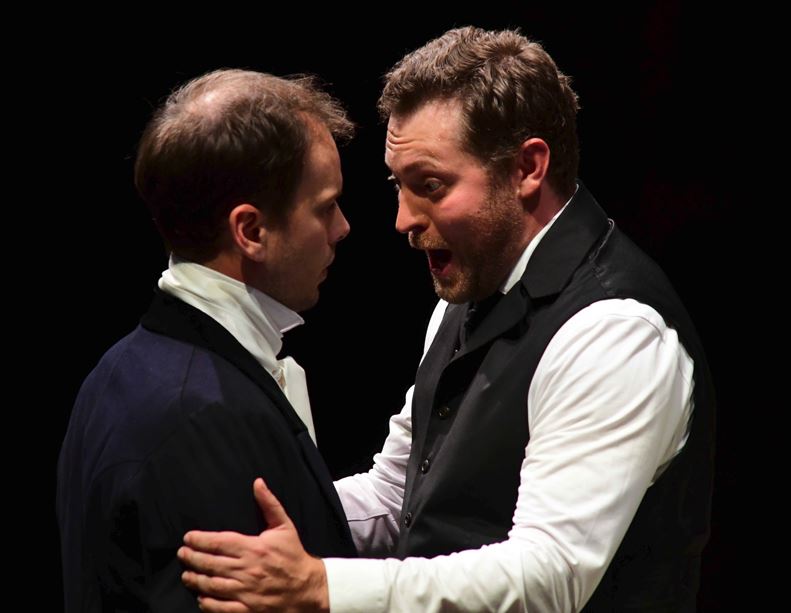
Notwithstanding this cruel put-down, Timothy Nelson portrays Onegin with some sympathy. It is an unusual portrayal, but thought-provoking. In spite of his consequent inheritance of a nearby estate, he has described the death of his uncle with real pathos, and one is led to consider that Onegin may be internalising a grief over a respected beloved uncle. His first-sight response on meeting Tatyana, as acted by Nelson, suggests something deeper is going on. With his burnished baritone Nelson is able to hint at protectiveness or even warmth in his long aria that explains he is not a man yet ready for love. Onegin, though, is a complicated character, as, yet for all this, his piqued reaction when he hears people gossiping about him is mischievous adolescent vandalism. He decides at Tatyana’s forthcoming name-day ball to flirt with Olga.
Two characters, ubiquitous in the early scenes, are Larina and Filipyevna, the mother and nurse of the two young sisters. They have over the years become close to each other, share reminiscences and often sing in duet. Hannah Sandison’s Larina, expressed in her soft lyrical mezzo, is warm and generous, buzzing around as the hostess, and wanting everything to be just so. The two are recognisable characters as they share gossip and memories, and Rozanna Madylus’s Filipyevna is totally believable as the loyal servant who has become one of the family. Her spirited mezzo puts across the character of a feisty woman, who is key in keeping the household together. She shares much with Madame Larina, and is even closer with the two daughters, whom she has known from their childhood. She speaks of Tatyana in a short aria as little dove, when she realises Tatyana has fallen for Onegin. Madylus convincingly shows this fondness.
At Tatyana’s name-day celebrations, Tchaikovsky has leavened the potentially heavy plot by introducing the light hearted, and indeed comic, role of Monsieur Triquet, a French tutor who is old enough to get away with making eyes at the girls. He sings some verses that he has composed in honour of Tatyana, while she squirms in embarrassment. Established tenor Robert Burt excels in this role, extracting all the humour from the part with a tinkle is both his eye and his voice. He sings of the smile on her lips, “Que la joie, les jeux, les plaisirs, fixent sur ses lèvres le sourire!”, while she blushes profusely and the guests roar with laughter. Burt is a baroque specialist and all the sparkle of that genre twinkles through.
The extrovert Olga loves all this, and is part of the party. Emily Hodkinson makes an effervescent Olga. Although singing at the lower end of her mezzo register, her voice has a light quicksilver timbre. Her set-piece “Tanya, O Tanya” aria says all about Olga’s joyous happy sweet life: remember she has Lensky. But she has a way to go, for when Onegin makes mischief by insisting on dancing with her, and Lensky’s jealousy rises to the suface, she “punishes” he by continuing the dance. The result is catastrophic.
Xavier Hetherington plays Lensky as sincere and passionate. His velvety tenor expresses his great love for Olga in his early aria “How happy, how happy I am!” but it really shines in the duel scene. As Lensky waits at the dawn duelling field, to fight a fight that ironically neither believes in, he has a premonition and sings that he may never see his beloved Olga again. Hetherington sings the well-known Kuda, kuda aria with great intensity, “Where have you gone, golden days of my spring?” It is deeply moving.
When the fatal shot is fired, Lensky’s second Zaretsky, a role deftly sung by baritone Alex Pratley, can hardly believe it. And neither can Onegin, as he takes his dead friend in his arms, weeping. The scene is very touching, but is perhaps over-egged by the appearance of the wraith-like spirit of Olga, as her love accompanies him to the grave.

When many years later, Onegin and Tatyana encounter each other again, he is amazed to discover that she is now the wife of the elderly retired General, Prince Gremin. Aristocratic, noble and beautiful, all the guests defer to her. Onegin is fired with desire for her, but the mutual devotion between Tatyana and her much older husband is clear, and is beautifully expressed in Prince Gremin’s aria, “To love, both young and old surrender”. It is the only aria for this role and Welsh bass Sion Goronwy fills it with a tender and gentle passion, richly and sonorously expressed.
The restrained denouement of Dromgoole’s Eugene Onegin is satisfying and enriching. It is an outstanding production that eschews extraneous elaboration. It is not “versioned”. What it does is to bring out the soul of the opera and present it as a work of art.
Mark Aspen, June 2025
Photography by Allan Titmuss

 Mark Aspen
Trackbacks & Pingbacks