
The Elixir of Love
Potent Passion Potions
The Elixir of Love
by Gaetano Donizetti, libretto by Felice Romani, after Eugene Scribe
Wild Arts Summer Opera Festival at The Layer Marney Tower, Essex until 22ndJune, then on tour until 16thAugust
Review by Mark Aspen

Operas (and their individual productions) come in all shapes and sizes, from the sombre or the tear-jerking, to the romantic or the somewhat baffling. The Elixir of Love falls squarely into the fun, knock-about comedy category . . . or does it?
All of the main characters are deceiving themselves, or others. The deceit ranges from self-delusion to downright subterfuge. In barely more than a day, the plot of The Elixir of Love disentangles the pretence of all of them, bar one, Dr Dulcamara, the purveyor of the titular elixir. Hence, we get to see the heart of each character, as we hear their, often moving and lyrical, revelations.
Nevertheless, Donizetti’s sunlit, outdoor score and the unsophisticated charm of the whole piece says, let’s have fun, and director Guido Martin-Brandis pitches the atmosphere just right. We can laugh broadly, whist allowing ourselves a wry smile, or even a sly tear. What his production does is immerse us in the characters’ lives and really feel for (or against) them.
This engagement is enhanced by a dais-height thrust stage, set amongst the audience and enabling the cast to be part of their experience too. Musicians can also walk on stage and make the whole a close-knit involvement. Minimal stage props, a folding table and some folding deckchairs, are all that is need to place it near the seaside.
The setting could be a shore boardwalk on East Coast America, a pier at the English seaside, or the original setting in an Italian coastal village, but designer Sophie Lincoln’s well-studied candy-stripe costumes tell us it is the mid-1950’s.
The English translation by Joseph Morris, who has worked very closely with Orlando Jopling to integrate with his musical arrangement, is very funny indeed, and makes the action very real.

Adina, a wealthy property owner, has it all, good looks, youth, charm, (lots of dosh of course) and above all no attachments. No wonder she is the honey-pot to whom all the are attracted. Amongst her adoring admirers, is the most besotted of all, a worker on her estate, Nemorino, who has little money, is socially inept and perhaps not the sharpest pencil in the box, but is kind, gentle and sincere. They are part of a community that knows the situation, which is the source of some amusement.
Right from the beginning, we see how enthralling Adina is to all her friends as well as her pursuers, as they gather around to hear her read the story of Tristan and Isolde, the Celtic knight and princess, who fall in love after drinking a magic potion. Bethan Terry is captivating and attractive in the role of Adina, adding just a little edge to the sassy and independent woman. Her seductive scarlet beach costume, the long skirts of the which reveal as much as they conceal, says much of the character who, beneath a controlled exterior, is unsure what she wants, and hence stays aloof. Terry’s honeyed soprano has a versatility of delivery, from spirited attack to lyrical introspection. First we hear (in the English translation) the enchanting della crudele Isotta aria, beautifully sung as her listeners take in the story, but none is more absorbed in the story than Nemorino.
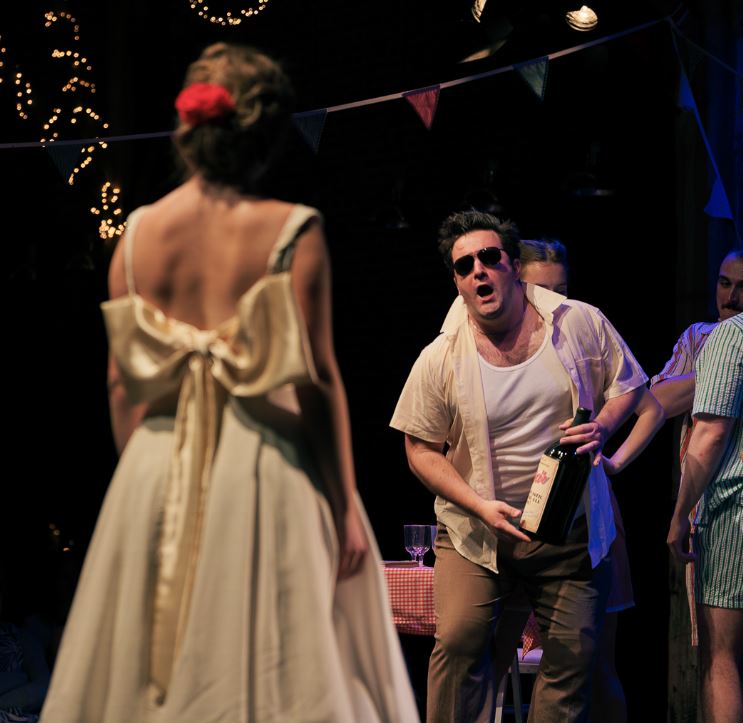
Nemorino is portrayed with warmly-examined empathy by Thomas Elwin. His Nemorino sits forlorn and doe-eyed on the sidelines, but in his quanto è bella aria, pouring out his heart about how beautiful and lovely Adina is, the expressiveness of Elwin’s tenor shows the intensity of his feelings. Throughout Elwin has us rooting for Nemorino.
The spur to Nemorino is the appearance of his nemesis, the arrogant Belcore, a naval captain whose ship has just docked nearby. Timothy Nelson’s Belcore demonstrates all the bluster and swagger of a braggart who thinks he is God’s gift to women. Dressed in a white naval officer’s uniform he appears a little like an escapee from South Pacific. Nelson’s lustrous and robust baritone is heralded by trumpet (Sam Lewis), most aptly for one who figuratively blows his own trumpets, in his come Paride vezzoso entrance, comparing himself to Paris with the apple, and almost immediately proposing marriage. Adina sees straight through him, but is intrigued and plays him along, much to Nemorino’s utter dismay, although he wishes he could be as bold as Belcore.
The duet by Terry and Elwin that follows between Adina and Nemorino, after the others have left, is one of several lyrical highlights. He, as discloses his feeling for her. Adina gently laughs it off, saying that she would like a fresh admire every day, but Nemorino declares that his feelings will never change, like “spring in the valley”. Both singers perform with great insight.

There is much activity in this production. Although the cast is small, three of the named parts also pick up the ensemble parts with gleeful energy, as the friends and employees of Adina. As Adina’s friend, Giannetta, Egyptian soprano Laura Mekhail is a sparking presence. It is Giannetta who opens the opera, leading in her friends, including Nemorino, and observing that, while there is shade to escape the heat of the sun, there is no escape from the heat of love. Adina’s other pals are Lauretta (creamy mezzo Eleanor O’Driscoll), Roberto (bright baritone Alex Pratley) and Claudio, whose proclivities lead him to have a more platonic relationship with Adina, who is played mischievously by Irish tenor Eamonn Walsh.
(Incidently, O’Driscoll’s and Walsh’s skills are also delightfully showcased in short open-air recitals during the afternoons of the performances.)
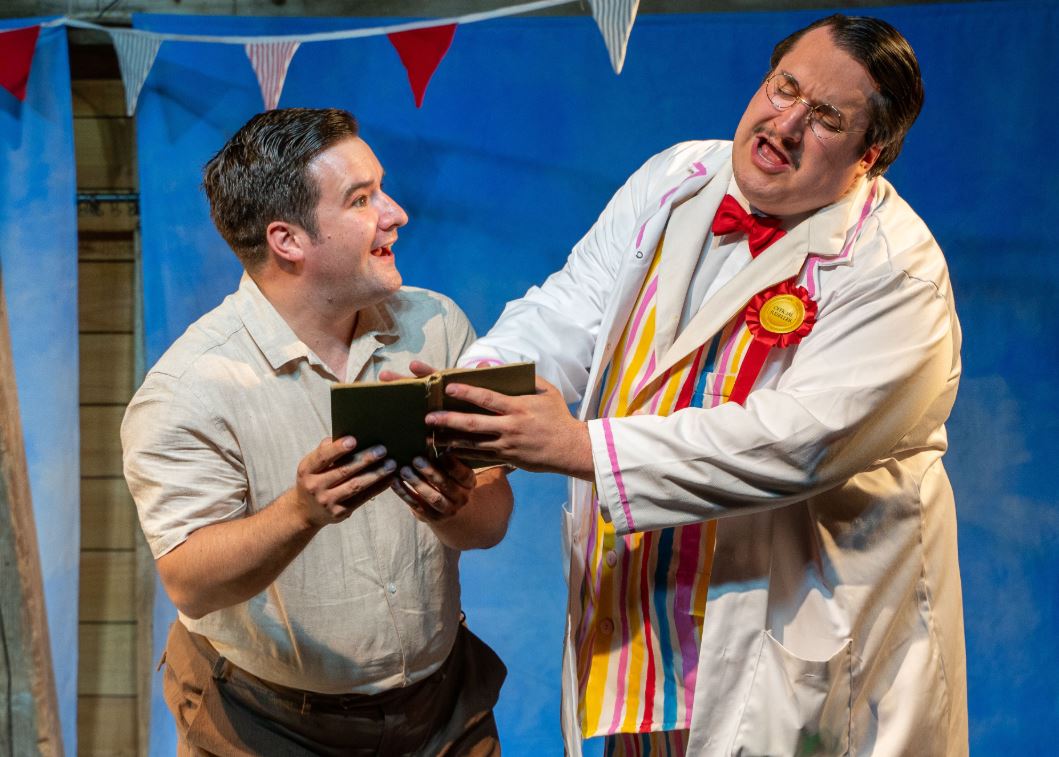
The open auditorium at Layer Marney lends itself to the razzmatazz of the entry of the itinerant quack, Doctor Dulcamara. He arrives in a (genuine) vintage open Rolls Royce , driven into the auditorium, and the flamboyant flanneller bursts onto the scene. Dulcamara always needs to be played BIG, and Alex Jones in the role is big in all senses. It is a pantomimic part that can never be played too over-the-top, and Jones pulls out all the stops. Jones makes a tall and impressive figure, as he immediately advertises his concoctions. His resonant bass voice has an athletic agility as, in a prolonged patter-song, he reels off the wonders of his tonic, a panacea for everything, according to his sandwich board, from dandruff to poverty. The other characters may have the most wonderfully lyrical and moving arias, but on the comedy front, Jones doesn’t so much steal the show, but takes it in armed robbery.
There are some gorgeous scenes between Nemorino and Dulcamara. Nemorino enquires about Isolde’s elixir and, when Dulcamara falls in, he flogs him a bottle of cheap claret. It is the same tonic he has flogged to the others for “five bob”, hastily relabelled, and the desperate Nemorino eagerly pays all the cash he has. Allow 24 hours for it to work, says Dulcamaara, but on Nemorino the effect is more immediate: liquor is quicker after all.

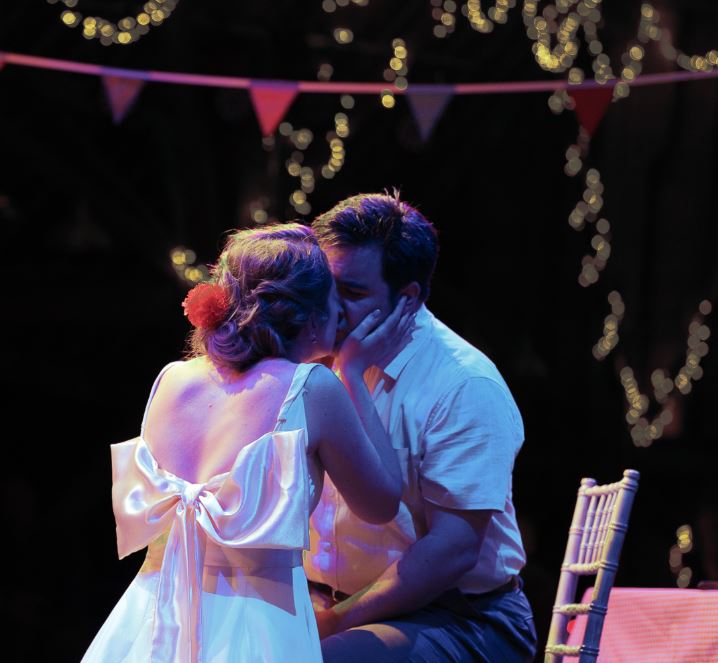
Anther enchanting episode is with Dulcamara is his Io son ricco – e tu sei bella duet with Adina, at the start of Act Two. Although it is not in triple time, it is called a barcarolle, for it is about a gondolier girl and a wealthy man, “I am rich, and you are pretty”. The auditorium is magically decked with fairy lights, for Adina’s “wedding”: she takes it this far to punish Belcore and test Nemorino. Jopling’s reduced scoring includes, as an inspired addition, an accordion. The the Ukrainian accordionist Yuliia Humeniuk comes from the Wild Arts Ensemble to the stage as part of the action. It really enhances the folksy feel of the duet, which concludes that love is flighty and blows away, but gold is heavy and remains. It says a lot about Dulcamara.
Orlando Jopling packs all the sentiment and all the comedy into an arrangement for just eight instruments, and it is brilliant. He conductors the Wild Arts Ensemble with a joyous vigour, yet not losing the intensity of the more reflective moments. In Nemorino’s well-known romanza Una furtiva lagrima, the instrumental introduction, normally a bassoon, is replaced by pizzicato strings. The pathos of his thinking that a “furtive teardrop” is perhaps even stronger. He believes she is in love with him, and he “could die of love”. Thomas Elwin excels in this aria, capturing that pathos and turning it to triumph.
Nemorino has joined that navy at Belcore’s suggestion (to get rid of him) and Nemorino uses the £50 enlistment bonus to buy another (now price inflated) bottle of the “elixir”. However, Adina has bought back the enlistment, when she sees how far he is willing to go for her. Bethan Terry has another fetching and expansive aria here, as Adina hands back the naval papers and tells Nemorino he is free. Terry beautifully expresses Adina’s self realisation here.
Oh, and the real reason Nemorino has suddenly become popular with all the young ladies is that they’re heard his inherited a fortune. All have been hiding behind a mask to conceal their real selves and now there is no need. Things will change for most, but Belcore shrugs his shoulders; he’s off to the next port. And Dulcamara can continue as before selling even more potent quackery. Well, the elixir worked for Nemorino, didn’t it?
Mark Aspen, June 2025
Photography by Becca Hunt and Bonnie Britain

 Mark Aspen
Trackbacks & Pingbacks