
Table Manners
Sunday Roast
Table Manners
by Alan Ayckbourn
Questors Productions at the Juli Dench Playhouse, Ealing, until 19th July
Review by Andrew Lawston
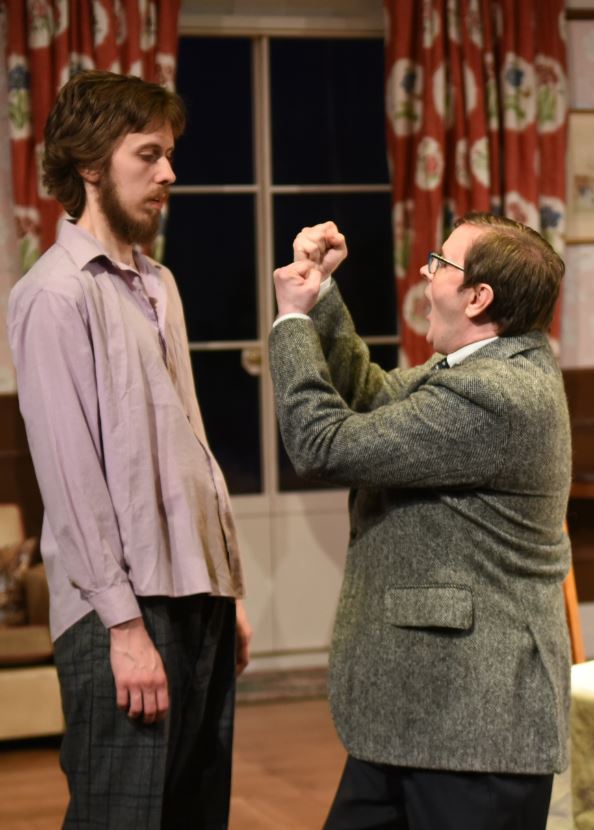
In the grip of yet another heatwave, the Questors Student Group 77 are taking us back to 1973, for a chaotic Alan Ayckbourn weekend of dysfunctional family fun with Table Manners.
Annie is looking after her bedridden mother, and is in need of a break. She asks her brother Reg and sister-in-law Sarah to take care of her for a few days so that she can abscond with her sister Ruth’s husband Norman for an illicit weekend away in East Grinstead. Plans go awry when Norman shows up to collect Annie, as does her other potential boyfriend, the well-intentioned local vet Tom. When the short-sighted Ruth also arrives, the stage is set for farcical fun.
The play is set in the house’s dining room and as such mostly revolves around meal times, including Annie’s terrible salads and stews that contain tinned potatoes “or maybe pears, I lost track”. Richard Gallagher’s direction keeps the pace brisk, and the laughs rattle off throughout the two hour play.

Nate Clarke plays Annie, the put-upon daughter caring for her elderly mother, and gives a wonderfully restrained performance, even when the other characters are letting loose all around her.
Mia Biagio plays the “fragile” Sarah, whose first act is to adjust and straighten all the cutlery and ornaments on set. In both her delivery and through her colourful wardrobe from Sarah Andrews, Mia perfectly and apparently effortlessly channels the queen of 1970s sophistication, Penelope Keith, who of course originated the role.
Sarah’s husband, the affable Reg, gives an assured performance throughout, coming across as one of the more well-balanced characters, despite occasional bursts of rage.

Wesley Lloyd makes a believable and sympathetic character of Tom, despite the vet frequently being the butt of jokes throughout the play.
Herman Svartling Stolpe plays the mercurial Norman, lothario and assistant librarian. Herman’s energy drives the play, and he gives a committed performance, cavorting around the stage in spectacularly 1970s pyjamas. As he attempts to seduce both Annie and occasionally Sarah, while arguing with Ruth, Norman is clearly an awful person in many ways, but Herman displays enough charisma that it’s impossible to truly dislike the character.
The cast is completed by Filipa Maia’s Ruth, Norman’s high-powered career-focused wife, played as something of a short-sighted force of nature whirlwind.
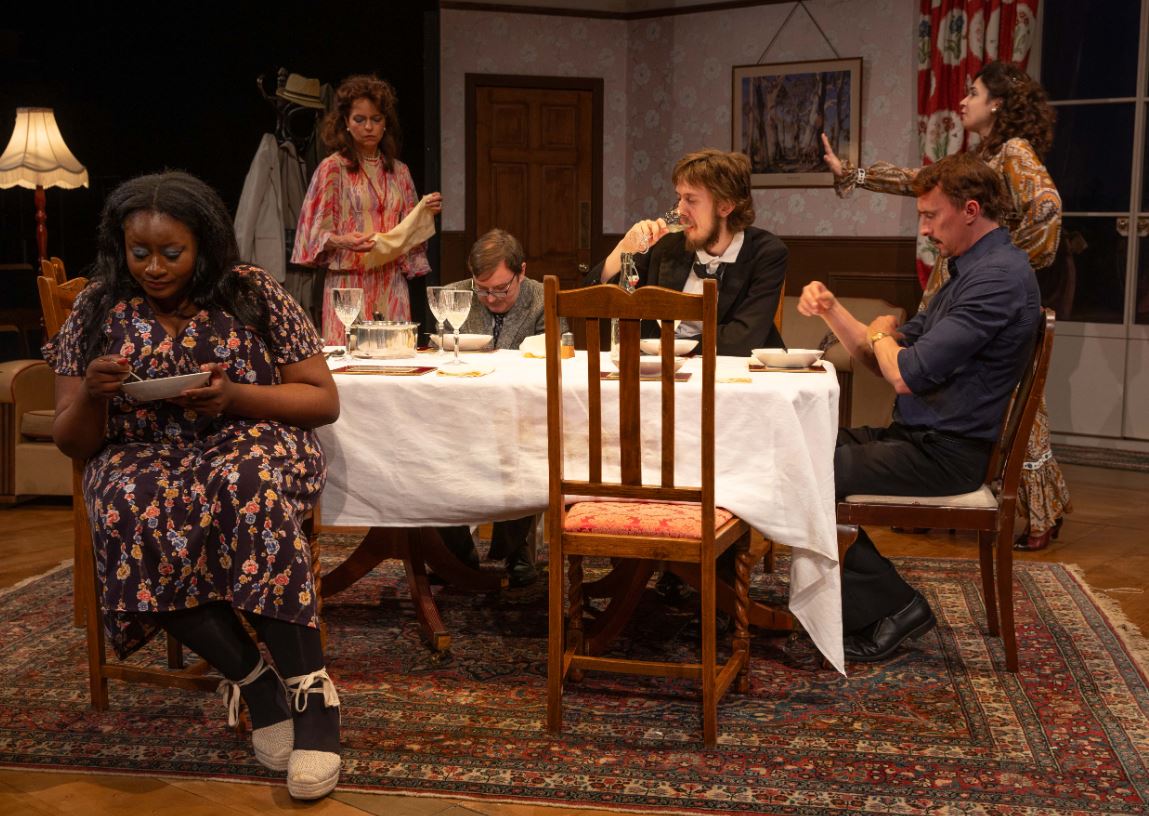
Mobolaji Babalola’s set is hugely impressive, a fully-decorated, sprawling dining room complete with French windows leading out to a small garden. It’s a wonderful creation that clearly dates from the 1970s without leaning into kitsch – it truly looks like a house in which real people live. Similarly, Jane Arnold-Foster’s sound design relies on beloved classics including Carly Simon’s “You’re So Vain” and Petula Clark’s “Downtown”, and clips from Radio 2. The aim is to evoke the 1970s as they were, rather than to play up the setting for comedy value.
The two acts are divided into four scenes, and it’s easy to forget that the other two plays which form the Norman Conquests trilogy are taking part in other parts of the house, as this strong cast forms a compelling ensemble that drives this family drama-comedy all the way to its distinctly ambiguous conclusion.
Andrew Lawston, July 2025
Photography by David Carter and Robert Vass


 Mark Aspen