
Poor Clare
Ancient and Modern
Poor Clare
by Chiara Atik
The Orange Tree Theatre, Richmond
Review by Harry Zimmerman
The Orange Tree’s latest production is Poor Clare, written by Chiara Atik, a show which has come to the UK after winning a slew of awards in the US.

The play tells the story of Clare, a wealthy young noblewoman in medieval Assisi who wants for nothing in life. Her plan for the future is simply to marry a rich nobleman and continue living her lavish lifestyle. However, her perspective on life begins to change when she meets Francis, a former soldier and son of a wealthy silk merchant, who has renounced wealth, privilege and power to live a simple life of piety and service.
Francis gradually introduces Clare to a new way of looking at the world and sets her on a new and very different path in life to the consternation and bewilderment of her rich, privileged family.
In one sense, Poor Clare is a broadly simplistic morality tale.
The play tracks Clare’s growing awareness of the true nature of the world as she moves from screaming at the sight of a beggar to giving away clothing and possessions. It is not long before a radicalised Clare is wearing a hair shirt and sleeping on the floor. Eventually, she completely crosses the Rubicon to dwell in a ruined church, eschewing all material comforts, and devoting her life to helping the poor, following the example of her mentor, Francis.
Whilst the setting is 12th century Assisi, and the costumes thoughtfully reflect this, the dialogue is very firmly contemporary, idiomatic American. Blanche McIntyre’s fluid direction complements Atik’s fast-paced script, and the narrative rattles along. This juxtaposition of historic events communicated via modern day vernacular, helps with the accessibility of the piece for a modern audience.
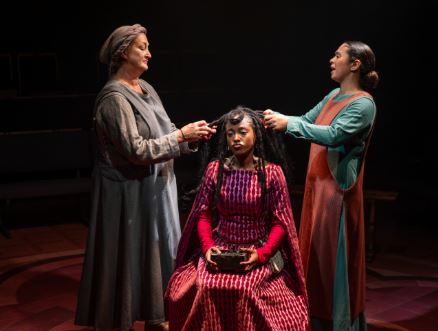
This merging of 12th century themes and 21st century expressionism is pointed right at the beginning of the play, where we encounter Clare having her hair plaited by her servants, sharing gossip and discussing fashion.
Nowhere is the sharp effervescence of the dialogue more skilfully delivered than in the relationship between Clare and her sweetly bratty sister, Beatrice.
Clare and Beatrice speak as modern teenagers about boys, relationships and clothes in a realistic, direct way which provides some murmurs of recognition and laugh out loud moments. Their rapport is charmingly played with great comic timing in the bickering, pauses, looks and snappy delivery. In discussing her new outfit for Church, Beatrice favours a more provocative style declaiming that I have to show people that the lights are on.
The clever melding of modern-day vernacular with medieval belief systems seeks to emphasise that the story of Clare is relatable to contemporary thinking, and assures us that, whilst these characters would have used language, references and mannerisms relevant to their time, human nature and behaviour is timeless.

Arsema Thomas makes an immensely assured and confident stage debut as Clare. Her journey from self-obsessed entitlement to a steely determination to devote her life to the poor, and the renunciation of all that this involves, is powerfully yet sensitively portrayed. Thomas moves effortlessly from humour, (her initial reaction to Francis’s tonsure), to unbridled sincerity, (her poignant realisation of all that she is giving up as she begs Francis to cut her hair). A poised and sensitive performance.
Anushka Chakravarti is very funny as Clare’s superficial sister Beatrice, blithely unquestioning of her own status and right to comfort. The embodiment of a Tik Tok influencer in 12th century costume, Chakravarti’s ebullient bubbly and brash characterisation is an absolute highlight.
Freddy Carter gives us a Francis that is not a stereotypical saintly presence. He is a little petulant and, at times, testy and irritable. Whilst always aspiring to be devout and pious, he is uncompromisingly forthright and is not always supportive to Clare as she is wrestling with the implications of her new life choices. Carter’s characterisation goes beyond the saintly and beatific, showing us someone who has had some doubts about his own calling, and is all the more interesting for that.
Special mention also must go to the dexterity with which the servants, (played by Liz Kettle and Jacoba Williams), fashion and craft the intricate hairstyles of the two sisters in real time, whilst never missing a beat.
The play fizzes along, with a strongly driven plot underpinned by slick transitions. The one hour and 45 minutes, (wisely presented with no interval), fly by.
It is clear that the objective of this play is to communicate clearly to the audience that penury, scarcity, inequality and all the social and economic ills that stem from it, are still with us, and challenge us all to consider our own lifestyle, and try to adopt a less passive acceptance of the status quo.
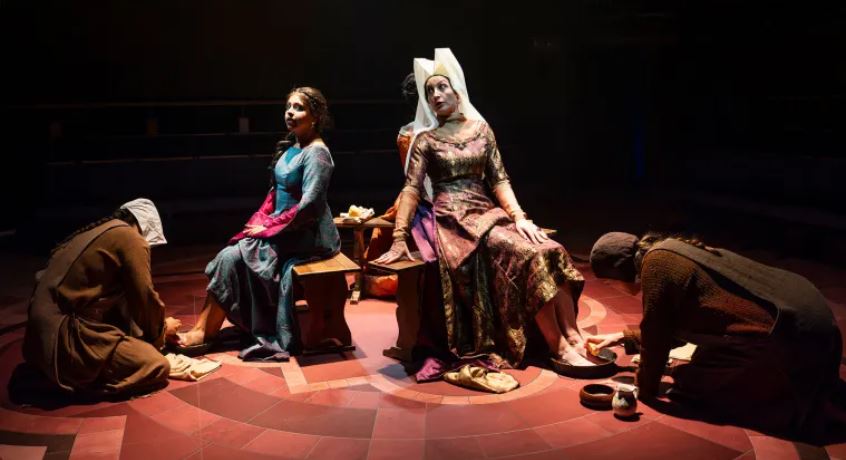
Poor Clare is unapologetic in its aim to persuade its audience to consider what they can do to actively change their own behaviours, attitudes and actions, thereby reducing the privations and hardships of poverty.
The stark contrast between this powerful message and the comic interchanges and easy flow of the narrative give the production a depth and bite that makes its portrayal of the intelligence, intensity and humanity of Clare’s conversion powerful and effective.
That having been said, this play at times suffers from an over egging of the social conscience pudding. There are times when the parallels drawn between economic and social deprivation in medieval Assisi, and the same problems in the present day, become laboured and over emphasised.
The declamatory speech of the beggar living under the bridge, (whose first appearance so scares Clare), is one that is redolent of many similar declarations of need encountered every day in the street or on public transport in our own times and appears to be bludgeoned into the dialogue . Whilst this does not dilute the essential importance and value of the message, it could have been less crudely introduced.
Similarly, the final scene where Clare, constantly repeating the mantra help me be good, is uncompromising in her depiction of the modern world and the implications of our obsession with materialism and the single-minded pursuit of instant self-gratification without a thought for other people, comes over as overly preachy and a little self-indulgent.
This sledgehammer to crack a nut approach is an irritant but should not detract from the broader intensity of this production. There is much to enjoy and admire in the awakening and the journey of Poor Clare.
Harry Zimmerman, July 2025
Photography by Ellie Kurttz

 Mark Aspen