
Tristan und Isolde
Wagner Stripped Bare
Tristan und Isolde
by Richard Wagner
ShatterBrain Productions and Regents Opera for Grimeborn Opera Festival at the Arcola Theatre, Dalston until 16thAugust
Review by Patrick Shorrock
The phrase only at Grimeborn might have been invented for this performance, in which Tristan and Isolde – that great peak of the operatic repertoire – is performed with a piano quintet instead of an orchestra. That is not quite the full story, as we do also get hunting horns and a pipe for the shepherd, as well as occasional woodwind (described enigmatically in the programme as banders). But most of the time it is two violins, a viola, cello, and piano, who have to cope with Wagner’s extortionate demands for a full orchestra. And most of the time Michael Thrift’s arrangement sounds rather good: like fine Fauré chamber music and banishing memories of that bloated over-ripe Liszt transcription of the Liebestod.
There were occasional moments when I thought that the orchestral support didn’t sound adequate, but they were few and brief: but four sailors do not constitute a Wagnerian chorus. If I’m being hyper-critical, it did sometimes feel that Thift’s conducting was a little too leisurely when I wanted increased urgency as the music surged towards a climax. But it is so refreshing to re-experience the sheer weirdness of the harmonies broken down to their essence: not only the infamous Tristan chord with its reputation for having destroyed tonality, but time after time, especially in the desolate Act Three prelude.
And this smaller scale is fitting for the singers too, when we remember that the music of the opera had its first incarnation in the Wesendonck Lieder. The smallness of the orchestra and the auditorium here mean that the intimacy of lieder is possible, as we couldn’t be closer to the singers and their interactions, with the orchestra confined to a corner at the back of the stage. We can see Isolde changing from anger to exhalation once she has drunk the potion, the joy that Tristan and Isolde find in one another, the rapture on Isolde’s face during the Liebestod, and the sheer panic of Brangane, doing a last minute and unplanned substitution of the love potion for the death potion. Indeed, I wish the singers would take more a lieder-like approach, as much of the singing is louder than it needs to be in such a small auditorium. It is standard (and possibly easier and less risky) with Wagner to give it some welly, but this is not always the best approach: the late David Rendall as Tristan and Gerald Finley’s Sachs and Amfortas have shown that a more bel canto approach in Wagner pays dividends and makes dramatic as well as musical sense.
But for all that, the singing is immensely impressive. Brian Smith Walters – singing Tristan three times in four days – has impressive stamina and musical insight. His hushed appeal to Isolde at the end of Act Three to follow him is superb. His voice does tend to harden and tighten slightly just at the moment when you want it to expand, and a bit more sweetness of tone wouldn’t come amiss, but any opera house would be glad to have him in a Heldentenor role and this big voice would clearly cope well with a larger auditorium. Becca Marriott was an agile Isolde with an appealing smoky colour to her voice that doesn’t sour or curdle, although it doesn’t have quite the beauty of timbre that this part deserves. She had plenty of power when needed but realised that often it was not always required. Simon Wilding as Marke put too much pressure on his voice which led to wobbles and sourness. Lauren Easton as Brangane also sang more loudly than necessary. This was not a mistake made by Oliver Gibbs’s Kurwenal who set an excellent example of how to sing in a small space. T he programme note correctly refers to the character as ‘a blokey bloke if ever there was one’ but Gibbs never overdoes it.
Indeed the programme contained plenty of good sense. Describing parts of Wagner’s libretto as word salad is naughty but accurate. Later on producer Guido Martin-Brandis makes the point that “the idea that pursuing love and sex at any cost, even unto death, can be squared with the Eastern inspired Schopenhauer’s abnegation of desire … requires a huge set of mental gymnastics that lead everywhere to paradox.” His lovers are certainly more sexually expressive than in many productions. Most of the productions I have seen seem rather more desire-averse and emphasise – whether intentionally or not – that the couple are a good deal more than half in love with easeful death. After all, the opera consists of three suicide attempts: in Act One when the lovers think they are drinking a death potion; in Act Two when Tristan runs himself onto Melot’s sword; and in Act Three when he rips off the bandages that are holding his wound together.
I remember an immortal Welsh National Opera programme note for this opera from 1980 that pointed out the paradoxical nature of non-existence/freedom from desire as a pleasure that, when you get it, you won’t be able to enjoy by definition. Martin-Brandis understands these paradoxes and doesn’t make the mistake of thinking that his production can or should resolve them. He gets involved and convincing performances from his cast.
I am less sure about Caitlin Abbott’s designs. This is not a venue where fancy sets are expected or wanted, but the wall of silver foil looked a bit tacky and I suspect that it reflected and intensified the heat. That said, other than that, her designs are otherwise effective, and Davy Cunningham provides some splendidly atmospheric lighting.
The main problem with the evening was the sheer heat: although the air conditioning could be heard, it seemed to have very little effect on the temperature. However, this was far more of a challenge for the singers who had military great coats and cloaks to contend with as well as Wagner’s score, so part of me doesn’t want to complain. But the Arcola really does need to provide a more effective way of cooling things down even though the audience (including me) clearly thought the ordeal was worth it.
Patrick Shorrock, August 2025
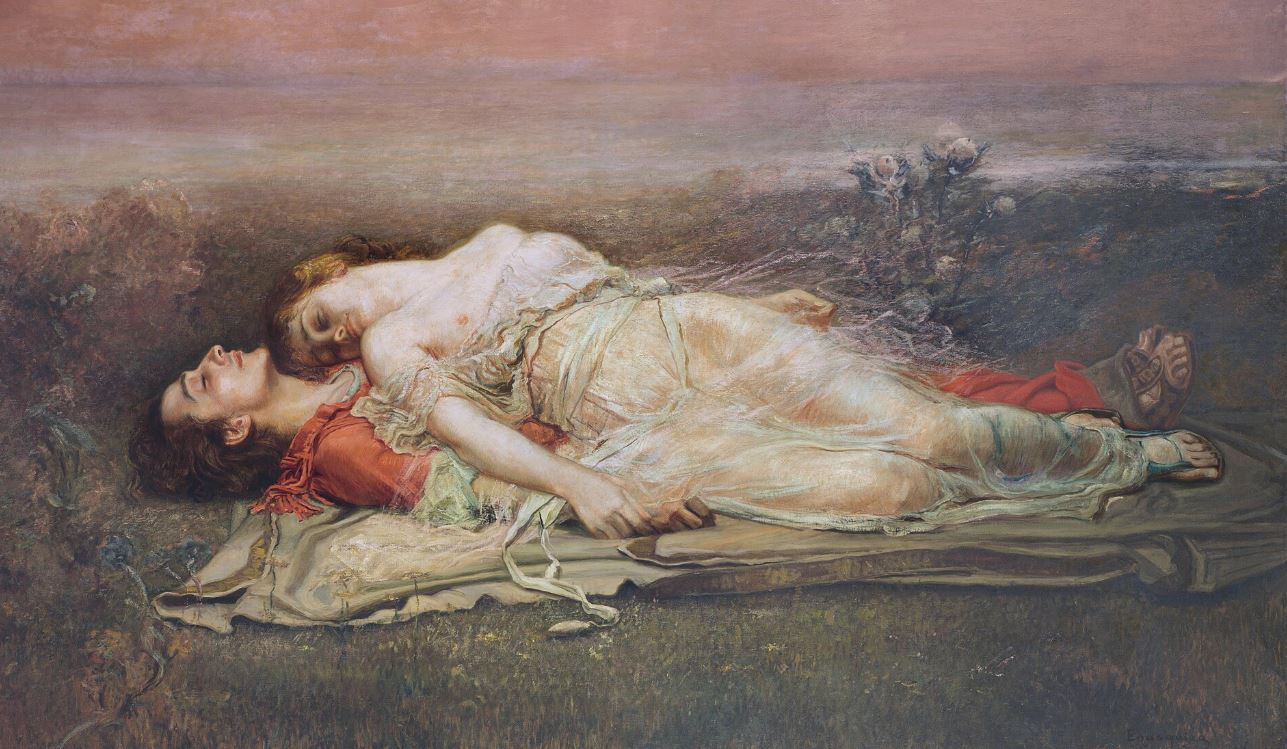
Image by Roger de Egusquiza (Public Domain)


 Mark Aspen