
All the World’s a Stage
Wise Saws
All The World’s A Stage
compiled and produced by Anne Warrington
Poetry Performance at Garrick’s Temple to Shakespeare, Hampton 24th August
Review by Hilary Jones

The wonderful garden pavilion on the banks of the Thames, built in 1756 by David Garrick to honour his muse and hero William Shakespeare, could not be a more fitting place for Poetry Performance to tread the boards in its presentation of all things theatrical. Its splendid round room has a mere 45 seat capacity. This intimate space provided the setting for the fourteen-strong cast to perform an array of poetry and music in its production, All The World’s A Stage.
The cast was led by Master of Ceremonies Ian Lee-Dolphin who joined Annie Morris on vocals and guitar. After this vibrant start, the first section Theatrical Greats began fittingly with resonant Francis Abbott reading the timeless Shakespeare’s All the World’s a Stage, from As You Like It, that created the right and true setting for this hour-long piece of theatre.
Sam Ball was outstanding as he animated and read his powerful The Tale of the Miller’s Wife. Our senses were with his words and with his puppets – especially the Miller’s Wife. Made and written by Sam Ball, it was a frank and vibrant piece, which weas beautifully done.

Velvet-voiced Francis Abbott then read the profound Hamlet’s Advice to Players before we arrived at Attitudes & Censorship, a section that started with Patricia Cammish’s Thank You Oliver (Who Knew Not What He Did). This strong piece about Cromwell was read out concisely by Sue Bell, and it reverberated nicely around this unique venue.
The whole performance was an eclectic evening of poetry and song, and Noel Coward’s witty and clever Don’t Put Your Daughter On The Stage, read by Francis Abbott, was certainly very apt.
The poignant A Lesson Learned, a piece that brought back uncomfortable memories for most of us. Performed and written by Heather Montford, our heartbreak matched hers as Heather recalled her aspirations for the school play. The acid At The Theatre: or the Lady Behind Me by A.P. Herbert was read with a cutting tone by Connaire Kensit.
We were ready for the next section of Into The Woods, and Connaire Kensit’s reading of his own piece What’s A Pantomime, Grandad was funny and profound, and relevant. Sue Bell and chorus followed with Fran Thurling’s Just Call Me Jack with a great refrain of “with a fee, a fi, a fo and a fum!”.
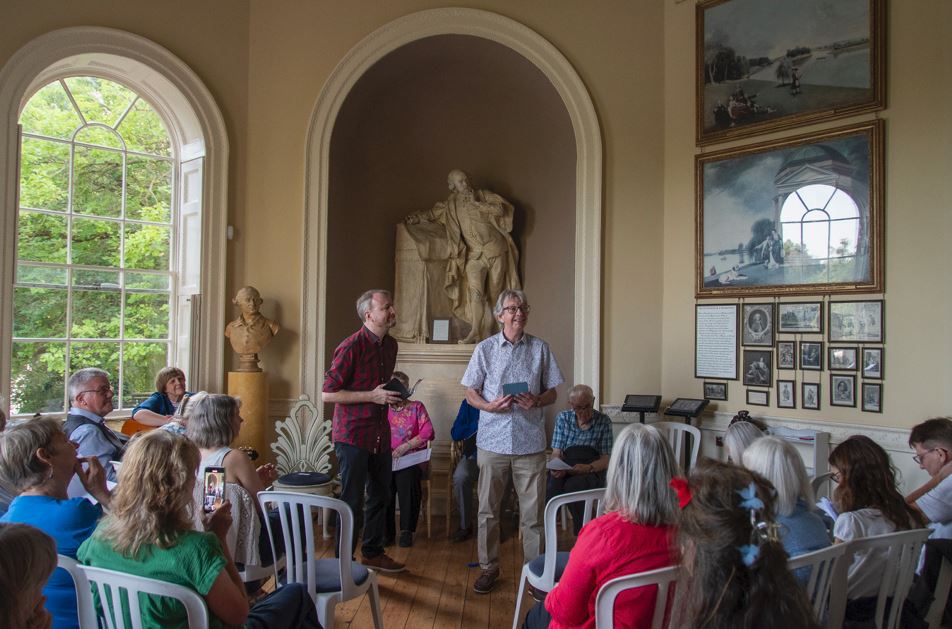
The audience embraced the section of High Brow And Low Brow as Ian Lee-Dolphin and Sam Ball entertained us with A Play on Words or a Word on Plays, astonishingly detailed and funny, and written by Lee-Dolphin himself. The two performers effortlessly delivered the clever lines and literary references.
The 1950’s stardust memories of At The Opera by Kenneth Mason was read nostalgically and with real feeling by Connaire Kensit. Seen through a young student’s eyes, it was a humorous and heartfelt piece.
Anthony Josolyne’s poem Memories of a Variety Artiste took us back to another theatrical era and was read succinctly by Francis Abbott, Sue Bell and Graham Harmes. Nicely paced out in three parts, the last line “Now variety is dead” was genuinely stirring.

Baron Bolligrew Gets Thwarted, a haibun written and performed by Heather Moulson brought back memories of local dramatic societies and their confusing hierarchy. It was fittingly followed by Excerpt from The Boy Actor by Noel Coward and read by Francis Abbott, putting over clearly how things were seen from the viewpoint of an aspiring child. Sarah Boyd’s The Grand Old Dame, read by Heather Moulson, was a detailed account of what was once a magical and important institution.
The last significant section was Theatre and War, and Siegfried Sassoon’s words drove the horror of war home to us in Blighters, a parallel of music hall and slaughter. Sam Ball did justice to this deceptive and moving piece.
The Script, beautifully written by Anne Warrington, was read by Heather Montford and was also disturbing and relevant. Graham Harmes was succinct with his reading of Anthony Josolyne’s Contest and the impact of his words were moving.

A strong rapport with Sue Bell and Francis Abbott embraced us with the reading of the penultimate piece Play Without End by the prolific Fran Thurling, a uniquely structured piece that enraptured the audience.
We were all glad to sing along with Where Have All The Flowers Gone with Annie Morris’ and Ian Lee-Dolphin’s skilled playing and musical tones.
The epilogue of Puck from A Midsummer Night’s Dream was profoundly read by Francis Abbott and made a fitting end to this theatrical triumph.
Thanks also to Kenneth Mason who devised the most beautiful programme. A real keepsake for an unforgettable evening.
Hilary Jones, August 2025
Photography courtesy of PP

 Mark Aspen