
A Number
Send in the Clones
A Number
by Caryl Churchill
Questors Productions at the Questors Studio, Ealing, until 27th September
Review by Andrew Lawston
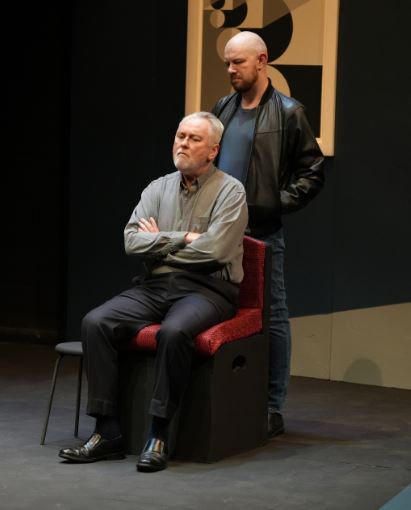
Cloning is a subject of endless fascination to creators of science-fiction, but is perhaps less commonly explored in theatre, which traditionally prefers to use twins to tell similar stories. Caryl Churchill’s short play A Number provides rich dramatic pickings through its simple story of a man meeting with several clones of his son, in the intimate confines of The Studio at The Questors Theatre.
Against Lucy Aley-Parker’s minimalist living room set, a man named Salter works his way through a decanter of whisky as he talks with various iterations of his son: Bernard 1, Bernard 2, and Michael.
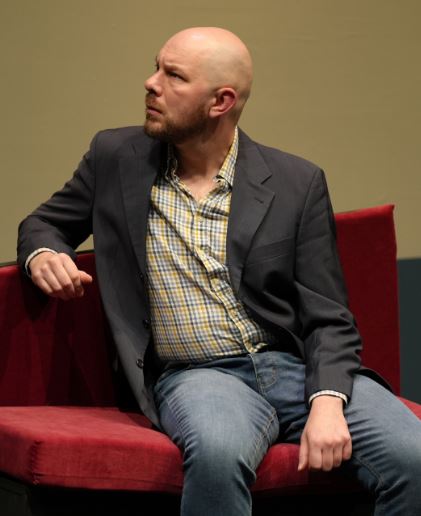
Their conversation veers between philosophical and a decidedly awkward father-son dynamic. We learn that Bernard 2 has recently discovered that he is one of “a number” of clones created to give Salter a second chance at raising a child.
A second scene covers much of the same ground as the first; Bernard 1 has learned about the clones. Where Bernard 2 was curious and anxious, however, Bernard 1 becomes hostile and aggressive.

Events escalate, but the structure remains the same, as each scene shows Salter talking to one of the clones, each time wearing subtly different clothes, courtesy of costume designer Nichola Thomas. Bernard 2 wears a t-shirt, tending to look quite vulnerable next to his jacketed father, while Bernard 1’s aggression is emphasised by his leather jacket. And what is the audience to make of Michael, a final clone who dresses in a style not dissimilar to his father?
Both Robert Gordon Clark and James Burgess, as Salter and the clones respectively, have a daunting task in conveying the play’s huge ideas through a series of awkward family conversations, and both succeed admirably. Their delivery ranges from thoughtful and philosophical to stilted and awkward, sometimes talking over each other in their confusion, while at other times leaving lengthy and uncomfortable pauses as they reflect.
Truths emerge about the clones’ past, and about their father. Neglect and alcoholism are mentioned, if not dwelt on, with hints of even more unpleasant abuse left hanging. Much is unsaid, and understated, between the two men, across all three versions of Salter’s son.
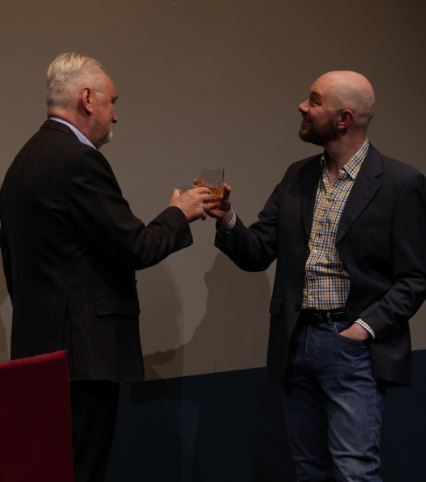
“Nature vs nurture” is the most obvious question that the play raises. Both Bernards and Michael the blithely unconcerned maths teacher, come from the same genetic material, but have turned out radically different due to their different upbringings. Bernard 1 was sent away to a children’s home following his mother’s suicide. Bernard 2 grew up with Salter, who tried to make up for his failings as a father with Bernard 1. Meanwhile, Michael is one of a number of additional clones (Michael says there are nineteen of them, but it’s unclear whether this is accurate).
Salter discusses the physical resemblance between all three of them, saying that they look similar but not identical. “It’s the eyes,” he says, to get around the fact that these similar but not identical men are all played by the same actor. In any case, Burgess is careful to use different body language and registers for each of the clones, which supports Salter’s point.
Lucy Aley-Parker has directed a brisk production, which still slows down to convey the big emotional beats. The play, and the issues it raises, are serious, but there are also funny lines, which get big laughs from the audience, as they are often perfectly timed to break the growing tension.
Robert Gordon Clark, James Burgess, and Lucy Aley-Parker have put together an engrossing production of an excellent modern play, which makes for a rewarding and thought-provoking evening.
Andrew Lawston, September 2025
Photography by Kanako Hata


 Mark Aspen