
Tosca
War at the Opera
Tosca
by Giacomo Puccini, libretto by Luigi Illica and Giuseppe Giacosa
The Royal Ballet and Opera at Covent Garden until 7th October
Review by Michael Rowlands
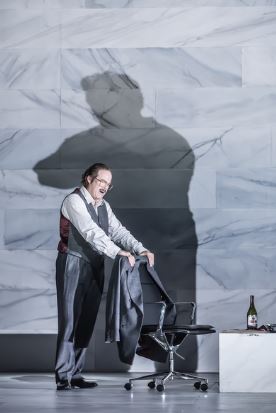
The Royal Opera’s new production by Olivier Mears was given the stellar media treatment, by the brave and controversial decision of the Royal Opera to cast Anna Netrebko as the leading lady for the first four nights, to be followed by Aleksandra Kurzak for the rest of the run. Ms Netrebko has been, earlier in her career, in proximity to President Putin. She helped him congratulate the takeover of the Dombas, “it would be a mistake not to”, and she made a statement concerned with the victims of Ukraine. She is apparently an Austrian Resident, pays taxes there and she says she not returned home since the war started. Is she a Unity Mitford figure? or a Co-Co Channel? Or an innocent bystander? Russia is already at war with us, though political manipulation and through cultural events – so where she stands, and we all stand, does matter in this climate.

She may be one the highest regarded sopranos at present, but one has to make a choice whether to see her and forgive. I chose the second casting, but then Kurzak was replaced by Ailyn Pérez due to illness. I do have sympathy for Netrebko’s situation, since if she did unambiguously support the Ukrainians, by say, a benefit concert, then for the rest of her life she would need to stay away from windows in buildings above five floors and check the door handles before touching them. Life sometimes does imitate art.
Tosca is one of the very few operas that is completely time and location specific, set over the course of less than a day. Producers who meddle with concept this do so at their peril, and, when staged in 1900, it was a forerunner of cinematic techniques.
It is set on 17th June 1800, in Rome, occupied by reactionary Neapolitan forces, represented by the evil, sexually predatory Scarpia, working in the Farnese Palace, owned by the King of Naples. They had overthrown the brief Napoleonic Roman anti-papal republic – hence the Pope is elsewhere, and one of the Consuls has escaped out of prison of Castle Saint Angeli. represented by Angelotti. Cavaradossi, the painter, is an ardent Republican sympathiser. However Tosca, his girlfriend, is a politically naive actress. War, Art, Love, Religion and Politics meet.

One of Puccini’s under rated skills is how often he uses events or music off-stage to provide drama – here in the last act he exactly reproduced the clock bells of Rome before the execution scenes — or the pastoral sound of the shepherds in the land outside Rome, or even torture off stage, for that matter.
The most important event in this opera is also off stage, and several hundred miles away, in the north of Italy. The news of battle at Manago, deciding the fate of Italy, between the Napoleon and the Austrian Bourbons, a few days before, is filtering through during the course of the Opera – at first the Austrians are winning, so a Te Deum is sung, but later after the torture of Cavaradossi has begun, the victory by Napoleon, which took place late in the afternoon, is announced. The shooting of Caravadossi is all in vain, as the Neapolitans have lost and will withdraw. It’s a completely pointless death.
Tosca is also unusual, as all four main characters have violent deaths and there is no triumph at the end – Angelotti hanged himself – off stage (shot in this production – on stage), Scarpia murdered by Tosca, Cavaradossi shot by execution and Tosca suicide by falling. It is melodrama at its best, and human nature at its worst.

This Tosca is a modern dress production, and nothing is sacred – the specific church Saint Andrea della Valle in act one is changed to Santi ‘Ivo alla Sapienza, a Roman Church designed by Borromini, “a more interesting building architecturally”, but with the roof bomb- damaged and open to the sky. Cavaradossi’s painting, so crucial to the plot, is facing away from us. Angelotti should be locked in the family crypt, but this is depicted by his walking off stage into the wings. The ornate Farnese Palace in the second Act is replaced as a fascist marble office, in the manner of Albert Speer. The battlements of Saint Angelo are replaced by a room with white blood-stained tiles used in an abattoir, complete with gowned assistant to hose the blood away, although there is a view of Rome from the window. The plot is tortured too – Angelotti is dramatically shot before the execution scene with blood flying onto the walls – so it’s more Reservoir Dogs, than complete calm at dawn with the innocence of the church bells ringing, before the final deception.
Tosca can be produced out of time, and with a modern twist, with great drama and success, such as the Bavarian State Opera’s current offering by Kornel Mundruczo, based on making the Pasolini movie Salo (100 days of Sodom). It is violent, sexual, clever and a successful reinterpretation, but faithful to the integrity of the original opera.
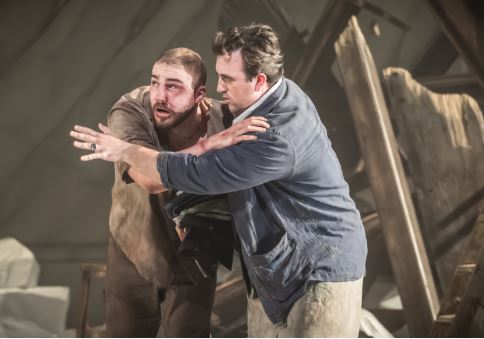
I thought Jakob Hrůša produced a completely different sound from the orchestra compared to Pappano – less melodic and less mellow. Ailyn Pérez, Kursak’s replacement, has a remarkable achievement, to walk into this production, without preparation, at a moment’s notice. She has true artistry, and she was on excellent form, better, as were the others, as they relaxed as the evening wore on. Freddie De Tommasio, lacking tone and power in the first act, but redeemed himself later too. Gerald Findley, as the creepy Scarpia, looked the part, but lacked the full depth of this role at the start, but again, better later. The overall impression was of a fragmented un-cohesive production with excellent singers doing excellent things.
The extra violence of a bloody execution of Angelotti means this Tosca is not suitable for children, and not to my taste too. As Groves Dictionary of Music once put it, Tosca “a prolonged orgy of lust and crime, made endurable by the beauty of the music”, so with this production. Add in gratuitous violence to complete the picture, for a mildly shocking, bloody, evening out, accompanied by generally well sung, but beautiful music.
Michael Rowlands, September 2025
Photography by Marc Brenner


 Mark Aspen