
La Cenerentola
Rossini as Entertainment
La Cenerentola
by Gioachino Rossini, libretto by Jacopo Ferretti
The English National Opera at the London Coliseum until 14th October
Review by Michael Rowlands

From the death of Mozart in 1791, shortly after the premiere of Die Zauberflote (The Magic Flute), until Rossini’s L’italiana in Algeri in 1813, a period of 22 years, there are no commonly currently performed operas, with the sole exception of Beethoven’s Fidelio of 1805. I’m not sure why there is this gap. Napoleon liked opera; he saw 163 different operas in 319 performances and he liked Neapolitan operas as well as ones with revolutionary themes. It was Rossini who broke through the drought, with a tremendous output of both serious and comic operas, and ending with his Parisian grand opera, Guillaume Tell, giving a total of 34 operas in thirteen years.
He composed, at speed, and following his great comedy success with Il Barbiere di Siviglia in 1816, he produced La Cenerentola, ossia La Bonta in trionfo, “Cinderella or Goodness Triumphant” composed in just 24 days. (And with two other operas in the year as well!) It was a great success and gave a role for coloratura contralto, for which this opera is designed.

Everybody is familiar with Cinderella and, as they say, its very relatable. It has meaning today, and the type of opera, dramma giocoso “drama with jokes” at the ENO is sung in English with English surtitles. The libretto translation by Christopher Cowell into contemporary doggerel (to be taken as a compliment as it works very well!), although, does verge at times towards Gilbert and Sullivan in effect. It provides interest and amusement, essential to be of the highest order as the singers were using it too. Rossini and his librettist, Jacopo Ferretti, made substantial changes to the original story to save cost and improve its ability to be staged. The glass slippers are replaced by silver bracelets, some say because showing an ankle was scandalous, but I suspect that it was to move the plot along at a faster pace.
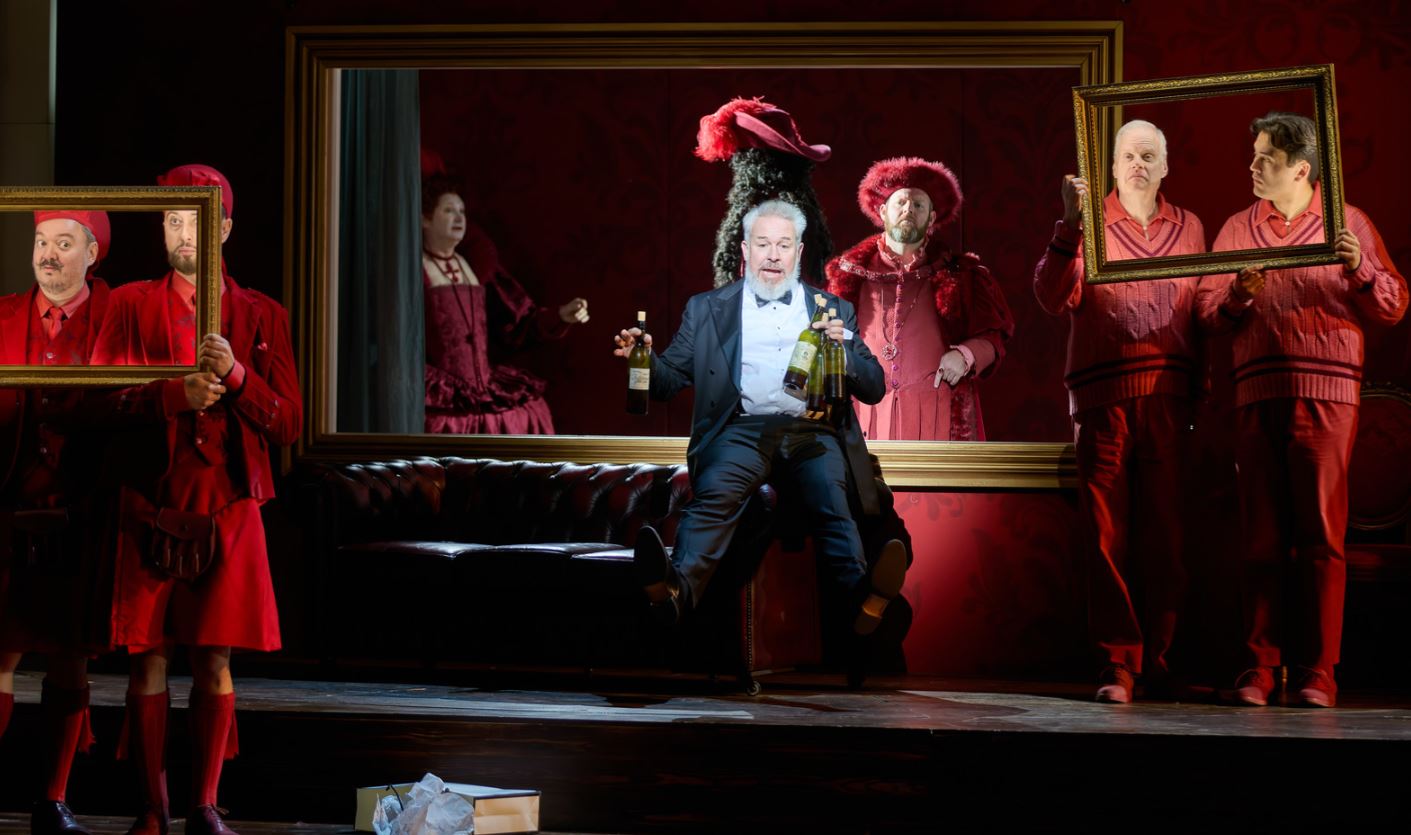
The opera is directed by Julia Burbach and I thought she had learnt a lot from her mentor Christof Loy. It’s an intelligent colourful, fun interpretation, busy but not fussy, tasteful and funny without being coarse. The production and the sets, both in concept and execution, are excellent. The characters are all “colour coded”, and there is a set of ancestral cross-dressing ghosts, mainly royal figures from the past, to help the action along. There are children dressed as mice and colour changes of the wallpaper to signify changes in location that all fits together well. There is only one set, a two storied modern house, which has two revolving rooms on the ground floor to add variety and interest. The choreography adds to the fun, slightly over the top as it should be for this Rossini entertainment. The orchestra led by Yi-Chen Lin proves to be on good form and is generally light on it’s feet, so providing effervescent foundation for the comedy.

The cast had a difficult task on their hands. The Coliseum is a very large theatre, not built for opera, but as “the largest and finest music hall” (2,359 seats). Projecting their voices with such complicated and florid coloratura, sung in English, at times seems to overwhelm them. They were clearly well rehearsed and manage group actions with comic effect.
The summary: La Cenerentola makes a great start to the ENO season, an enjoyable easy opera that can appeal to children and adults alike. The singing, set, costumes come together to make a well thought through entertaining evening.
Michael Rowlands, September 2025
Photography by Mark Douet


 Mark Aspen